

Fiat Factory, Italy New York Stock Exchange Chemist in PowerPoint PPT Presentation
1 / 20
Title: Fiat Factory, Italy New York Stock Exchange Chemist in
1
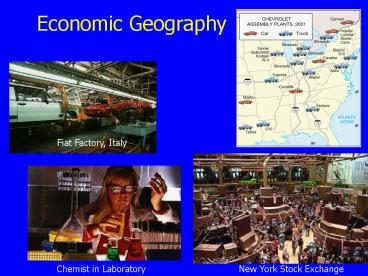
Economic Geography
Fiat Factory, Italy
New York Stock Exchange
Chemist in Laboratory
2
Overview
- Economic Sectors
- Changes in the U.S. and Global Economy
- Trading Blocks
- Economic Location Theory
3
Primary Activities
- Direct removal of natural resources such as
mining, forestry, and agriculture -most important
in the LDCs. - Subsistence Agriculture
- Fishing and Forestry
- Mining and Quarrying
4
Primary Products
The percentage of people working in agriculture
exceeds 75 in many LDCs of Africa and Asia. In
Anglo-America and Western Europe the figure is lt5
5
Trade in Primary Products
- Importance to Developing Economies
- Danger of Commodity Trade Dependence
Puerto Rico Coffee Plantation
6
(No Transcript)
7
Secondary Activities Manufacturing
- Secondary - Processing and transforming natural
resources steel, textiles, auto assembly. These
used to be most important in MDCs, but
increasingly important in the semi-periphery
(Korea, Mexico, Brazil, Singapore)
8
Tertiary and Beyond Services
- Provision of services in exchange for payment.
Includes retailing, banking, law, education, and
government. - Education, R D, and information technology
becoming most important in the postindustrial
core regions. - Less-developed countries often focus on tourism.
- Services historically were clustered into
settlements. Increasingly the most important
service centers are massive world cities.
9
Tertiary and Beyond Services
- Less-developed countries often focus on tourism.
Vendors, Bali
Club Med, The Bahamas
10
Tertiary and Beyond Services
11
Resources and Technology
- Resources affect patterns of development
cultivable land, energy sources, minerals. But
changes in technology affect the value of these
resources. Also, trade or lack of it can offset
lack of resources (Japan) or make them less
relevant (Brazil). - Technology Systems roughly every 50 years since
1790 a new complex of technologies has
revolutionized the world economic system and its
structure. The most recent of these is the system
which includes biotechnology, advanced materials
(superconductors, solar power) and information
technology. - Which parts of the world benefited from the shift
from coal to oil? Which suffered? Which parts of
the world will benefit from the inevitable end of
our reliance on petroleum and the necessary shift
to wind, hydro, tide, or solar power ?
12
New International Division of Labor
- Transnational Companies have been very aggressive
in using low-cost labor in LDCs. - Seek elimination of trade barriers (Tariffs)
- No minimum standards in place
- A rush to the bottom?
- Loss of U.S. jobs - a great sucking sound after
NAFTA?
13
New International Division of Labor
14
Trading Blocks
- International agreements that eliminate barriers
to trade within regions - North American Free Trade Agreement (NAFTA)
- European Union (EU)
- Oil Producing and Exporting Countries (OPEC)
Trading Organizations
- International agreements that eliminate barriers
to trade among members - World Trade Organization (WTO)
15
Principals of Location
- Industrial Location Site and Situation Factors
- Raw Materials
- Energy
- Labor
- Market
- Transport
- In order to succeed industries must have some
comparative advantage in one or more of these
factors. Moreover, demand must exist for the
product.
16
- Industrial Location of Steel Mills Transport
Characteristics (Bulk-Reducing)
17
Secondary Activities Manufacturing
- Industrial Location Site and Situation Factors
- Transport Characteristics (Bulk-Gaining)
18
Service Location Theory
Convenience Store Locations
- Market Areas - circular or hexagonal area from
which customers are drawn. - Range - maximum distance people will go for a
service - Threshold - minimum of consumers needed to
support the service.
19
Service Location Theory
Grocery Store Locations
- Market Areas - circular or hexagonal area from
which customers are drawn. - Range - maximum distance people will go for a
service - Threshold - minimum of consumers needed to
support the service.
20
- Industrial Location Site and Situation Factors
- Labor Supply versus Access to Markets
The industrial centers of Japan, for example,
depend on imported raw materials and access to
markets via the Pacific.
Woven Cotton Production
Why are so many wovens produced in the less
developed world?
East Asian Manufacturing Centers
Recommended

