

Back Pain PowerPoint PPT Presentation
1 / 16
Title: Back Pain
1
Back Pain
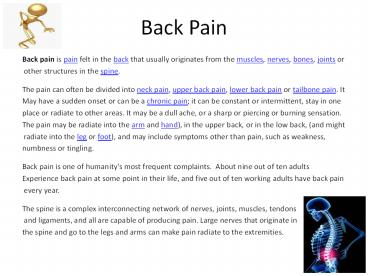
- Back pain is pain felt in the back that usually
originates from the muscles, nerves, bones,
joints or - other structures in the spine.
- The pain can often be divided into neck pain,
upper back pain, lower back pain or tailbone
pain. It - May have a sudden onset or can be a chronic pain
it can be constant or intermittent, stay in one - place or radiate to other areas. It may be a dull
ache, or a sharp or piercing or burning
sensation. - The pain may be radiate into the arm and hand),
in the upper back, or in the low back, (and might - radiate into the leg or foot), and may include
symptoms other than pain, such as weakness, - numbness or tingling.
- Back pain is one of humanity's most frequent
complaints. About nine out of ten adults - Experience back pain at some point in their life,
and five out of ten working adults have back pain - every year.
- The spine is a complex interconnecting network of
nerves, joints, muscles, tendons - and ligaments, and all are capable of producing
pain. Large nerves that originate in - the spine and go to the legs and arms can make
pain radiate to the extremities.
2
The different parts of the spine
3
Causes of back pain
- There isn't usually an underlying condition
causing back pain - nothing shows up in tests and
- nothing is permanently damaged. This is called
simple or non-specific back pain. Nine out of 10 - people with simple back pain recover completely
within six weeks. - You're more likely to develop simple back pain if
you - stand, sit or bend down for long periods
- lift, carry, push or pull loads that are too
heavy, or if you go about these tasks in the
wrong way - have a trip or a fall
- are stressed or anxious
- are overweight
- Occasionally, there may be a more serious
underlying cause of your - back pain, but this is rare. These causes include
osteoporosis, a prolapsed - (slipped) disc, spinal stenosis, malformation of
the spine, infection or - collapse of the vertebrae, tuberculosis or
cancer.
4
What are the risk factors for back pain?
- A risk factor is something which increases the
likelihood of developing a condition or - disease. For example, obesity significantly
raises the risk of developing diabetes type - 2. Therefore, obesity is a risk factor for
diabetes type 2. The following factors are - linked to a higher risk of developing low back
pain - A mentally stressful job
- Pregnancy - pregnant women are much more likely
to get back pain - A sedentary lifestyle
- Age - older adults are more susceptible than
young adults or children - Anxiety
- Depression
- Gender - back pain is more common among females
than males - Obesity/overweight
- Smoking
- Strenuous physical exercise (especially if not
done properly) - Strenuous physical work
5
Symptoms of back pain
- Simple back pain is often in your lower back
(lumbar region), and may also spread to your
buttocks and - thighs. It's often described as a dull pain and
can come and go at different times, depending on
your - level of activity. The pain can begin suddenly or
come on gradually if you strain your back over
time. - Simple back pain usually only lasts a few days
and gets better on its own. - However, you should see your GP as soon as
possible if, as well as back pain, you have - fever (high temperature)
- redness or swelling on your back
- pain down your legs and below your knees
- numbness or weakness in one or both legs or
around your buttocks - loss of bladder or bowel control (incontinence)
- Some symptoms are called "red flags" and may
indicate that you require - treatment for an underlying condition.
You should see your GP if - your pain is the result of an injury
- you're under 20 or over 55 and the pain lasts for
more than a few days - you have had or currently have cancer in any part
of your body - you have HIV/AIDS
- you have been taking steroid medicines for more
than a few months
6
Diagnosis of back pain
- Your GP will ask you about your symptoms and
examine - you. He or she may also ask you about your
medical history. - If your pain lasts longer than six weeks, or if
your GP suspects - there is some underlying cause of your pain, he
or she may - recommend more tests such as
- X-rays
- CT scans - a CT scan uses X-rays to make a
three-dimensional image of the body/or part of
the body - MRI - an MRI scan uses magnets and radiowaves to
produce images of the inside of your body - blood tests
7
Treatment of back pain
- Self-help
- - There are many things you can do to help
yourself. - - Stay active - return to your usual level of
physical activity as soon as possible. This may
hurt more at first, but it - will help you get better and reduce
your risk of getting simple back pain again. - - Bed rest - if the pain is so bad that you
can't get moving, keep the time you stay in bed
as short as possible. Lying - in bed can do more harm than good.
- - Stay positive and set yourself goals - this
will help you get back to your usual levels of
physical activity. - - Heat therapy - apply a hot water bottle or
heat pack directly to the affected area, or take
a hot bath. - - Ice therapy - apply a cold compress, such as
ice or a bag of frozen peas, wrapped in a towel.
Don't apply ice - directly to your skin because you
could damage it. - - Pace yourself - be careful not to overdo it
when your pain improves. - Medicines
- Transcutaneous electrical nerve stimulation
(TENS) - Manipulation
- Pain clinics
- Injections
- Surgery
- Complementary therapies
8
Prevention of back pain
- Good back care can greatly reduce your risk of
back pain. - To look after your back, make sure you
- take regular exercise - walking and swimming are
particularly recommended - try to reduce your stress levels - use relaxation
techniques - bend from your knees and hips - not your
- back
- maintain good posture - keep your shoulders
- back and don't slouch
9
Back Pain in Children
- Most treatment for back pain in children is
non-surgical. Treatment of children with
non-specific back pain - Includes change in activity and rest. Trunk
strengthening and postural exercises with the
help of a physical - therapist may be useful. Short-term use of
over-the-counter medications such as Ibuprofen
(Advil, Motrin) may - be beneficial. Weight loss may be recommended.
- Carrying backpacks may sometimes be to blame for
non-specific back pain. It is suggested that
children wear - their backpack using both shoulder straps. Making
more frequent trips to the locker can decrease
the weight of - The backpack. Some children choose to use wheeled
backpacks. - Treatment of non-specific back pain may include
involving the school counselor or a psychologist.
Children may
10
(No Transcript)
11
(No Transcript)
12
(No Transcript)
13
QUIZ
- The highest incidence of back pain is between
what ages? - 20-34 years old
- 35-55 years old
- over 55 years old
- Equal among all age groups
- The spine is
- Strong - flexible supportive
- Weak - not flexible - easily injured
- There is a genetic predisposition involved with
back pain. If your - parents have a back condition you are likely to
have back problems. - True
- False
- Statistically, what percentage of people with low
back pain are - successfully treated without surgery?
- 30
- 50
- 70
- Prolonged bed rest is
- The primary recommended
- treatment for back pain.
- Not the recommended
- treatment for back pain.
- Which of the following is recommended for
preventing recurring episodes - of back pain?
- Lift by bending at the knees, not bending from
the waist. - Sleep on your side with knees drawn up.
- Regular exercise
- All of the above
- None of the above
- The backbone is a stack of how many jointed bones
(vertebrae)? - 14
- 24
- 34
- Most back pain is located in
14
QUIZ
- Pain in the lower back is the leading cause of
work-related - disability.
- True
- False
- In spinal stenosis, the spinal canal, which
contains and protects the - spinal cord and nerve roots, narrows and pinches
the spinal cord - and nerves. The result is low back pain as well
as pain in the legs. - Which is not a possible cause of spinal stenosis?
- Aging
- Heredity
- Changes in blood flow to the lumbar spine.
- Good posture
- Which statement is true?
- Xrays show alignment of your bones.
- MRI and CAT scans can detect herniated discs, or
problems with bones, muscles, tissues, tendons, - ligaments, nerves, blood vessels.
- Bone scan can detect tumors, or compression
fractures.
- Which of the following are popular complementary
treatments for - chronic back pain?
- Chiropractic care
- Massage
- Acupuncture
- Heat
- All of the above
- None of the above
- Compression fractures in the bones of the back
result from - Osteosarcoma
- Osteoarthritis
- Osteoporosis
- Osteopenia
- Which of the following can contribute to back
pain? - Sedentary lifestyle
- Obesity
- Strenuous sports
15
QUIZ ANSWERS
- The highest incidence of back pain is between
what ages? - 20-34 years old
- 35-55 years old
- over 55 years old
- Equal among all age groups
- The spine is
- Strong - flexible supportive
- Weak - not flexible - easily injured
- There is a genetic predisposition involved with
back pain. If your - parents have a back condition you are likely to
have back problems. - True
- False
- Statistically, what percentage of people with low
back pain are - successfully treated without surgery?
- 30
- 50
- 70
- Prolonged bed rest is
- The primary recommended
- treatment for back pain.
- Not the recommended
- treatment for back pain.
- Which of the following is recommended for
preventing recurring episodes - of back pain?
- Lift by bending at the knees, not bending from
the waist. - Sleep on your side with knees drawn up.
- Regular exercise
- All of the above
- None of the above
- The backbone is a stack of how many jointed bones
(vertebrae)? - 14
- 24
- 34
- Most back pain is located in
16
QUIZ ANSWERS
- Pain in the lower back is the leading cause of
work-related - disability.
- True
- False
- In spinal stenosis, the spinal canal, which
contains and protects the - spinal cord and nerve roots, narrows and pinches
the spinal cord - and nerves. The result is low back pain as well
as pain in the legs. - Which is not a possible cause of spinal stenosis?
- Aging
- Heredity
- Changes in blood flow to the lumbar spine.
- Good posture
- Which statement is true?
- Xrays show alignment of your bones.
- MRI and CAT scans can detect herniated discs, or
problems with bones, muscles, tissues, tendons, - ligaments, nerves, blood vessels.
- Bone scan can detect tumors, or compression
fractures.
- Which of the following are popular complementary
treatments for - chronic back pain?
- Chiropractic care
- Massage
- Acupuncture
- Heat
- All of the above
- None of the above
- Compression fractures in the bones of the back
result from - Osteosarcoma
- Osteoarthritis
- Osteoporosis
- Osteopenia
- Which of the following can contribute to back
pain? - Sedentary lifestyle
- Obesity
- Strenuous sports
Recommended

