

Types of Vinyl Polymerization PowerPoint PPT Presentation
1 / 21
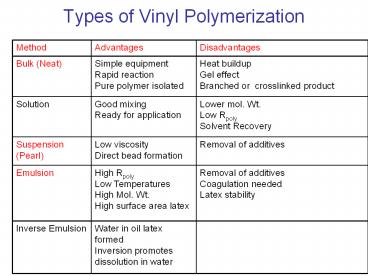
Title: Types of Vinyl Polymerization
1
Types of Vinyl Polymerization
2
Fate of Initiator Radicals
- Radical reactions
- Recombination in solvent cage
Reaction with polymer radicals (kt)--primary
termination
Reaction with initiator (MIH)
Hydrogen abstraction from polymer chains (chain
transfer to polymer)
Reaction with solvent or inhibitor
- Chain initiation, Ri 2 f kd I
- Efficiency factor, f 0.1 - 0.9
3
Radical Initiators
- Azo Initiators
4
Decomposition of Azo Initiators
- 2- bond cleavage to liberate nitrogen
Cage Recombination ---Side reaction- irreversible
coupling of succinonitrile radicals, efficiency
decreases at high conversion
5
Peroxy Initiators
- High temperature initiators
Moderate temperature initiators
6
Peroxy Initiators
- Low temperature initiators, 35-60 C
3-bond cleavage process?
b-cleavage to carbon centered radical
7
Redox Initiation
0-5 C in water
0-5 C in organic/aqueous phase
8
Decomposition of Peroxy Initiators
- 1-bond cleavage process
If R aryl, acyl radical initiates alkyl,
CO2 lost before initiation occurs
9
Reaction of benzoyloxy radicals with styrene
10
Chain Transfer
- Hydrogen transfer to growing polymer chain
- Reinitiation of growing chain using transferred
radical
11
Effect of Chain Transfer on Rp and DP
12
Control by Chain Transfer
- Chain transfer depends upon nature and
concentration of chain transfer agent.
Where Ctr is the chain transfer constant that
includes the rate constants for hydrogen
abstraction and re-initiation of a new chain
Ctr is specific for a given monomer at a given
temperature
13
Common Chain Transfer Agents
14
Additional Chain Transfer Processes
- Chain transfer to monomer, Ctr x 104
- Ethylene, 0.4- 4.0 Styrene, 0.3-0.6
Vinyl acetate, 1.75-2.8 Vinyl chloride,
10.8-16 Allyl systems, 50-100
Chain transfer to polymer--branching Polyethylene
Vinyl acetate Vinyl chloride
15
Transfer to Polymer
- Polyethylene branching
Long branches
Short branches
16
Inhibition of Radical Polymerization
- Must stop oxygen- and carbon centered radicals
Radicals generated by auto oxidation
May be metal catalyzed
- Oxygen centered radicals stopped by hydrogen
transfer
Carbon centered radicals stopped by addition
17
Critical Inhibitor Properties
An inhibitor should not add to, abstract from or
otherwise reach with monomer or solvent
Inhibitors should not undergo self reaction or
unimolecular decomposition
Inhibitors must react rapidly with the
propagating and/or initiator derived radicals to
terminate polymer chains
18
Trapping Oxygen Centered Radicals
19
Trapping carbon centered radicals
- Carbon centered radicals stopped by addition to
oxygen or carbon
20
Typical Inhibitors
21
Stable Radical Inhibitors
Recommended

