

Stages of Animal Embryogenesis PowerPoint PPT Presentation
1 / 34
Title: Stages of Animal Embryogenesis
1
Stages of Animal Embryogenesis
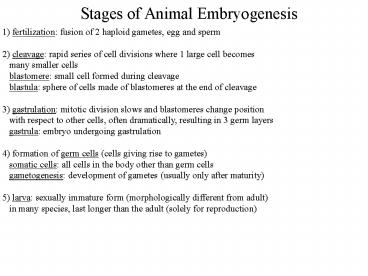
1) fertilization fusion of 2 haploid gametes,
egg and sperm 2) cleavage rapid series of cell
divisions where 1 large cell becomes many
smaller cells blastomere small cell formed
during cleavage blastula sphere of cells made
of blastomeres at the end of cleavage 3)
gastrulation mitotic division slows and
blastomeres change position with respect to
other cells, often dramatically, resulting in 3
germ layers gastrula embryo undergoing
gastrulation 4) formation of germ cells (cells
giving rise to gametes) somatic cells all
cells in the body other than germ cells
gametogenesis development of gametes (usually
only after maturity) 5) larva sexually immature
form (morphologically different from adult) in
many species, last longer than the adult (solely
for reproduction)
2
Example of Vertebrate Development-- Frogs
starting out-- the egg (in frogs is quite large--
up to about 1 mm across animal hemisphere upper
half of the egg pigmented, less yolk vegital
hemisphere lower half more yolk (typically
larger cells)
animal hemisphere
vegetal hemisphere
pronucleus haploid nucleus of egg and sperm-
fuse to form a zygote
3
Example of Vertebrate Development-- Frogs
blastocoel fluid filled cavity in the animal
hemisphere formed in blastula required to
allow the cell movement that takes place during
gastrulation blastopore slit/hole formed during
gastrulation to allow cells to migrate into
the blastocoel-- gets larger as gastrulation
proceeds dorsal blastopore lip edge of the
exterior cell layer that expands provides
cells to migrate through the blastopore
blastocoel
show movies
4
Example of Vertebrate Development-- Frogs
note that the blastopore and blastopore lip occur
during gastrulation gastrulation forms the 3
germ layers ectoderm is formed from the cells
remaining on the outside of the embryo expands
to cover the the entire vegital and animal
surfaces mesoderm is formed from the cells that
migrate through the blastopore endoderm is
formed by the larger, yolky cells that do not
migrate and remain in the vegital hemisphere
before becoming encircled
5
Example of Vertebrate Development-- Frogs
organogenesis interactions between the 3 germ
layers to form tissues notochord dorsal rod of
mesodermal cells that induces nearby ectoderm
to become neural tissue making up the nervous
system neurula embryo undergoing this initial
phase of organogenesis involving neural
induction cells induced by the notochord fold
inward making the neural tube, which then gets
covered by ectoderm as it grows out/over the
neural tube neural crest neural tube cells
touching the epidermis will migrate from the
neural tube, forming peripheral nervous system,
melanocytes, face cartilage somites segmented
mesodermal cells induced by the notochord will
form back muscles, vertebrae, and dermis
6
Example of Vertebrate Development-- Frogs
neurula
neural tube
notochord
7
Example of Vertebrate Development-- Frogs
8
Example of Vertebrate Development-- Frogs
9
Example of Vertebrate Development-- Frogs
10
Example of Vertebrate Development-- Frogs
20
17
24
28
32
38
11
Example of Vertebrate Development-- Frogs
42
45
49
12
Example of Vertebrate Development-- Frogs
metamorphosis transformation of a larva
(tadpole) into an adult (frog) induced by
hormones from the thyroid gland (thyroxin)
tadpole (larva)
13
Unicellular Development- Starting at the Beginning
Acetabularia large, single cell protist used for
showing the nucleus contains developmental and
hereditary information consists of 3 parts cap,
stalk, and rhizoid rhizoid contains the
nucleus transplanting the nucleus from one
species to another would change the structure
of the cap to that of the transplanted nucleus
after a few weeks information determining the
morphogenesis of the cap comes from the nucleus
14
Unicellular Development- Starting at the Beginning
if the nucleus is totally removed, Acetabulgaria
still survives and forms a stalk, although the
protist dies soon afterwards a rhizoid with a
nucleus can reform both stalk and cap a cap
requires the apical (top) bit of the stalk to
regenerate the cap information (mRNA) is stored
temporarily in the apical tip of the stalk and
is sufficient to form a cap
15
Chlamydomonas protist model of sexual
reproduction
normally Chlamydomonas is haploid and has 2
mating types (like yeast) a plus and a minus
Chlamydomonas recognize each other (by cell
surface receptors located on their flagella)
and the 2 cells and their nuclei fuse to form
a diploid zygote Chlamydomonas then undergoes
meiosis to form 2 and 2 - haploids note that
plus and minus are equal-- distinction between
egg and sperm are not yet made
16
Multicellularity complexity due to
differentiation
despite the formation of a diploid zygote,
chlamydomonas is a unicellular organism--
cells are independent and each must perform all
functions volvox closely related to
chlamydomonas, but contains several cells that
are arranged in particular patterns
17
Multicellularity complexity due to
differentiation
some (not all) volvox species developed the first
germ cells specific for reproduction somatic
cells and germ cells started to become
morphologically and functionally
different morphological/functional
differentiation of germ cells is not an absolute
requirement (usually not found in plants) but
is most common in animals
18
Multicellularity complexity due to
differentiation
volvox has its germ cells in the center,
surrounded by somatic cells in asexual
reproduction, the germ cells divide and form
juveniles inside the adult, but are inside
out inversion process by which juveniles leave
the adult and turn rightside out-- in some
ways is similar to animal gastrulation after
reproduction, the germ cells are used up, and the
somatic cells die apoptosis programmed cell
death controlled during development
19
Multicellularity complexity due to
differentiation
asexual reproduction is typical for
volvox increased temperature (found in shallow
ponds that tend to dry out in summer) trigger
the production of a sexual inducer protein that
causes individuals to make eggs or sperm,
depending upon their sex sperm swim to eggs,
fertilize to form zygotes, zygotes can withstand
heat and dessication until resubmerged in water
20
Multicellularity complexity due to
differentiation
Chlamydomonas is isogamous both gametes look the
same heterogamous gametes look and function
very differently (motility, morphology,
location, sizes, etc) both Chlamydomonas and
volvox zygotes make haploid organisms after
meiosis, producing both mating types in identical
numbers single volvox haploid cells then divide
multiple times to make the multicellular
organism
21
Multicellularity complexity due to
differentiation
Dictyostelium exhibits a second form of
multicellular differentiation normally a
haploid "social amoebae" (myxamoebae) that
reproduces by fission when food is exhausted,
the amoebae move together and join together slug
(grex, or pseudoplasmodium) motile multicellular
form that is covered in slime and migrates to
an area of light front 1/5 of the slug
differentiate form a stalk with a tube down the
center remaining 4/5 of cells move through the
stalk to form spore cells spore cells disperse
to form more of the normal haploid myxamoebae
22
Multicellularity complexity due to
differentiation
23
Multicellularity complexity due to
differentiation
Dictyostelium can also fuse to create a diploid
zygote giant cell diploid cell eats its
neighbors in the bunch, forms a type of cyst
where it undergoes mitoses and meioses before
releasing more haploid amoebae single cell type
(haploid myxamoebae) becomes either stalk or
spore cells individual cells come together to
form a new cohesive structure (grex) these two
features mimic much of what is found in animal
development (cell differentiation and
migration)
show dictyostelium grex and stalk migration movies
24
Multicellularity complexity due to
differentiation
dictyostelium myxamoebae move as a series of
streams flowing together towards a central
point to form the grex chemotaxis movement of
cells towards or away from a chemical cAMP
signaling molecule causing movement causes
movement towards higher cAMP causes cells to
secrete more cAMP very common signalling
molecule aggregation centers are random, based
on the distribution of myxamoebae present
all of the cells are equal, with each secreting
and responding to cAMP
show dictyostelium aggregation movie
25
Multicellularity complexity due to
differentiation
myxamoebae must also start sticking together in
order to form a grex normally they grow and
feed independently and individually
cell adhesion molecule type of cell surface
protein which specifically binds and
recognizes another substance and is used for
sticking together often glycoproteins
(proteins with various carbohydrates
attached) dictyostelium uses several cell
adhesion molecules to form a grex when there
is a lot of food, no cell adhesion molecules are
expressed first adhesion protein gp24 (24 kD) is
expressed after mitosis stops required for
next sequential steps-- block this protein with
an antibody so that it cannot function,
differentiation into a grex stops antibody
protein produced by the immune system of
vertebrates which recognizes a particular
antigen(substance that induces immune response)
used freqently to recognize and mark (or block) a
specific protein
26
Multicellularity complexity due to
differentiation
a second adhesion molecule (gp80) is also made
during aggregation if blocked, only a small
slug will form-- not enough of cells stick
together to make a full size grex during late
aggregation, more gp80 is made along with a third
cell adhesion molecule (gp150) blocking
gp150 by mutation or antibody stops development
at the loose aggregate stage-- grex cannot
move or form prespore or stalk cells
dictyostelium models several aspects of other
multicellular organisms 1) respond to chemical
gradients 2) use several cell adhesion
molecules to generate morphology
27
Differentiation in Dictyostelium
biggest choice a cell ever makes is what it is
going to become often has to make a choice
between one or several alternatives
dictyostelium has a simple choice to make between
stalk or spore cell 4 distinct stages in the
differentiation of cell types 1) bias-- tendency
to become one cell type or the other 2) lable
specification a decision has been made, but can
be changed by changing its environment 3)
firm commitment a cell fate decision to become a
specific cell type occurs before that cell
type is attained 4) differentiation actually
becoming a particular cell type
28
Bias
decision is regulated by both internal and
external factors external factors include
cyclic AMP that draws myxamoebae
together internal factors include nutritional
status, cell size, cell cycle, calcium, etc S
and early G2 phase cells have high calcium and
tend to become stalk mid or late G2 phase cells
have low calcium and tend to become spore have
not made any decisions yet
29
Labile Specification
ammonia increases prespore gene expression and
reduces gene expression for stalk-- ammonia is
generated from protein degradation cAMP also
stimulates spore-specific gene expression
blockade of cAMP formation causes prespore cells
to revert serves as both an extracellular
signal and an intracellular regulator moving
from one end of the grex to the other can shift
the cell fate calcium is a major determinant of
pre-stalk cells high calcium stalk
differentiation more stalk cells can be
generated by increasing intracellular calcium a
particular lipid also regulates stalk cell
specification both cAMP and calcium are major
signals in vertebrate specification too
30
Commitment and Differentiation
final differention requires 2 specific secreted
proteins to make spores SPF1 (secreted protein
factor 1) is required for 'culmination' SPF2
(secreted protein factor 2) is required for
encapsulated spores prespore cells express a
receptor for SPF2 prestalk cells do not cells
'respond' differently to a given signal because 1
receives, other not stalk cells require protein
kinase A (PKA), normally activated by cAMP
also requires the lipid DIF-1
31
Metazoan Development
metazoan multicellular animals that go through
embryonic development animal evolution isn't
linear-- 3 (or 4) major branches sponges
(parazoans) are very different than the other 3
types archeocyte type of sponge cell that
can become the other 2 types individual
sponge cells can reaggregate and form a new
sponge has no true mesoderm, so only 2 germ
layers instead of 3 diploblasts jellyfish and
hydra, radiata distinct ectoderm and endoderm
rudimentary or missing mesoderm less rigid
matrix than sponges
32
Metazoan Development
Bilateria bilateral symmetry-- most metazoans--
and 3 germ layers Protostomes mollusc,
arthropods, and worms mouth forms first, opens
to gut during gastrulation coelom body
cavity-- forms by hollowing out of the
mesoderm Deuterostomes chordates and
echinoderms (starfish and sea urchins)
echinoderms included because mouth forms after
the anus and gut forms from pouches of the
mesoderm rather than hollowing out gets back to
the evolution of animals being obvious from
embryos
33
Metazoan Development
amniote egg is a development of the
deuterostomes yolk sac stores food for
embryo amnion fluid bathing the
embryo allantois collects waste products made
during embryo development chorion covering
around the embryo separating it from the
'environment' and allowing only some things to
pass protostomes developed a protective egg
case but eggs do not have the same structure
34
Metazoan Development
Recommended

