

Like Water for Chocolate by Laura Esquivel como agua para PowerPoint PPT Presentation
1 / 18
Title: Like Water for Chocolate by Laura Esquivel como agua para
1
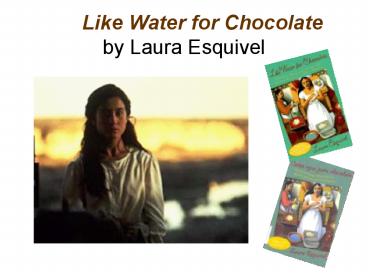
Like Water for Chocolateby Laura Esquivel
2
como agua para chocolate
- In some Latin American countries, such as Mexico,
hot chocolate is made not with milk, but with
water instead. Water is boiled and chunks of milk
chocolate are dropped in to melt. The saying
"like water for chocolate," alludes to this fact
and also to the common use of the expression as a
metaphor for describing a state of passion or
sexual arousal. In some parts of Latin America,
the saying is also equivalent to being 'boiling
mad' in anger.
3
Laura Esquivel
- LWFC was Esquivels first novel
- Met with unusual success when it was published in
1989 - Translated from Spanish into English in 1992 and
became a best seller - English-subtitled film became one of the most
popular foreign language films in American film
history
4
- I grew up in a modern home, but my grandmother
lived across the street in an old house that was
built when churches were illegal in Mexico. She
had a chapel in the home, right between the
kitchen and the dining room. The smell of nuts
and chilies and garlic got all mixed up with the
smells from the chapel, my grandmothers
carnations, the liniments and healing herbs.
5
lo maravilloso real magical realism
- First developed by Cuban writer Alejo Carpentier
- Lo maravilloso real, 1949
- Generally describes novels by Latin American
writers that are infused with distinct
fantastical, mythical, and epic themes
6
- Often explained as a unique product of Latin
America, particularly its history of European
colonialism - Resulted in a delicate relationship between the
contradictory, yet co-existing, forces of
indigenous religion and the powerful Catholic
Church - Often involves
- Time shifts
- Dreams
- Myths
- Fairy tales
- Surrealistic descriptions
- Element of surprise or shock
- The inexplicable
7
Adapted from M. H. Abrams A Glossary of Literary
Terms, 6th ed.
- these writers interweave, in a an ever-shifting
pattern, a sharply etched realism in representing
ordinary events and descriptive details together
with fantastic and dreamlike elements . . . - these novels violate, in various ways, standard
novelistic expectations by drastic and
sometimes highly effective experiments with
subject matter, form, style, temporal sequence,
and fushions of the everday, the fantastic . . .
8
- The fantastical element in Titas cooking is that
it produces such strong emotions in her family - The art of cooking reflets the patience and
talent of the cook - The spirits who appear to Tita symbolize the
long-lasting effects of those who impact our
lives and our own feelings of responsibility and
guilt
9
Significant works of magical realism . . . some
of Shaffers favorites
- Isabel Allende, The House of the Spirits (and her
other works as well) - Gabriel Garcia Marquez, Love in the Time of
Cholera, One Hundred Years of Solitude - Toni Morrison, Song of Solomon
- Ben Okri, The Famished Road
- Yann Martel, The Life of Pi
10
Set against the Mexican Revolution of 1910 1917
- Most important modernizing force in Mexican
history - Peasants and natives banded together under the
leadership of Pancho Villa and Emiliano Zapata to
reject dictatorship and revive democracy - Claim Mexico for the everyday man and woman
11
As you read, watch for . . .
- The physical illnesses that plague the characters
- The role of ghosts
- The role of tradition
- Fire as a symbol
- The different personalities of the three De La
Garza sisters - Their options
- The domestic life of women
12
The recipes make it work . . .
- Esperanza finds her aunts cookbook in the ruins
of the De La Garza ranch. - As she recreates the recipes in her home, she
passes down the family stories to her daughter. - Her daughter becomes the novels narrator as she
incorporates her great-aunts recipes, remedies,
and experiences into the story. - She justifies her unique narrative Tita will
go on living as long as there is someone who
cooks her recipes.
13
A womans place
- Richard Corliss Laura Esquivel brought Gabriel
Garcia Marquezs brand of magic realism into the
kitchen and the bedroom, the Latin womans
traditional castle and dungeon. - Traditionally, a Latin womans place is in the
home, especially in the patriarchal society of
the early 20th century - Women expected to serve fathers, brothers then
they got married and served husbands, sons, and
daughters
14
- Women turned to the domestic arts for creative
outlets, along with storytelling, gossip, and
advice - Created their own female culture within the
social prison of married life - Maria Elena de Valdes notes that little has
changed for the Mexican woman She must be
strong and far more clever than the men who
supposedly protect her. She must be pious,
observing all the religious requirements of a
virtuous daughter, wife, and mother. She must
exercise great care to keep her sentimental
relations as private as possible, and, most
important of all, she must be in control of life
in her house, which means essentially the kitchen
and bedroom or food and sex.
15
- Based on genre of womens fiction published in
monthly installments in calendars for young
ladies - Also included recipes, dressmaking patterns, home
remedies, moral exhortations, and calendars of
church observances - 1860s installment novel grew out of the
monthly recipe - Elaborate love stories by women appeared in the
1880s - Episodic plots, overt sentimentality
- By the end of the century every literate Mexican
woman was an avid reader of this genre
16
- Behind the simple episodic plots there was an
infrahistory of life as it was lived with all the
multiple restrictions for women of this social
class - Heroines were survivors
- Led full lives despite marriage
- Transcended conditions of existence and expressed
themselves through love and creativity - A la mesa y a la cama, una sola vez se llama
17
Each chapter is prefaced by the title, the
subtitle, the month, and the recipe for that month
- Narration that follows is a combination of direct
addresson how to prepare the recipe and
interspersed stories about the loves and times of
the narrators great-aunt Tita
- Narration moves from first person to the
third-person omniscient - Each chapter ends with the information that the
story will be continued and an announcement of
next months recipe
18
- The recipes and their preparation, as well as
the home remedies and their application, are an
intrinsic part of the story. There is therefore
an intrinsic symbiotic relationship between the
novel and its model in the reading experience.
Each is feeding on the other. - Maria Elena de Valdes
Recommended

