

Teaching reading at Key Stage 3 PowerPoint PPT Presentation
1 / 16
Title: Teaching reading at Key Stage 3
1
Teaching reading at Key Stage 3
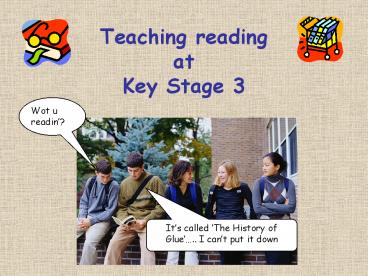
Wot u readin?
Its called The History of Glue.. I cant put
it down
2
How to maintain good habits from KS2 in a KS3
environment
How to help make links between reading and writing
How to balance the teaching of reading with the
love of reading
Whole school responsibility
Pupil apathy
How to motivate and avoid the its boring
syndrome
NLS extracts used for shared reading of a text
will pupils experience a whole text?
Challenges for teaching reading at KS3
How do you teach specific reading skills to
individual children within a class of 30 pupils?
Staff knowledge/ training to teach skills with
confidence
Differentiation - reading ages
Reading assessment optional tests and KS3 SATs
should show progress by 2 sub levels above KS2
result
Reading for different purposes
How best to use library lessons
3
Key Stage 3 Reading Assessment Focuses
4
(No Transcript)
5
Key Stage 3 Reading How to spot Assessment
Focuses
Find.what is? how did?
What does it mean when..? What/ how does the
writer suggest..?
How does..? How can you tell..?
How does..? What are the effects of..?
How effective is..? What/ how does the writer..?
6
Optional tests in Y7 8
- Non-statutory tests for pupils who achieved L4 or
higher at KS2 - offer schools a means to monitor pupils
progress in Key Stage 3..between the statutory
tests at years 6 and 9 (QCA Y7 optional tests
Teachers guide) - Diagnostic - identify individual needs or group
trends - Greater continuity and progress between key
stages - 3 texts from different genres with 5 (approx.)
questions on each text, each question testing a
specific reading skill - Format same as end of KS3 tests
- Optional tests marked internally
7
What about pupils who failed to achieve L4 at KS2?
- Optional tests assume a minimum reading ability,
therefore not appropriate - Pupils identified by SEN dept. in Summer term
- Small teaching groups with SEN support
- Reading recovery programme
- Literacy Progress Units (LPUs)
8
Literacy Progress Units
- Aim to help pupils achieve L4 by end of Y7
- 20 minute sessions with small group
- There are six units on 1. organising writing
2. spelling 3. phonics - word choices 4.
inference and deduction 5. information retrieval
6. improving sentences - End of Year 7, pupils sit a Progress Test
9
LPU benefits
- Six units written to specifically target reading
and writing - Resources and plans are written minimal
preparation time for staff - Tasks relate directly to assessment criteria for
L4 on Progress Tests - 20 min clear focus for each session with small
number - Can boost pupil confidence and self esteem
- Optional tests could be set at same time as
Progress tests
10
LPU issues
- Timetable for LPU remove from lessons? Lunch?
Before/after school? - How to pitch LPU to pupils
- How user-friendly are the resources? Photocopying
bill!? - Who delivers the units English staff? LSA?
Librarian? Literacy assistants? - Timing of units dont finish too early before
tests, but some schools dont finish them - What if pupils still do not achieve L4 at end of
Y7?
11
How do we teach reading skills?
- Use of a quick Starter in pairs addressing a
specific AF This one is based on AF3 - Read the passage on the next slide.
- Why are the writers feelings about rugby?
- How are we know this?
12
The Starter
- I couldnt wait for the games lesson to
start. It was going to be great. After all those
skills sessions with my dad in the park, I would
really show the kids in my class how good I was
and maybe, just maybe, I would finally make some
friends at the High School. Coming from a
different primary school to all the others hadnt
made life easy for me and today was the day
that was going to change everything. I was going
to whizz down the wing, side step, then cut in
and fly over the line like Jason Robinson in the
World Cup Final. All I needed was for someone to
actually pass the ball to me, and I would be the
star, the hero everybodys mate!
13
How do you teach reading skills?( a few tips)
- Little and often use starters as route in
link to lesson objectives - Use class reader rather than extract overkill
prediction, inference etc - Teacher-led reading showing pupils how you read
a text (use of annotation/ interactive
whiteboard) - Diagnostic tests to inform differentiated paired
reading - Guided reading
14
Guided reading
- Common at KS2 Y7 will be used to it
- 20 min group work with teacher within lesson
working on specific reading skill - Clear and focussed learning objectives related to
optional/ KS3 tests - Good way of supporting weak students but to also
challenge GT pupils - Diagnostic tests/ target levels useful for
grouping - Encourages pupils to be more aware of skills used
when reading a text
15
Guided Reading practicalities
- Planning, planning and planning!!!
- How to select pupils
- How to ensure all pupils in class have guided
reading time - Selecting resources for session
- How to manage classroom space
- How to manage behaviour of rest of group
16
Your turn!! Group activity
- You will be given an Assessment Focus and a text
- With these, you need to produce a plan of how you
would aim to deliver a 20 minute guided reading
session for pupils
Recommended

