

Light Brown Apple Moth and Common Leafrollers in California PowerPoint PPT Presentation
1 / 2
Title: Light Brown Apple Moth and Common Leafrollers in California
1
Light Brown Apple Moth and Common Leafrollers in
California
W. K. Frankie Lam, Ph.D., Entomologist, UCCE,
Monterey County Marc E. Epstein, Ph.D., Senior
Insect Biosystematist, CDFA
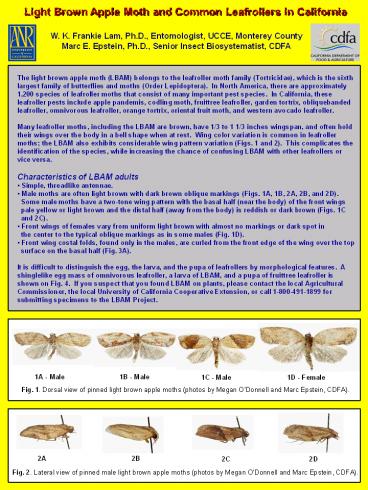
- The light brown apple moth (LBAM) belongs to the
leafroller moth family (Tortricidae), which is
the sixth largest family of butterflies and moths
(Order Lepidoptera). In North America, there are
approximately 1,200 species of leafroller moths
that consist of many important pest species. In
California, these leafroller pests include apple
pandemis, codling moth, fruittree leafroller,
garden tortrix, obliquebanded leafroller,
omnivorous leafroller, orange tortrix, oriental
fruit moth, and western avocado leafroller. - Many leafroller moths, including the LBAM are
brown, have 1/3 to 1 1/3 inches wingspan, and
often hold their wings over the body in a bell
shape when at rest. Wing color variation is
common in leafroller moths the LBAM also
exhibits considerable wing pattern variation
(Figs. 1 and 2). This complicates the
identification of the species, while increasing
the chance of confusing LBAM with other
leafrollers or vice versa. - Characteristics of LBAM adults
- Simple, threadlike antennae.
- Male moths are often light brown with dark brown
oblique markings (Figs. 1A, 1B, 2A, 2B, and 2D).
- Some male moths have a two-tone wing pattern
with the basal half (near the body) of the front
wings - pale yellow or light brown and the distal half
(away from the body) is reddish or dark brown
(Figs. 1C - and 2C).
- Front wings of females vary from uniform light
brown with almost no markings or dark spot in - the center to the typical oblique markings as
in some males (Fig. 1D). - Front wing costal folds, found only in the
males, are curled from the front edge of the wing
over the top - surface on the basal half (Fig. 3A).
- It is difficult to distinguish the egg, the
larva, and the pupa of leafrollers by
morphological features. A shinglelike egg mass
of omnivorous leafroller, a larva of LBAM, and a
pupa of fruittree leafroller is shown on Fig. 4.
If you suspect that you found LBAM on plants,
please contact the local Agricultural
Commissioner, the local University of California
Cooperative Extension, or call 1-800-491-1899 for
submitting specimens to the LBAM Project.
1A - Male
1B - Male
1D - Female
1C - Male
Fig. 1. Dorsal view of pinned light brown apple
moths (photos by Megan ODonnell and Marc
Epstein, CDFA).
2A
2B
2D
2C
Fig. 2. Lateral view of pinned male light
brown apple moths (photos by Megan ODonnell and
Marc Epstein, CDFA).
2
4C Fruittree leafroller pupa
4B Light brown apple moth larva
4A Omnivorous leafroller egg mass
Fig. 3. Costal fold of light brown apple
moth (photos by Marc Epstein and Megan
ODonnell, CDFA).
Fig. 4. Egg mass, larva, and pupa of
leafrollers (4A and 4C - photos by Jack Kelly
Clark 4B photo by Marc Epstein and Megan
ODonnell, CDFA).
Other Moths Captured in the LBAM Pheromone Traps
5A Orange tortrix
5C Clepsis fucana
5B Orange tortrix
5D Clepsis fucana
5E Garden tortrix
5H Achyra sp. (Not leafroller)
5G Fruittree leafroller
5F Henricus umbrabasana
Fig. 5. Dorsal view of other moth species
commonly found in California LBAM traps (photos
by Megan ODonnell and Marc Epstein, CDFA).
Common Leafrollers in California
6A Apple pandemis
6C Fruittree leafroller
6B Codling moth
6D Garden tortrix
6E Obliquebanded leafroller
Female
Male
Female
Male
6F Omnivorous leafroller
6H Oriental fruit moth
6G Orange tortrix
6I Western avocado leafroller
Fig. 6. Common leafroller moths in
California, some could be captured by the LBAM
pheromone trap (6A to 6H, photos by Jack Kelly
Clark 6I, photo by Max Badgley).
Common and scientific names of moths included
above Leafrollers (Lepidoptera Tortricidae)
apple pandemis, Pandemis pyrusana codling moth,
Cydia pomonella fruittree leafroller, Archips
argyrospila garden tortrix, Clepsis
(Ptycholoma) peritana light brown apple moth,
Epiphyas postvittana obliquebanded leafroller,
Choristoneura rosaceana omnivorous leafroller,
Platynota stultana orange tortrix, Argyrotaenia
franciscana oriental fruit moth, Grapholita
molesta and western avocado leafroller, Amorbia
cuneana. Snout and Grass Moths (Lepidoptera
Pyralidae) Achyra sp.
Recommended

