

Light and Vision How do we see? PowerPoint PPT Presentation
1 / 41
Title: Light and Vision How do we see?
1
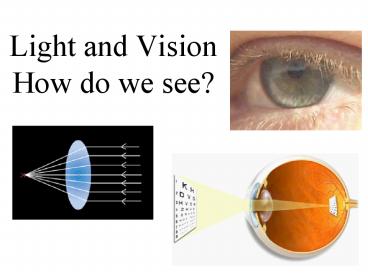
Light and VisionHow do we see?
2
The Electromagnetic Spectrum
3
Things to Think About Today
- Light waves travel in straight lines until they
meet matter - Then, light is reflected, absorbed, refracted
- Why do animals have eyes? How did eyes evolve?
- What are the parts of the eye and how do they
work to bend light
4
Light Energy Meets Matter
Refracted (Bent)
Reflected
Absorbed
5
- Light waves travel in straight lines until they
meet matter - Some matter ( lenses) focus rays and bend them in
defined ways
- Pin activityBoxes with solutions/laser pointer,
ray box - Ray boxes with lenses, gelatin lenses
6
Convex Lenses
Magnifying Lenses are Convex lenses
7
Concave Lenses(divergent lenses)
8
Eyes Detect and Focus Light
- Eyes are organs that detect light, and convert it
to electro-chemical impulses in neurons - In higher organisms the eye is a complex optical
system which - collects light from the surrounding environment
- regulates its intensity through a diaphragm
- focuses it through an adjustable assembly of
lenses to form an image - converts the image into a set of electrical
signals - transmits these signals to the brain, through
complex neural pathways that connect the eye, via
the optic nerve, to the visual cortex and other
areas of the brain.
9
3 types of eyes have evolved
- Single centered lens
- Advanced mollusks (octopus), spiders,vertebrates
- Many tiny lenses
- Arthropods (trilobites)
- Ex. Ants (50 images) Horsefly (7,000 images)
Dragonfly (30,000 images) - Hole without lens
- snakes
10
Parts of the Eye that you can See!
11
Functions of Parts of the Eye
- Eyelid- protection of eye from injury
- Pupil- hole in the center of the iris that lets
light in - Appears black because the eye tissue absorbs most
of the light - Sclera-tough outer layer
- collagen and elastin
- Iris-colored area surrounding pupil
- Composed of smooth muscle
12
Interior Parts of the Eye
13
(No Transcript)
14
(No Transcript)
15
Path of an Image
- Goes through the Cornea and Lens
- Hits the back of the retina
- Activates rod and cone cells
- Transmit impulse through optic nerve to the brain
16
(No Transcript)
17
Rod and Cone Cells
- Rod Cells- numerous ( 130 million in each eye
- Responsible for Twilight vision, Gray shades
- Very sensitive to light
- Found on outside of
- retina
- Cone Cells-
- less numerous
- ( 7 million)
- Responsible for
- Ability to see Color
- Found in center of the retina
- (macula)
18
Now, lets think about what might go wrong
19
Myopia- Near-sighted
- Genetic Basis
- Eye is longer than normal, Cornea steeper
- Correct with glasses, contacts, surgery
- Very common!
- Can make it better by squinting!- Changes the
eyeball shape!
20
Myopia Near Sightedness
21
Hyperopia- Far-sighted
- Image is focused behind the eyeball
- Cornea is flatter, eye is shorter, focusing power
is weaker - Young people can accommodate by changing shape
of eye As people get older, lens get harder and
cant be bent. - Lasix surgery changes shape of cornea
- http//www.ncbi.nlm.nih.gov/pubmedhealth/PMH000485
3/
22
Hyperopia Farsightedness
23
(No Transcript)
24
Cataracts
- Clouding of the lens
- Caused by aging or damage to the proteins that
make up the lens - Chemicals, Diabetes, Injury, Smoking are
causative - Surgery to remove lens
25
Normal/Cataract
26
Retinitis Pigmentosa
- Rare genetic disease (1/4000 people in US)
- Rods die and leave dark deposits in retina
- Lose peripheral
- and night vision
27
Normal/Retinitis
28
What about compound vision?
29
A Grid- Seen by a Human and an Insect
30
A spider web- seen by a human and an insect
31
Bee as seen by a mammal and an insect
32
Insect images
33
Insects See Colors Differently
http//www.naturfotograf.com/UV_flowers_list.html
34
What about other animals?
35
Bird Vision
- How do nocturnal birds see?
- Rod cells are very sensitive in low light
- Humans have around 200,000/mm2, some owls have
over a million/mm2 - Birds also have larger pupils which let more
light in - What about day foragers
- Have more cones than humans
- May have more than one fovea area of sharpness)
36
Ruminant Pupils
- Slit-like in bright light, circular in dim light
- Gives permanent wide-angle vision whether in dim
or bright light -makes watching for predators
more efficient.
37
Making the connection between physical science
and biology
- Light travels in straight lines
- Light bends when it meets matter
- Lenses are matter that bend light
- How animals see
- Eye diseases
- Do you need light to see?
- Ray box
- Bending Experiment
- Play with Lenses
- Eye Dissection
- Annenberg video
38
Video
39
Wrap up Questions
- What is seeing?
- Can a human being see in the dark? Why?
- How would a scientist test if you could see in
the dark?
40
Reading Resources
- A Natural History of the Senses-Diane Ackerman
- Video- Annenberg Foundation
- GEMS- http//lawrencehallofscience.org/gems/gemsgu
idestopic.html
41
Exploring Light and Lenses
- Concave Lenses and light
- Pinhole Viewer (Camera)
- Camera Obscura
Camera Box
Camera Obscura (CA)
Recommended

