

Putting Parents Front and Center Understanding Standards-Based School Reform PowerPoint PPT Presentation
1 / 45
Title: Putting Parents Front and Center Understanding Standards-Based School Reform
1
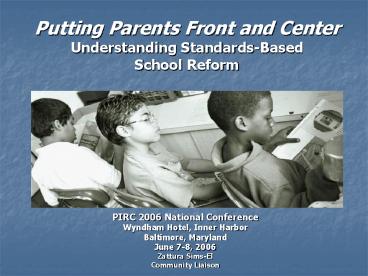
Putting Parents Front and CenterUnderstanding
Standards-Based School Reform
- PIRC 2006 National Conference
- Wyndham Hotel, Inner Harbor
- Baltimore, Maryland
- June 7-8, 2006
- Zattura Sims-El
- Community Liaison
2
Why Are We Here?
- Introductions
- Purpose of the Workshop
3
ICEBREAKER!!!!!
- Opinion Exercise
4
Testing/Assessments
- Who designs the test my child takes in school?
- Why are students given tests?
- How are test used?
- Are test important?
5
Norm-referenced Testing (NRT)
- Human beings make tests. They decide what topics
to include on the test, what kinds of questions
to ask, and what the correct answers are, as well
as how to use test scores. Tests can be made to
compare students to each other (norm-referenced
tests) or to see whether students have mastered a
body of knowledge (criterion or
standards-referenced tests). This fact sheet
explains what NRTs are, their limitations and
flaws, and how they affect schools. - Fair Test The National Center for Fair and Open
Testing
6
- Norm-referenced tests (NRTs) compare a person's
score against the scores of a group of people who
have already taken the same exam, called the
"norming group." When you see scores in the paper
which report a school's scores as a percentage --
"the Lincoln school ranked at the 49th
percentile" -- or when you see your child's score
reported that way -- "Jamal scored at the 63rd
percentile" -- the test is usually an NRT. - Fair Test The National Center for Fair and Open
Testing
7
- Most achievement NRTs are multiple-choice tests.
Some also include open-ended, short-answer
questions. The questions on these tests mainly
reflect the content of nationally-used textbooks,
not the local curriculum. This means that
students may be tested on things your local
schools or state education department decided
were not so important and therefore were not
taught. - Fair Test The National Center for Fair and Open
Testing
8
- Commercial, national, norm-referenced
"achievement" tests include the California
Achievement Test (CAT) Comprehensive Test of
Basic Skills (CTBS), which includes the "Terra
Nova" Iowa Test of Basic Skills (ITBS) and Tests
of Academic Proficiency (TAP) Metropolitan
Achievement Test (MAT) and Stanford Achievement
Test (SAT, not to be confused with the college
admissions SAT). "IQ," "cognitive ability,"
"school readiness," and developmental screening
tests are also NRTs. - Fair Test The National Center for Fair and Open
Testing
9
- NRTs are designed to "rank-order" test takers --
that is, to compare students' scores. A
commercial norm-referenced test does not compare
all the students who take the test in a given
year. Instead, test-makers select a sample from
the target student population (say, ninth
graders). The test is "normed" on this sample,
which is supposed to fairly represent the entire
target population (all ninth graders in the
nation). Students' scores are then reported in
relation to the scores of this "norming" group. - Fair Test The National Center for Fair and Open
Testing
10
- The dangers of using norm-referenced tests
11
Creating the bell curve
- To make comparing easier, testmakers create exams
in which the results end up looking at least
somewhat like a bell-shaped curve (the "normal"
curve, shown in the diagram). Testmakers make the
test so that most students will score near the
middle, and only a few will score low (the left
side of the curve) or high (the right side of the
curve). - Fair Test The National Center for Fair and Open
Testing
12
THE EDUCATION TRUST
Norm Referenced System
Losers
Winners
Average
Standards Based System
Highly Proficient Proficient Novice Basic
13
- In making an NRT, it is often more important to
choose questions that sort people along the curve
than it is to make sure that the content covered
by the test is adequate. The tests sometimes
emphasize small and meaningless differences among
testtakers. Since the tests are made to sort
students, most of the things everyone knows are
not tested. Questions may be obscure or tricky,
in order to help rank order the test-takers. - Fair Test The National Center for Fair and Open
Testing
14
- Tests can be biased. Some questions may favor one
kind of student or another for reasons that have
nothing to do with the subject area being tested.
Non-school knowledge that is more commonly
learned by middle or upper class children is
often included in tests. To help make the bell
curve, testmakers usually eliminate questions
that students with low overall scores might get
right but those with high overall scores get
wrong. Thus, most questions which favor minority
groups are eliminated. - Fair Test The National Center for Fair and Open
Testing
15
- To compare students, it is often easiest to use a
norm-referenced test because they were created to
rank test-takers. If there are limited places
(such as in a "Gifted and Talented" program) and
choices have to be made, it is tempting to use a
test constructed to rank students, even if the
ranking is not very meaningful and keeps out some
qualified children. - Fair Test The National Center for Fair and Open
Testing
16
- StandardsHow Important are They?
17
PAIR SHARE EXERCISE STANDARDS IN
EVERYDAY LIFE Standards might have only been
emphasized in education for 10 or so years, but
they are common in our everyday life. We rely on
Standards all the time.
18
STANDARDS IN EDUCATION TIMELINE
19
ACHIEVEMENT GAP
- Currently there is a difference in school
achievement among different groups of students,
such as racial/ethnic groups, income levels,
disability and/or language barriers. - The No Child Left Behind Act seeks to eliminate
the achievement gap nationwide by consistently
closing it over a twelve year period. - No Child Left Behind requires the collection of
data to show where these gaps exist.
20
HOW TO USE STANDARDS
21
STANDARDS are roadmaps to an educational
destination
22
- What are Academic Standards?
23
Content Standards
- Statements of what students should know and be
able to do in each subject area. Standards make
clear what teachers should be teaching and the
expectation for achievement is the same for all
students.
24
Performance Standards
- Describe the levels of performance on tasks that
students must reach to demonstrate that they have
met the content standards, or that they are on
their way toward meeting them. - Performance standards can be distinguished from
content standards because performance standards
have levels e.g., 1,2,3,4 or below basic,
basic, novice, proficient, advanced
25
Opportunity to Learn Standards
- Describe the learning conditions required to
ensure that students have a fair chance to meet
the content and performance standards such as
adequate facilities, appropriate resources,
conducive learning environment, etc.
26
Four Factors that Contribute to the Achievement
Gap
- Low Standards
- Low-Level Curriculum
- Least Qualified Teachers
- Fewer Resources
- Whats behind these reasons? Low Expectations of
and for our children.
27
Cycle of Low Achievement
Low Expectations
Poor Test Results
Less Challenging Courses
Low Level Assignments/Instruction
Stephanie G. Robinson, Ph. D. Education Trust
28
Students Who Start 3rd Grade at About the Same
Level of Math Achievement
Source Heather Jordan, Robert Mendro, and Dash
Weerasinghe, The Effects of Teachers on
Longitudinal Student Achievement, 1997.
29
Finish 5th Grade at Dramatically Different
Levels Depending on the Quality of Their Teachers
Source Heather Jordan, Robert Mendro, and Dash
Weerasinghe, The Effects of Teachers on
Longitudinal Student Achievement, 1997.
30
Students Who Start 3rd Grade at About the Same
Level of Reading Achievement
Source Heather Jordan, Robert Mendro, and Dash
Weerasinghe, The Effects of Teachers on
Longitudinal Student Achievement, 1997.
31
Finish 5th Grade at Dramatically Different
Levels Depending on the Quality of Their Teachers
Source Heather Jordan, Robert Mendro, and Dash
Weerasinghe, The Effects of Teachers on
Longitudinal Student Achievement, 1997.
32
Pueblo, ColoradoRaising Achievement, Closing
GapsGrade 3 Reading
Source Data provided by the Pueblo School
District.
33
El Paso TAAS Pass Rates Reading Grades 3, 8 and 10
Source Texas Education Agency - Academic
Excellence Indicator System Report 1994 through
1999
34
El Paso TAAS Pass Rates Math Grades 3, 8 and 10
Source Texas Education Agency - Academic
Excellence Indicator System Report 1994 through
1999
35
Student Work
- Have participants look at student work and decide
which work they would want for their child.
36
What Role Do Counselors Play?
- Families of high school students
- Regular meetings with teachers and counselors to
plan their childrens academic program - Information about program options, graduation
requirements, test schedules, and post-secondary
education options and how to plan for them - Information about where to find academic support,
such as help with homework, tutoring,
after-school programs, and special classes.
Include subject areas covered and associated
costs. - Explanations of courses students should take to
be prepared for college or other post-secondary
education and the work force. - Information about costs of higher education and
applying for financial aid - Child Trends Data Bank
37
Low-Income Students Less Likely to be Enrolled in
a College Preparatory Track
Source US Department of Education, National
Center for Education Statistics. National
Education Longitudinal Study of 1988 Second
Follow-Up, 1992 in A Profile of the American
High School Senior in 1992.( p. 36) Washington,
DC US Department of Education, June 1995.
1999 by The Education Trust, Inc.
38
More African American and Latino 12th Graders Do
Daily Worksheets
Source USDOE, NCES, 1996 NAEP Math Summary Data
Tables online.
39
Results of a Rigorous Curriculum
40
A Rigorous Math Curriculum Improves Achievement
Source National Center for Education Statistics.
NAEP 1999 Trends in Academic Progress (p 113).
Washington, DC US Department of Education. 2000
41
Students Who Take Algebra Show Greater Gains in
Mathematics Achievement
Source Algebra for Everyone? Benefits of
College-Preparatory Mathematics for Students With
Diverse Abilities in Early SecondarySchool,
Educational Evaluation and Policy Analysis, Vol.
22, Fall 2000.
42
Vocational Students Taking High-Level English
Courses Score Higher
Source Bottoms, Gene. High Schools That Work,
SREB, .
43
William Fleming High SchoolRoanoke, Virginia
Source Roanoke (VA) Public Schools, 2000.
44
- THANK YOU
45
The Education Trust
202-293-1217 www.edtrust.org
Recommended

