

The ARFORGEN Training Event Cost Model The Army needs the PowerPoint PPT Presentation
1 / 38
Title: The ARFORGEN Training Event Cost Model The Army needs the
1
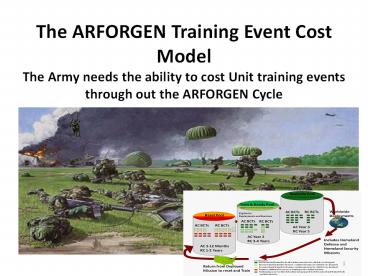
The ARFORGEN Training Event Cost ModelThe Army
needs the ability to cost Unit training events
through out the ARFORGEN Cycle
2
What is Army Force Generation (ARFORGEN)
- ARFORGEN is a structured time based process
on which Army units progressively become
equipped, trained and available for combat. It is
broken into three the time periods called phases
the reset phase, train/ready phase and the
available phase. In each of phases units receive
equipment, conduct specific type of training and
have capabilities to perform some missions.
3
Services Expeditionary Force Models
Army
Navy
Air Force
Marines
4
Force Organization Cost Estimating System
(FORCES)
ARFORGEN Cost Model (Being Designed)
End Strength Cost Model (ESCM)
- gt1500 Users
- HQDA
- OSD
- MACOMs
- Sub Commands
- Units
- Installations
- ARNG/RC
- Schools
FORCES Cost Model (FCM)
Army Contingency Operations Cost Model (ACM)
Cost Factors Handbook (CFH)
The ARFORGEN Training Event Cost Model will join
the FORCES Suite of tools available on the
DASA-CE website
5
Purpose of the Model
- Provide HQDA with an ARFORGEN costing capability
- Provide FORSCOM with the ability to align and
synchronize Army resources within the ARFORGEN
FORCE Pools by Aim Points, changes in training
events etc.
6
Model Cost Visibility
- Fiscal Year
- Unit
- Training Event down to the Battalion /Company
level - Compo (AC, ARNG, AR)
- Appropriation
- FORSCOM Specific Costs
- Contingency FORCE
- Operational Force Package (e.g. Disaster Relief)
- Ad Hoc Formations
- Mission Force (e. g. 1/5/20/90)
- Model will adjust for
- Duration
- Aim Points
- Compressed Time
- Training Intensity
- Frequency
7
Event Menu Matrix (EMM)
- What is an Event Menu Matrix (EMM)?
- A tabular representation of a corresponding
doctrinal training template that depicts
multi-echelon training, individual to brigade or
higher, that support preparation for and
participation in gate training events. - We used the 9 Event Menu Matrices (EMMs) to
associate activity (vehicle miles) with training
events. - EMMs by type
- Corp and Div HQ
- Combat Aviation Brigade
- Heavy Brigade Combat Team
- Infantry Brigade Combat Team
- Stryker Brigade Combat Team
- Fires Brigade
- Military Police Brigade
- Maneuver Enhancement Brigade
- Sustainment Brigade
8
EMM Links Pacing Item Activity
(miles) with
Training Event
9
Training Event CategoriesEstablished a Master
List of Live, Virtual, and Constructive Training
Events from the Event Menu Matrices (EMMs), DA
PAM 350-38 Standards in Weapons Training and Army
Resource Training Information System (ARTIMS)
with validation from FORSCOM.
Live Training Events Virtual Training Events (Fixed Costs) Constructive Training Events (Simulations)
Gunnery Qualifications Training Aid Devices (e.g MILES gear) Computer, High Resolution (Bde), Low Resolution (Div) COCOM funded
Unit/Maneuver Training Events Simulators (e.g U-Coft, CCTT, ABCS) in lieu of (or combined with) live fire Simulation Training Ctrs at Installation
CTC rotations
10
Training Across the 3 ARFORGEN Pools
11
Training Event Cost
- Direct Equipment OPTEMPO Equipment Activity
Associated with Event x Equipment qtys x
Equipment Cost Factor.
- Based on TRADOC Event Menu Matrix provided by
FORSCOM, which assigns activity by Training Event
for pacing item(s) by unit type (BCTs, CABs,
Combat Arms, FIRES, MEBs CS, CSS)
12
Training Event CostLive Training Direct OPTEMPO
Cost Categories
Direct Equipment Costs Training
Operations Aircraft Operations
Reparables POL Ground/Afload
Operations Aircraft Operations
Reparables POL Non-OSMIS Equipment
Operating Cost Post Production Software Support
Annual Maintenance Cost
Modernization Amortized Cost
- Adjust for
- Training Event Activity
- Equipment Qtys
13
Direct OPTEMPO by TNG
Event (Combine Arms BN
Extract)
Based on EMM TNG Strategy by Event
14
Training Event Cost Virtual Training Events
- Virtual Training Events conducted using Training
Aid Device, Simulators and Simulation (TADSS) - - Training Aid Devices (e.g MILES gear)
- - Simulators (e.g U-Coft, CCTT, ABCS) in lieu
of (or combined with) live fire - Cost Factor for TADSS sustainment cost
- - Based on planning factor of 10 of
acquisition costs - - Linked TADSS to platforms they are used in
lieu of. - - Computed average for the TADSS associated
with a LIN to obtain one cost per LIN supported - - Calculated cost per day based on 242 days of
annual usage (annual training days per G-3)
15
Training Event CostAmmo
- Based on FORCES Ammunition Costs
- Ammunition Cost Factors by Active, Guard and
Reserve units are generated from the the Total
Ammunition Management Information System (TAMIS),
the Army system for managing training munitions. - TAMIS provides actual training ammunition
expenditure by DODIC. An average annual
expenditure is computed based on a 3-4 year
average and apportioned to a training event based
on AR 350-38 ammo requirements by training event.
- FORCES links the munitions (DODIC) to the firing
platforms in the unit (SRC), allowing for the
summation of total training ammunition cost by
unit.
16
Unit Costs Must be Adjusted by AIM Points
17
Other ARFORGEN Cost Categories
- RESET Pool Unique Costs
- Personnel Costs
- Other Unit Costs
- SDT
- Installation Services
- Deployment
18
Reset Pool Unique Costs
- Equipment Reset costs RESET cost factors
(Depot/Field) based on prior FY actual costs from
AMC. Depot costs applied to LINs designated to go
to depot. - Personnel Transition Costs Average Personnel
Transition costs (computed from Budget J-Book
Data) - Rotations
- Movement
- TDY
- Institutional Training
- Operations
19
Personnel Costs
- The Personnel costs used are from FORCES and
include the replacement of personnel lost through
attrition, the PCS cost for the normal rotation
of personnel, and the pay and allowances, by
grade, for the personnel in the unit - Basic pay and allowances by grade, BAH/OHA,
COLA, and Special, Incentive, and Hazardous Duty
Pay authorized the personnel in the unit based on
the grade, MOS, SQI, and/or ASI. - Replacement Personnel Training includes the costs
to train the personnel through initial MOS
qualification and their initial issue clothing. - The PCS cost includes travel of the military
personnel, their dependents, and the movement of
household goods and privately owned vehicles.
20
Other Unit Costs (FORSCOM by Unit Type)
Note Cost Factors Based on 3 year average
21
Second Destination Transportation (SDT) Cost Data
Sources
- The following FORCES databases are used to
calculate movement costs - Distances Defense Table of Authorized
Distances - SRC EQUIP - Contains the quantity of all TOE
equipment in each SRC - SRC PERS - Contains the number of personnel in
each SRC - EQUIPMENT CUBIC WGT - Consolidated TOE Update
USATEA Equipment Configuration File - LINEHAUL/RAIL/BUS RATES SDDC Study Data
- PORTHANDLING RATES- SDDC Import Rates Air
Mobility Command Export Rates - SEALIFT RATES SDDC Linear Ocean Transport
Program Billing Rates - AIR RATES Air Mobility Command JCS SAAM
aircraft rates
22
ARFORGEN Installation Services
- Added Training Costs (G-3/5/7)
- Visual Info Tng Spt Ctrs
- Integrated Tng Area Mgmt (ITAM)
- Battle Simulation Ctrs
- Training Range Operations
23
Deployment Expeditionary Force (DEF) Units
Require Contingency Operations Costing
- Army Conops Cost Model (ACM)
- More detailed deployment costing
- Allows for modification of all factors (globally
or individually)
Ops Sustainment
Pre-Deployment
Redeployment
Deployment
Reconstitution
Demobilization
Models
FORCES
Contingency Operations
INCREMENTAL COSTS
24
Deployment Costs
25
Summary
- ARFORGEN Training Event Cost Model Requires
Costing by - Force Pool
- Training Event
- Training Intensity
- Training Frequency
- Unit (Subordinate Unit Level)
- Aim Points
- Personnel strength
- Equipment on Hand
- Equipment Readiness
- Unit Training Level Proficiency
- Time
- Base/OCO/FORSCOM
- Way Ahead
- Collaborate with RAND to Validate Methodology
- Develop Prototype Model
- Conduct Unit Site Visits
26
Back Up Slides
27
Ammunition Cost by Training Event
Annual Cost for Ammo for an Abrams Tank
Reset Phase Cost for Ammo for En BN
Note Factors generated from Delta between
AR-350-38 Requirements and TAMIS execution will
give user Option to calculate Requirements
28
Virtual Training Programs (examples)
29
TADSS Cost by Weapon Systems
30
Avg TADSS Cost by System Supported (Example)
Avg 149.27
31
Combat Training Center (CTC) Rotation
- Culminating maneuver training event in Train
Ready Pool designed to increase unit collective
proficiency - CTC has four Major Centers each with a different
focus - -- Battle Command Training Program (BCTP)
- -- Combat Maneuver Training Command (CMTC)
- -- Joint Readiness Training Center (JRTC)
- -- National Training Center (NTC)
CTC Program Focus CTC Program Focus CTC Program Focus CTC Program Focus CTC Program Focus
CTC BCTP CMTC JRTC NTC
Focus Brigades, division, corps to ARFOR/ASCC Platoon/company to brigade Squad to Brigade Platoon/company to brigade
Venue Home Station-Simulation Europe-Live LA-Live CA-Live
32
CTC Exercises
33
Combat Training Center Support
CTC Event Costs per Program
- Funds CTC program at maneuver CTCs and BCTP.
Includes - Deployment, operational, and contract costs to
support annual 10/10/4 rotation cycle at NTC,
JRTC and JMRC - Transportation to and from CTCs (air and rail)
- Operations Groups to include Bravo, Foxtrot and
Sierra - Exportable Training Capability (ETC)
- Contemporary Operational Environment
(000)
Events
Cost per Event
20
7,200
8
10,400
10
34,800
10
47,104
Source HQDA G-3
34
Requires Costing of Subordinate Units
(Co/Bn) (Example)
35
HBCT AIM Point Adjustment (Example)
36
Virtual Constructive Events
- Computer/IT Simulation
- -- High Resolution (Bn)
- -- Low Resolution (Div)
- Funded by COCOMs costs TBD (must contact
COCOMs)
37
TADSS Cost by Installations (Example)
38
TADSS Cost by Installations
Recommended

