

Autonomous Management of Agitation in Dementia PowerPoint PPT Presentation
1 / 36
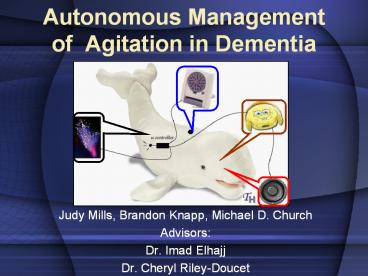
Title: Autonomous Management of Agitation in Dementia
1
Autonomous Management of Agitation in Dementia
- Judy Mills, Brandon Knapp, Michael D. Church
- Advisors
- Dr. Imad Elhajj
- Dr. Cheryl Riley-Doucet
2
Presentation Outline
- Background Information on Aging and Dementia
- Project Objectives and Design
- Sensory Stimuli
- Physiological Signal Sensors
- Cost Analysis
- Current Progress and Future Goals
3
Aging and Dementia
- Expected population boom
- Increase from 35 to 72 million between 2010 and
2030 (26) - People over the age of 65 are at highest risk for
developing Alzheimers Disease (26) - AD is the leading cause of dementia in the
elderly (26) - Estimated 4.5 million cases (26)
- Could grow to about 11.3 million to 16 million
with population boom (26)
4
Aging and Dementia
- Dementia is a growing public health concern (3)
- Affects 8-10 of all people over 65 (26)
- Affects nearly half of all nursing home residents
(26) - Can lead to emotional stress and psychiatric
symptoms of burn-out in caregivers/nurses (20) - Amplified by short-staffing and lack of
professionals - The main behavioral characteristic of dementia is
agitation (5)
5
Agitation
- Behavioral Response
- Wringing hands
- Vocalizations
- Pacing
- Repetitive actions
- Destructive behaviors
- Hostility
- (5) (14)
- Physiological Response
- Increase heart rate
- Increased skin temperature
- Diaphoresis
- Increased blood pressure
- Increased pulse pressure
- (6) (10)
6
Agitation
- Interrupts care
- Decrease patient quality of life
- Can lead to catastrophic reaction (7)
- Requires nursing time
- Increased cost of care
- Currently measured with documenting surveys to be
filled out by caregivers or staff (5) - Documentation requires time
- Subjective
7
Cost Implications
- Staff time expenditure (23)
- Nursing staff spend an average of 23 minutes
managing each negative behavior related to
agitation - Depending on frequency and the number of patients
staff can spend up to 80 minutes per day for each
patient in their care - More efficient methods are needed to reduce cost
associated with dementia care
8
Methods for Managing Agitation
- Neuroleptic drugs (22)
- Of the 24 of nursing home patients taking these
medications, 88 are receiving them
inappropriately - Hastens cognitive decline
- Reminiscence Therapy
- May be over-stimulating and enhance agitation
- Consumes staff time
- Spinoza Bear (24)
- Limited ability to personalize
- Old technology
- Not Proactive
- Snoezelen Rooms (27)
- Must be set up by caregiver
- Not proactive (patient is already agitated)
- Not personalized for patient
9
Multi-sensory Stimulation
- Has been found to be an effective method for
calming agitation (27) - Most effective when personalized (8) (10)
- Enhances alertness (17)
- Decreases anxiety (17)
- Improves quality of life (2)
10
Project Objective
- Develop and prototype an intervention device
- Monitor physiological conditions to detect
symptoms of agitation in dementia patients - Provide multi-sensory stimuli in order to reduce
agitation - Will be unique because it will be the first to
detect agitation in a dementia patient and then
attempt to reduce that agitation
11
Device Benefits
- Reduce time nurse spends managing agitated
dementia patients - Reduce health care cost
- Reduce stress on nurses
- Improve quality of patient life
- Reduce use of neuroleptic drugs
- Stimulate happy emotions through memory
12
Device Requirements
- Portable
- Transparent
- Adaptive
- User-friendly
- Easy to interface to the patient
- Patient customizable
- Minimizing cost
- Ensuring safety
13
Challenges
- Quantify and detect agitation before exacerbation
- Choosing physiologic signals to detect and
analyze - Choosing appropriate and safe technology
- Choosing appropriate stimuli
- How to administer stimuli
- Controlling stimuli based on sensor feedback
14
Chosen Sensor Technology
- Polar Chest Band Heart Monitor
- Comfortable fit designed for working out
- Sends signal in 3-volt pulses
- Easily interpretted
- RTD Temperature Sensor
- Resistance in relation to temperature
- GSR Skin Conductance Sensor
- Worn on fingers
- Similar to sensor used in lie detection
15
Sensor Technology Available
- BodyMedia SenseWear Armband (15)
- Galvanic skin response, skin temperature,
two-axis accelerometer, heat flux, and near body
temperature - Has been used in order to capture physiological
responses associated with specific emotions - Not used in this project because intercepting the
wireless signal from the armband would have been
problematic
16
Sensor Technology Available cont.
- Research Group from MIT is developing a system
called LiveNet. - Groups goal is to develop monitoring systems for
proactive health and elder care - System can monitor a variety of physiological
signals - Continuous monitoring to detect subtle changes
- Not commercially available, system is bulky
17
Sensor Technology Available cont.
- UCLA group is developing a system called CustoMed
(15) - Revolves around placement of Med nodes
- Med nodes are stand-alone units equipped with
processing units and batteries that support
various types of sensors for physiological
readings - Med nodes interface with a personal PC that
collects data and coordinates and controls the
overall functionality of the system
18
Sensor Technology Available cont.
- CustoMed Applications
- Post knee surgery patient tracking
- Track the angular motion of the knees (flex
sensors) - Measure pressure and force under foot (pressure
sensors) - Aid Alzheimers patients
- Detect arousal
- Notify staff
19
Sensor Acquisition System
- Features
- Microcontroller attached to the heart rate
monitor chest strap - Battery pack location can be moved
- RTD temperature sensor can be placed almost
anywhere on the body - GSR sensors must be placed around two fingers
20
Chosen Stimuli
- Based on the concepts of Multi-Sensory
Stimulation (MSS)(12) - Involves stimulating multiple senses at once
- Non-challenging or stressful stimuli
- Elders with dementia have difficulty processing
normal stimuli due to neuronal losses (4) - Music
- Aromatherapy
- Light Stimuli
- Tactile Stimuli
21
Music Therapy
- Memory loss in dementia is associated with recent
events - Remote memory relatively intact (1)
- Neural pathways used to recall music are not
generally affected by dementia (1) - More therapeutic than spoken words (1)
- Helps elder to retrieve lost memories or feelings
22
Using Preferred Music
- Therapy that uses music the resident prefers is
more effective (8) - Decreases agitation fast (9)
- Longer lasting effects (9)
- Sony Psyc Walkman
- Battery powered
- CDs can be changed easily based on patients
preferences - Anti-skip capability
- Able to play upside down
23
Aromatherapy
- Has been used in mental health services for years
(25) - Studies conducted with lavender and lemon balm
oil (2) (11) - Effective for reducing agitation
- Increased quality of life indices
- Found to have no significant side effects
- Aura Cacia Fan Diffuser
- No heat diffusion
- Pads can be changed easily according to patient
preference - Battery powered
24
Visual and Tactile Stimulation
- Visual Stimulation
- Colored fiber optic fibers are stimulating with
bright color and contrast change despite existing
visual impairment - LED lighting in many colors and patterns
- Non-abrasive materials
- Non-frightening
- Tactile Stimulation
- Stuffed dolls used in studies to calm agitation
have reported some success (18) - Soft, pleasant texture
- Non-frightening shape to avoid inducing
halucinations
25
Stimuli Delivery System
LED box
Fiber optics
Funnel aroma therapy fan
Battery pack
Fiber optics
Microcontroller
Battery pack
Microcontroller case
Speakers
LED box
CD player
BlueTooth AirCable
Funnel aroma therapy fan
Speakers
- Features
- Microcontroller case contains most of the
components - Fiber optic cables can be removed from LED box
- This allows nurses to remove all electronics for
replacement and cleaning
26
Stimulation Control
- Sharp Change or Relative Threshold
- Sharp Change
- Any combination of two of the following
- 5 beats/minute
- 1 F/ 5 minutes
- 5 consecutive recessive readings in GSR
- Will evolve with further study
- The definition of a sharp change will decrease if
the threshold for that sensor is reached.
27
Stimulation Control
- Relative Threshold
- Relative to the persons baseline measurement
- Either of the following
- 15 beats
- 1.5 F
- GSR stays the same
- Will evolve with further study
- In place to ensure gradual changes are recognized
as well
28
Cost Analysis
Components Cost
Microcontroller (2) 118.00
Blue Tooth Air Cables (2) 138.00
Rechargeable Battery Pack (2) 34.00
Galvanic Skin Response 18.00
RTD Temperature Sensor 39.00
Polar Heart Rate Monitor 91.00
Wild Republic 28' Plush Whale 29.94
Sony Psych Walkman 31.79
Sony Desktop Speakers 27.94
Aura Cacia Aromatherapy Diffuser 16.67
Lavender Lemon Essential Oils 8.37
Fiber Optic Strands 37.00
LEDs Parts 27.50
Zipper, thread, Velcro, ect 15.00
Total Cost 632.21
29
Total Cost Estimate
- Total Cost 632.21
- When weighed against nursing staff time based on
study findings - 26.39 average RN hourly pay 11.12
average CNA hourly pay - In an long term care facility where 2 CNAs and 1
RN are responsible for 22 patients the staff to
patient ratio is 17.33. - 7.33 x 80 minutes per day 586.4 minutes or 9.77
hours. - ((.33 x 26.39) (.66 x 11.12)) x 9.77 156.61
- This facility spends 156.61 per day or
57,162.65 per year for the management of
agitated behaviors. - The device pays for itself in approximately 4
days in this situation, or 89 days for one device
for every patient on the unit.
30
Current Progress
- Literature Review
- Understanding of relevant research
- Familiar with products available
- Prototype Design
- Selection of sensors and stimuli
- Selection of components needed for interfacing
and control - All components received
- Further technological refinement of device
functioning - wireless transmission of patient data to PC
- System learns patients stimuli preferences
- Construction
- 90-95 completed
- Manuscript
- Completed
31
Plan for Future Work
- Three Phase Project
- 1. Disseminate Research on Device Development
- Submit Abstract to 2007 31st Annual Research
Conference Midwest Nursing Research Society in
Omaha, Nebraska, March 23-26 - Submit manuscript for publication in Western
Journal of Nursing Research. - Improve device
- Wireless communication to nurse
- Data storage
32
Plan for Future Work
- Pilot MSE Device Functioning
- Obtain IRB approval
- First test on students to determine functionality
- -Stroop test to simulate agitation
- Submit pilot results to Gerontological Society of
America (GSA) Annual Scientific Meeting Nov.
2007.
33
Plan for Future Work
- Pilot Effect of MSE Device
- Pilot test device on group of Alzheimer's and
dementia patients - Clinical setting
- Observation
- Submit results to GSA Annual Scientific Meeting
Nov. 2008
34
Sources
- Bakker, R..(2003). Sensory loss, dementia, and
environments. Generations, 27(1), 46-51. - Ballard, C.G., OBrien, J.T., Reichelt, K.,
Perry, E.K. (2002), Aromatherapy as a safe and
effective treatment for the management of
agitation in severe dementia The results of a
double-blind, placebo-controlled trial with
melissa. Journal of Clinical Psychiatry, 63(7),
553-558. - Bartels, S.J., Smyer, M.A..(2002) Mental
disorders of aging An emerging health crisis?,
Generations, Spring 26(1), 14-20. - Bower H.M. (1967) Sensory stimulation and the
treatment of senile dementia, The Medical
Journal of Australia, No.1, pp. 1113-1119. - Cohen-Mansfield, J..(2001). Managing agitation
in elderly patients with dementia.. Geriatric
Times, 2(3). - Copstead, L.C., Banasik, J.L., (2000),
Pathophysiology Biological and Behavioral
Perspectives, 2nd Edition. W.B. Sauders Co.,
Philadelphia, Pennsylvania. 39. - Cutler, N.R., Sramek, J.J., (1996) Understanding
Alzheimers Disease For general readers a guide
to understanding a devastating illness that
affects a significant segment of the elderly
population. University Press of Mississippi. 65,
82, 93. - Gerdner, L.A..(2005). Use of individualized
music by trained staff and family Translating
research into practice. Journal of
Gerontological Nursing, 31(6), 22-30. - Goodall, D., Etters, L.. (2005). The use of
music on agitated behavior in dementia A placebo
controlled study. Holistic Nursing Practice,
19(6), 258-262. - Heuther, S.E., McCance, K.L, (2005),
Understanding Pathophysiology, Mosby-Year Book,
St. Louis, Missouri, 218-223, 361-362.
35
Sources Continued
- Holmes, C., Hopkins, V., Hensford, C.,
Maclaughlin, V., Wilkinson, D., Rosenvinge, H.
(2002).Lavender oil as a treatment for agitated
behavior in dementia A placebo controlled
study. International Journal of Geriatric
Psychiatry, 17, 305-8. - Hope, K.W,, The effects of multisensory
environemts on older people with dementia,
Journal of Psychiatric and Mental Health Nursing,
Vol. 5, pp. 377-385, 1998. - 13. Jafari, R., Encarnacao, A., Dabiri, F.,
Noshadi, H., Sarrafzadeh, M.. Wireless sensor
networks for health monitoring. University of
California, Department of Computer Science,
Accessed on June 5, 2006. - 14. Kong, E., (2005), Agitation in dementia
Concept clarification, Journal of Advanced
Nursing, 52(5), 526-536. - 15. Lisetti, C.L.. (2004) Using noninvasive
wearable computers to recognize human emotions
from physiologic signals. Journal of Applied
Signal Processing 2004, 11, 1672-1687. - 16. Lorenzi, E.A..(1999). Complementary/alternati
ve therapies So many choices. Geriatric
Nursing, 20(3), 125-133. - 17. Maddocks-Jennings, W., Wilkinson, J.M.,
Aromatherapy practice in nursing A literature
review, Journal of Advanced Nursing, 48(1),
93-103. - 18. Nakajima, K., Nakamura, K., Yonemitsu, S.,
Oikawa, D., Ito, A., Higashi, Y., Fujimoto, T.,
Nambu, M., Tamura, T..(2001). Animal-shaped toys
as therapeutic tools for patients with severe
dementia. 2001 Proceedings of the 23rd Annual
EMBS International Conference, October 25-28,
Istanbul, Turkey. 3796-8. - 19. Pulsford, D., (1997) Therapeutic activities
for people with dementia what, whyand why
not? Journal of Advanced Nursing, 26, 704-709. - 20. Rosenblatt, A..(2005). The art of managing
dementia in the elderly. Cleveland Clinic
Journal of Medicine, 72(3), S3-12.
36
Sources Continued
- 21. Sloane, M.C., Lau, H., Preisser, J., Galanko,
J.. Use of tactile and auditory stimuli to
reduce disruptive vocalization in nursing home
residents with dementia A pilot study..
Accessed from www.spinozabear.com/longterm.html. - 22. Smallwood, J., Brown, R., Coulter, F.,
Irvine, E., Copland, C..(2001).Aromatherapy and
behaviour disturbances in dementia A randomized
control study.. International Journal of
Geriatric Psychiatry, 16, 1010-1013. - 23. Souder, E., OSullivan, P., (2003)Disruptive
behaviors of older adults in an institutional
setting Staff time required to manage
disruptions, Journal of Gerontological Nursing,
29(8), 31-6. - 24. Spinoza in Health Care Long Term Care,
accessed on June 2, 2006 from www.spinozabear.com/
longterm.html. - 25. Thorgrimsen, L., Spector, A., Wiles, A.,
Orrell, M.. (2003). Aroma therapy for dementia.
The Cochrane Database of Systematic Reviews 2003,
Issue 3. Art. No. CD003150. DOI
10.1002/14651858.CD003150. - 26. U.S. Census Bureau, 65 in the United
States2005. Access from www.census.gov/prod/2006
pubs/p23-209.pdf. - 27. van Weert, J.C., van Dulmen, A.M.,
(2005).Behavioral and mood effects of snoezelen
integrated into 24-hour dementia care. Journal
of the American Geriatrics Society, 53, 24-33.
Recommended

