

Transition from Communism (cont.) and the rise of new powers PowerPoint PPT Presentation
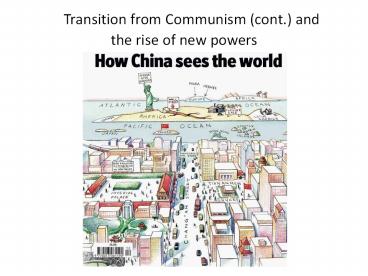
Title: Transition from Communism (cont.) and the rise of new powers
1
Transition from Communism (cont.) and the rise
of new powers
2
Review from Tues.
- Why the transition from Socialism to Capitalism?
- Liberal arguments
- Inability for socialist economies to grow and
modernize - Inability to compete in the global economy
- Economic Nationalist arguments
- For Russia, elites saw that their country was
becoming less powerful as it was becoming less
wealthy
3
The Soviet Union under Gorbachev tinkering with
Socialism
- Perestroika
- Glasnost
- Led to.
- Econ. Crisis
- Weakening of Communist partys hold on the state
- Declarations of independence
- Which meant the death of the Soviet Union
4
Soviet experience suggests that Kornai is
correct that a complete system change from
socialism to capitalism is necessary
- Political power
- Change from command to market friendly state
- Property rights
- decentralization
- From state ownership/control to private
ownership/control - Coordinating allocation
- From bureaucratic to market allocation
5
Simultaneous economic and political
liberalization markets and democracy
- Many features of democracy put in place in 1991
with fall of communism - But the government was weak and unstable
- And could not control the negative consequences
of shock therapy
6
Russia chooses Shock Therapy.
- Washington Consensus
- Liberalize, privatize, stabilize
- Same process as the Bolshevik Revolution
- Utopian social engineering?
- Large cluster of simultaneous changes needed
- Price liberalization privatization
elimination of subsidies for industry
anti-monopoly policies enforcement
7
Russia Shock Therapy in action
8
So market institutions were in place but they
were weak..
- Crony Capitalism
- Emergence of oligarchs
- Asset stripping
- Job losses
- Capital flight
- Bandit Capitalism
- Protest
- Longing for a return to Communism
9
Inequality
10
Brain Drain
11
Poverty
12
Protesting Bandit Capitalism
13
Repression
14
Russia. A One Trick Pony or a new world
economic Power?
15
Russia Crash and Burn?
16
Small Stimulus Package
- Russia benefitted from the same easy credit that
everyone else benefitted from. - Debt is still high and billions are needed to
rebuild infrastructure - Sept. 2008, govt. used oil revenue to bolster
stock market - But oil price volatility
17
China
18
China chooses Gradualism
- The institutionalization of markets without
democracy - The Chinese got shock therapy out of their
system with the Great Leap Forward - They learned the hard way
- So they chose the path of gradualism
- Ideological pragmatism
- Stiglitz believes they had the wisdom to know
what they didnt know
19
Peasants regain control of the land after the
Great Leap Forward failed
20
Abandoning Autarky
- China started entering the international economy
after 1978 - Foreign trade decisions were decentralized
- Special economic zones were created
- Volume of foreign trade rose
- And foreign investment flowed in
21
Free movement of people? Chinese migrant workers
22
The China Price
- Low wage industrial reserve army
- Joint ventures
- Technology transfor
- Competition
- Remember the product cycle?
23
Microeconomic Reforms
- One-stop shopping
24
Influx of Capital FDI
25
Chinas growth
26
Growing at 9 per cent per year
China's GDP, 1990-2006 (current value, billions
of U.S. dollars)
27
70 of goods in Wal Mart are made in China
28
Equality and Inequality in China
29
Poverty
30
Corruption
31
Any movement toward democracy?
32
Economic growth substitutes for political reform?
- Economic reform as a substitute for political
reform? - Institutional reforms limit the power of the
one-party state - Some of the reforms were
33
China is more cushioned from economic shock than
most countries.
34
China and the current economic crisis
35
What did we learn from the Transition experience?
- Both Liberals and Economic Nationalists agree
that. - Growth is ultimately more important than
equality.
36
What about the relationship between markets and
democracy?
- The Lesson from Russia
- Simultaneous introduction of markets and
democracy backfired - Democracy was weak and illiberal
- The weak state could not regulate the market
- Market undermined democracy
- It takes a strong state to introduce the market
- But why did it work in Poland?
37
The relationship between markets and democracy
- The Lesson from China
- Gradual introduction of markets without democracy
- China followed Gerschenkron strong state led
development
38
China State-led development
- Moved from focus on equality to focus on growth
- Started with agriculture
- Lifted rural population out of poverty
- Mandatory planning gradually replaced by markets
- developed without inequality
39
Why is China Better off than Russia?
40
Shifting World Power
- The rise of New Powers and the end of American
leadership?
41
The world is changing rapidly
- The international order is obsolete
- Shaped by US during the cold war
- Institutions based on rules of capitalism and
democracy - Powerful, wealthy, often non-democratic countries
with state-run economies are challengers - The BRICs
- But they have little power in international
institutions like the IMF, World Bank, G-8 - And why should they care about the current
international order?
42
Why should we care?
- The Liberal Would dismiss this question. Why?
- U.S. economic nationalists would be worried. Why?
43
The BRICs
44
Simultaneous Take-offs
- China and India 1/3 of worlds population
- High growth rates
- Likely to keep growing
- And shifting the technological balance of power
- India will vault over Germany in our lifetimes
45
For the economic nationalist Economic power
means military power
- China has the worlds largest foreign exchange
reserves - Uses it for access to raw materials
- Large foreign aid programs
- Nigeria
- Sudan
- Indonesia
- Can military power be far behind?
46
?
47
And Russia.
- Nuclear petro-state?
- Growth without development?
- Failure to modernize
- Global Ambitions
48
There are now more non-democracies than
democracies in the world
- They are powerful
- They include two nuclear powers
- Half the global population
- Oil producers
- Their Economic policies have not followed western
liberal model - They pursue state capitalism
- Blurring distinction between public and private
49
And they are changing the game
- They are already shaping world politics
- Russia exerts influence in areas vital to U.S.
security - India is dethroning US high tech industry
- India and China are settling their differences
and cooperating - They are proving to be resilient in economic
crisis - They have amassed sovereign wealth funds
- That buffer their economies
- And they dont have a place at the table
50
The G-20
51
Meanwhile.U.S. Hegemony is declining
- US Growth rate has fallen by ½ since the
beginning of the century - Debt and deficit
- Energy dependent
- Chinas share of global product has grown by 144
pe3r cent - India is growing at 5 per year
- Russia is flush is oil and gas revenues, paying
off debts while the US sinks deeper into debt
52
And is being challenged in international
institutions
- Old arrangements are relics
- In IMF and World Bank, Benelux has a larger quota
than China - China challenges the Washington Consensus
- Why should it be the premise for economic
development - And a condition for loans?
53
Why is this happening?
- Theories of Political Economy have an answer
54
Theories of Dynamic Markets
- The Business Cycle
- Product Cycle Theory
- Marxist Analysis
- All of Development Theory
- Webers open source theory
- Creative Destruction
55
Creative Destruction
- Joe Schumpeter Capitalism, Socialism, and
Democracy - Creative Destruction innovators destroy
established businesses - Source of market power
- Ensures against monopoly power
- It hurts
56
Creative destruction historically Schumpeters
waves
57
Econ. Nationalist View Nations that produce
high technology are most powerful
- Britain rose to Hegemony on the invention of the
steam engine - Germany rose to power because of its
revolutionary technological contribution to heavy
industry - During its hegemonic period, the United States
was the most innovative
58
Waltz international political economy ruled by a
hegemon is unstable
- Dominant powers expand too much
- Imperial decay is . . . primarily a result of
the misuse of powerwhich follows inevitably from
its concentration. - And even if they dont, others worry that they
are too powerful - Their preferences might not be the preferences of
others - But isnt America different?
- Arthur Schlesinger thinks so.
59
Solution? Bring these challengers into
international institutions
- Elevate the G-20
Recommended

