

Is the Birth Control Movement another Form of Imperialism PowerPoint PPT Presentation
1 / 13
Title: Is the Birth Control Movement another Form of Imperialism
1
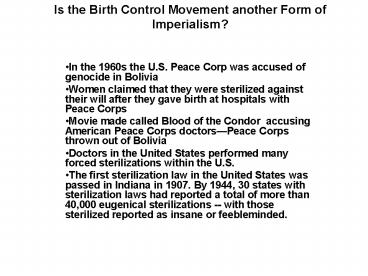
Is the Birth Control Movement another Form of
Imperialism?
- In the 1960s the U.S. Peace Corp was accused of
genocide in Bolivia - Women claimed that they were sterilized against
their will after they gave birth at hospitals
with Peace Corps - Movie made called Blood of the Condor accusing
American Peace Corps doctorsPeace Corps thrown
out of Bolivia - Doctors in the United States performed many
forced sterilizations within the U.S. - The first sterilization law in the United States
was passed in Indiana in 1907. By 1944, 30 states
with sterilization laws had reported a total of
more than 40,000 eugenical sterilizations -- with
those sterilized reported as insane or
feebleminded.
2
The International Planned Parenthood Foundation
- Organization led by Margaret Sanger of the US,
Elise Ottsen of Sweden, Dr. C.P. Blacker and Dr.
Helena Wright of the UK, as well as leaders in
the newly created federation of India, created
the organization in 1952 - It has become the worlds second largest NGO,
with over 180 countries participating. - Founding members include Hong Kong, Singapore,
Germany, Netherlands, Sweden, India, U.K. USA - In terms of when groups organized
internationally, African countries began to join
as early as 1971 (Tunisia), and the Middle East
in the early 1970s (Lebanon, Iraq, Morocco) - Its success has sparked protests as well as new
laws affirming womens right to birth control
3
A Rand Corporation Poll Taken in 2000 shows U.S.
Division over Funding Family Planning Abroad
4
What Happens if Governments Oppose Birth Control?
5
(No Transcript)
6
Family Planning and the Rockefeller Foundation
- Began its family planning activities in 1953 by
giving grants to Public Health programs in the
United States to begin tracking fertility rates
in women - In 1955, it helped India set up its birth control
program - In 1958 it began to fund the Population Council,
founded by John D. Rockefeller III in 1952 to
promote informed population policies
7
Functions of the Population Council
- Developing contraceptives and other products to
improve reproductive health - Improving the quality and outreach of family
planning and reproductive health services - Conducting research on reproductive health and
behavior, family structure and function, gender
issues, and the causes and consequences of
population growth - Strengthening professional resources in
developing countries through collaborative
research, awards, fellowships, and training - Providing a forum for publication of innovative
research in peer-reviewed journals, books,
working papers, and regional monographs.
8
Current Contraceptive Use
9
Contraceptive Use, Less Developed Countries
10
Womens Need for Contraceptives
11
A Brief History of Abortion
- Prior to the 19th century, abortion, both planned
and spontaneous, was rarely regulated by law
because it was difficult to ascertain what caused
an abortion. - Catholic Church did not always opposed abortion.
St. Augustine in 400 AD sanctioned abortion for
up to 80 days for a female fetus and 40 days for
a male. - 1588 Pope Sixtus banned all abortions, but his
edict was rescinded by Pope Sixtus in 1591. - Most anti-abortion laws passed in 19th century,
particularly after distinguishing between before
and after quickening - 1869 Pope Pius IX forbade all abortions in return
for Napoleon III acknowledging papal infallibility
12
Abortion Across the World
- BRAZIL
- Abortion only legal if the life of the mother is
in danger and the child is the result of rape - Advocates want to amend the law to include
deformed or retarded babies - IRELAND
- Abortion made illegal in 1861
- In 1983 it passed the 8th Amendment to the
Constitution declaring the right to life of the
unborn - In 1992 the ECU declared Ireland to be abusing
human rights with its ban - India
- Had population policies since 1950s
- Passed liberal abortion law in 1971, but few
women can obtain access to it. Abortions, as
well as number of children, can be examined in
terms of literacy, access to land, and
inheritance rights for womenvaries from state to
state-also little demand for female babies
13
Abortion in the United States
- Anti-abortion laws originally distinguished
before and after quickening. - Laws increased after the invention of x rays that
could detect the presence of fetal bones in the
bodies of accident victims - Not until the 1940s could doctors detect hormones
in womens blood that would indicate they had
been pregnant - 1967 Colorado and California became the first
states to legalize abortion. A number of other
states passed similar laws until the Supreme
Court decided in Roe vs. Wade that abortion was
legal.
Recommended

