

Wireless Communication Systems PowerPoint PPT Presentation
1 / 52
Title: Wireless Communication Systems
1
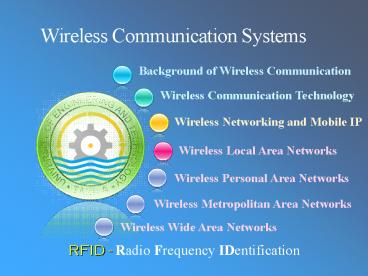
Wireless Communication Systems
Background of Wireless Communication
Wireless Communication Technology
Wireless Networking and Mobile IP
Wireless Local Area Networks
Wireless Personal Area Networks
Wireless Metropolitan Area Networks
Wireless Wide Area Networks
RFID - Radio Frequency IDentification
2
Outline
- Definition
- How does it work?
- Advantages and Disadvantages
- Frequency Standards
- Application
- Security
- Future
3
Outline
- Technical details
- Applications
- Privacy and security
- Challenges and controversy
- Current research
4
Definition
- Short for radio frequency identification.
- The term RFID is used to describe various
technologies that use radio waves to
automatically identify people or objects.
5
What are RFID Systems?
- Radio Frequency Identification Systems
- Identification system that consists of chip-based
tags and readers - Data is stored and retrieved remotely using radio
waves - Onboard sensors
- Product information
6
Bar Codes vs RFID
- Think of barcodes and how much easier theyve
made our lives. For shoppers the checkout is
faster while for companies it is easier to
control stocks.
7
How does it work?
- RFID tags are tiny microchips - about the size
of a full stop on your computer screen. - That hold a unique identifier number.
- They are attached to a small antenna.
- RFID System Components
- Chip will include memory and some form of
processing capability. - Reader read the radio frequency and identify
tags. - Antenna provides the means for the integrated
circuit to transmit its information to the reader.
8
Two different kind of tags
- Passive Tags
- are small and cheap (about 6 pence each), get
all their power from the signal sent by the
reader, but only work at a range of up to five
meters and require you to install an array of
expensive readers (250 - 3,000 each).
(11.625) - Active Tags
- are larger, because they need a battery, and
more expensive (about 6), but have a much wider
range and can be read with fewer and cheaper
readers. - Disadvantage
- adds cost to the tag
- run out of power eventually
- Note RFID tags can be combined with sensors.
which - have been used to monitor the temperature of
perishable goods. - Other sensors that have been used with active
RFID include - humidity, shock/vibration, light, radiation,
temperature.
9
Frequency
- RFID tags and readers must be tuned into the
same frequency to enable communications. - 1. Low frequency (125 to 134 KHz)
- 2. High frequency (850 MHz to 950 MHz ).
- 3. Ultra High Frequency (850 MHz to 950 MHz
and 2.4 GHz to 2.5 GHz) - Air-interface This is a specification for how
tag and reader talk to each other.
10
Advantage Disadvantage
- Advantage
- Reduce system cost
- Automation
- Speed up jobs,
- Disadvantage
- Security problems
- High cost of RFID system
- Limited Operation Range
11
Application
- RFID systems can be used just about anywhere,
from clothing tags, to missiles, to pet tags, to
food -anywhere that a unique identification
system is needed. - Supply Chain Management (SCM)
- Passport
- Transportation
- Automotive
- Identification
- Product tracking
- Sports
- Identification (Human Animal)
- Health
12
RFID App SCM
- The United States Department of Defense has
successfully used active tags to reduce costs and
improve supply chain for more than 15 years. - inventory systems
- Eliminating the discrepancy between inventory
record and physical inventory. - Prevent or reduce the sources of errors. Benefits
of using RFID include the reduction of labor
cost.
13
RFID App Passport
- Passport
- RFID tags are being used in passports issued by
many countries. The first RFID passports
("e-passports") were issued by Malaysia in 1998. - (thin metal lining).
14
RFID App Transportation
- The Moscow Metro, was the first system in Europe
to introduce RFID smartcards in 1998. - Taiwan the transportation system uses RFID
operated cards . The Easy Card is charged at
local convenience stores and metro stations, and
can be used in Metro, buses, parking lots and
taxis. - In Singapore, the public transport network of
buses and trains employs passive RFID cards.
Traffic into the crowded downtown areas of the
country is regulated by variable tolls imposed
using an active tagging system combined with the
use of stored-value cards.
15
RFID App Automotive
- Microwave RFID tags are used in long range access
control for vehicles. Since the 1990's RFID tags
have been used in car keys to prevent theft.
Without the correct RFID, the car will not start.
- Starting with the 2004 model year, a Smart
Key/Smart Start option became available to the
Toyota Prius. Since then, Toyota has been
introducing the feature on various models around
the world under both the Toyota and Lexus brands,
including the Toyota Avalon (2005 model year),
Toyota Camry (2007 model year), and the Lexus GS
(2006 model year). The driver can open the doors
and start the car while the key remains in a
purse or pocket.
16
RFID App Identification
- Animal Identification
- RFID chips for animals are extremely small
devices injected via syringe under skin. Under a
government initiative to control rabies, all
Portuguese dogs must be RFID tagged by 2007. When
scanned the tag can provide information relevant
to the dog's history and its owner's information. - Human Identification
17
RFID App Human Identification
- Implantable RFID chips designed for animal
tagging are now being used in humans. An early
experiment with RFID implants was conducted by a
British professor who implanted a chip in his arm
in 1998. Night clubs in Barcelona, Spain and
Rotterdam use RFID, to identify their VIP
customers, acts as a debit account from which
they can pay for drinks. - Prison
- Mexican Attorney Generals office
- did it hurt?
- made of glass, the frequencies used are in the
normal radio spectrum and experts currently don't
predict any particular health issues.
18
RFID App Product Tracking Sports
- Product tracking
- library book or bookstore tracking
- airline baggage tracking
- Sport
- Football (Ticket)
- Ski
- RFID tags provide skiers hands-free access to ski
lifts, Tracking skier.
19
RFID App Health
- Track a patient's location.
- Provide real-time tracking of the location of
doctors and nurses in the hospital. - Track the whereabouts of expensive and critical
equipment. - Control access to drugs.
20
Future of RFID
- Consumer goods are unlikely to be tagged on a
large scale before 2012. - Civil liberties groups are concerned that much of
the talk about the technology has focused on the
benefits to business, rather than the
implications for consumers. - "When you look at these tags, you see an
interesting technology that has the potential to
save money for companies".
21
Security
- In the US, retail giant Wal-Mart razor blades.
- Security experts are warned against using RFID
for authenticating people due to the risk of
Identity Theft. For instance a Mafia Fraud
Attack.
22
Regulation and Standardization
- EPCglobal
- EPCglobal is working on international standards
for the use of RFID. - There is no global public body that governs the
frequencies used for RFID.
23
(No Transcript)
24
Components of an RFID system
25
Layout of a transponder
26
Operation type
- Full and half duplex systems
- Transponders response is broadcast when the
readers RF field is switched on - Sequential procedure
- Readers RF field is periodically switched off
- Loss of power during breaks
- Need auxiliary capacitors or batteries
27
Data capacity
- Normal range is from a few bytes to several
kilobytes - 1-bit transponders
- Useful for simple monitoring
- Low cost
28
Read only vs writeable
- Electrically erasable programmable read-only
memory (EEPROM) - High power consumption
- Limited number of write cycle
- Ferromagnetic random access memory (FRAM)
- Lower power consumption
- Static random access memory (SRAM)
- Rapid write cycles
- Needs power supply for data retention
29
Power supply
- Passive
- Require no internal power source or maintenance
- Tag reader is responsible for power
- Active
- Require a power source
- More reliable and efficient in rugged environments
30
Frequencies of operation
- Low frequency
- 30-300 kHz
- Tags need to be closer to the reader
- Poor discrimination
- High frequency/radio frequency
- 3-30 MHz
- Tags can be read from relatively greater
distances - Tags can hold more information
- Ultra high frequency/microwave
- gt300 MHz
- Longest range
- More interference
31
Technical details
32
(No Transcript)
33
Applications
- Keyless entry
- Electronic Product Code (EPC)
- Proximity cards
34
Applications (contd)
- Payment tokens
- Contact-less credit cards
- Automatic toll-payment
- Euro banknotes
- Passports
35
Applications (contd)
- Libraries
- Security device
- Bookstores
36
More applications
- Animal and human implantation
- Avid
- Pet-ID
- VeriChip
- RFID-privacy legislation
- REAL ID Act
37
Privacy Concerns
- Clandestine tracking
- Inventorying
38
Protecting Privacy
- Kill function
- Normal tags
- Prevents unauthorized readings
- Blocks electric waves
- Jamming and interference
- Smart tags
- Rewritable memory
- Anonymous-ID scheme
- Lightweight circuits
- Hash-function circuit
39
Other challenges and concerns
- Big Brother is watching
- Worker displacement
- Dependent on orientation
- Blocked signals
- Cost
- No standard
40
4 requirements for consumer use
- Notify the consumer
- Visible and easily removable tags
- Disabled at point of sale
- Tag the products packaging
41
Benetton Controversy
42
Smart-shelf system
43
Current Research
- Trevor Pering (automatic configuration)
- Eric Dishman (memory impairment)
- PSA Corporation, Hutchinson-Whampoa, PO
(anti-terrorism)
44
SmartMoveX
- Low cost active badge system
- A small radio transmitter is attached to the
person being tracked - Receivers are placed around the building
- Measure the RF signal strength from badge
transmissions to compute locations - Average error within 3.05 meters
45
Proactive Computing
- David Tennenhouse
- Systems anticipate what we need
- We do little to nothing
- Networks of RFID readers will be everywhere
- Permanent and connected by cables
- Ad hoc wireless network
46
More open research issues
- Rogue scanning and eavesdropping
- Nominal read range
- Rogue scanning range
- Tag-to-reader eavesdropping
- Reader-to-tag eavesdropping
47
Open research issues (contd)
- Authentication
- Denial of service
48
Conclusion
- RFID has many potential uses
- Likely to play a key technological role
- Perceptions of privacy and security vary
- Privacy and security concerns must be addressed
49
References
- Ohkubo, M., Suzuki, K., and Kinoshita, S. RFID
privacy issues and technical challenges.
Communications of the ACM, ACM Press (2005),
66-71. - Want, R. RFID A key to automating everything.
Scientific American, 2003, 56-65. - Juels, A. RFID security and privacy A research
survey. To appear in Proc. Of IEEE JSAC06. - Want, R. An introduction to RFID Technology. IEEE
Pervasive Computing, 2006, 25-33. - Wikipedia. http//en.wikipedia.org/wiki/RFID .
- Finkenzeller, K. RFID Handbook. West Sussex,
England Wiley, 2003. - CNET News. http//news.com.com/2100-1017_3-1023934
.html . - Krumm, J., Williams, L., and Smith, G. SmartMoveX
on a graph An inexpensive active badge tracker.
UbiComp, Springer-Verlag (2002), 299-307.
50
References
- http//news.bbc.co.uk
- http//www.superrfid.net
- http//www.rfidgazette.org
- http//www.wikipedia.com
- http//www.Rfidjournal.com
- http//www.rfidinc.com
- http//www.rfidc.com
- http//www.edn.com
- Thanks to Donia Malekian and Judy Chen for their
contribution to this presentation. Some contents
are based on RFID A Key to Automating
Everything (RFIDEverywhere-SciAm.pdf) by Roy
Want
51
QA
- ?
52
Assignment 10
- What is the size of smallest RFID chip designed
by Hitachi in this presentation? (Slide 7 - RFID
Journal) - What is the maximum range of ultra wide band RFID
Tags from Hitachi? (Slide 7 - RFID Journal) - What is the frequency range and maximum operation
distance of RFID Security Devices installed on
the entrances of all departments?
Recommended

