

Lecture 6. Formation of the Moon, Absolute Ages, Radiometric Dating PowerPoint PPT Presentation
1 / 19
Title: Lecture 6. Formation of the Moon, Absolute Ages, Radiometric Dating
1
Lecture 6. Formation of the Moon, Absolute Ages,
Radiometric Dating
reading Chapter 4
2
Pre-Apollo Hypotheses for Formation of the Moon
- 1. Fission Hypothesis
- Moon once part of Earth, somehow separated.
- Rapid spinning, cast off outer layers.
- Possibly separated from the Pacific Ocean
basin. - Composition resembles Earths mantle.
- Capture Hypothesis
- Moon formed somewhere else in the solar system.
- Gravitational field of the Earth caught it.
- Condensation Hypothesis
- Moon and Earth condensed in place individually
from - the solar nebula.
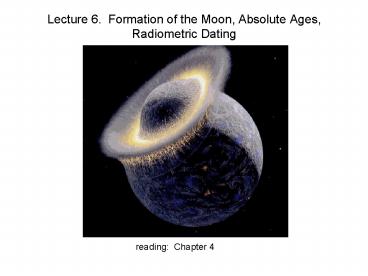
- Giant Impact Hypothesis
- Planetesimal or planet struck the Earth just
after it formed. - Ejected large volumes of hot material into
orbit. - Disk of ejected matter formed, condensed into
the Moon.
3
Observations of the Moon
- What did Apollo find?
- age of the moon is 4.5 Ga (same age as the solar
system). - Moon rocks dry (contain very little water, or
other volatiles). - Moon is less dense than the Earth
- Moon 3.3 g/cc
- Earth 5.5 g/cc
- - Earth has a large iron core, Moon does not.
- - Moon has same ratio of oxygen isotopes as the
Earth. - - Moon is unusually large compared to other moons.
4
Rejecting Hypotheses
- 1. Fission Hypothesis
- Earth would have had to spun much faster - not
likely. - Moon lacks volatiles - water, Pb, Au.
- Capture Hypothesis
- Moon would have to be traveling very slow -
unlikely. - Moon would have very different composition - not
seen. - Moon lacks volatiles - water, Pb, Au.
- Moon lacks a core.
- Condensation Hypothesis
- Moon is too large - 1/4 Earths diameter.
- Most other moons thought to have formed this way
are small. - Moon lacks volatiles - water, Pb, Au.
- Moon lacks a core.
- Giant Impact Hypothesis
- Explains lack of volatiles, size, composition,
lack of core.
5
Giant Impact Hypothesis
Mars sized, grazing impactor. Melted the
surface Ejected molten crust and mantle into
space. Molten material formed a ring of
asteroids. Asteroids accreted to form the
Moon ..movie .. simulation so how old is the
Moon and the Earth??
6
Sedimentary Rocks
Erosion (wind, water, chemical) produces
sediment Sediment grains carried deposited in
different location Sediments - often form flat
layers - made of sand, silt, mud - can trap
organisms or their remains - fossils Fossils can
be - tracks - physical traces - chemical
traces - morphological traces - macroscopic or
microscopic
7
Igneous Rocks
Molten rock that cools and solidifies - if it
erupts on the surface lava - if it is below the
ground magma
basalt Mg and Fe rich Hawaii
granite Si rich Cascades, Sierra Nevadas
8
Metamorphic Rocks
- Sedimentary or igneous rocks
- Have been heated to high T or subjected to high P
- - not quite enough to melt
- - minerals in the rock change
- - often see original layering
gneiss
marble
deformed shale
9
Rocks Contain Minerals
augite/clinopyroxene
garnet clinopyroxene
calcite CaCO3
Atlas of Igneous Metamorphic Rocks
quartz SiO2
10
Geological Record / Rock Record
- Hadean - Greek God of the underworld
- - abundant impacts
- - life??
- Archean - ancient life
- minimal evidence of life
- microbial life
- - oceans and continents different
- Proterozoic - earlier life
- - appearance of oxygen
- - gradual increase in oxygen
- - multi-cellular life (algae)
- Phanerozoic - visible life
- - multi-cellular animals
- - plants
- - fungi
- colonization of land
- most eons defined arbitrarily
- except for the Phanerozoic
11
The Phanerozoic
- 3 eras in the Phanerozoic
- Paleozoic - old life
- - 543-248 Ma
- - origins of multi-cellular
- animals
- - origins of plants
- - colonization of land
- - C, O, S, D, C, P
- Mesozoic - middle life
- - 248-65 Ma
- time of the dinosaurs
- T, J, C
- Cenozoic - recent life
- - 65 Ma to present
- - age of the mammals
12
Absolute Ages Through Radiometric Dating
Before the 1950s ages were all
relative. Radioactive isotopes are unstable,
spontaneously decay to stabler elements. Parent
Daughter Half-life 238U 206Pb 4.47
Ga 40K 40Ar 1.25 Ga 87Rb 87Sr 48.8
Ma 26Al 26Mg 700,000 years 14C 14N 5,730 years
238U
time
Half-life time for half of the starting
material to decay to the daughter element Amount
of 206Pb in the rock depends on - amount of
starting 238U and 206Pb - time
238U 206Pb
13
Radioactive Decay
Is a probabilistic process. Any particular atom
will have a 50 chance of decaying during the
first half life.
1.25 Ga
another 1.25 Ga
1 µg 40K (parent) 1/2 µg 40K 1/4 µg 40K 0 µg
40Ar (daughter) 1/2 µg 40Ar 3/4 µg 40Ar
another 1.25 Ga
1/8 µg 40K 7/8 µg 40Ar
14
Radiometric Dating of Rocks
Measure the amount of 40K and 40Ar in the
rock. Assume all 40Ar came from 40K (this is
reasonable - Ar is a gas not normally found in
rocks). Calculate the age, calculate the of
half lives current amount 1 (amount
of radioactive original amount 2
material in the rock) Can use different
parent-daughter pairs depending on your
sample. 14C only useful for objects lt50,000 years
old. 238U only useful for the oldest rocks on
Earth. Chose the pair with the most parent and
daughter contents. Note that the Age date that
the mineral in the rock formed.
t/thalf
(
)
15
Radiometric Dating of Rocks, cont.
Note that the Age date that the mineral in the
rock formed. Is this method useful for
sedimentary rocks?
16
Age of the Solar System
- Determine radiometric age of the oldest rocks in
the solar system. - 4.55 0.02 Ga
- 4.6 Ga Meteorites
- - left from from accretion
- carbonaceous chondrites (86 of stony
- meteorites)
- minerals formed during the
- process of accretion
- 4.5/4.4 Ga Moon
- - oldest minerals on the moon
- - when the moon formed minerals crystalized from
molten material
17
Age of the Earth
Oldest rocks are 4.0 Ga. Heavily
metamorphosed. Older mineral grains in
sedimentary rock are 4.4 Ga (zircon mineral
grains, ZrSiO4) Rock ground, grains
separated. Put under SHRIMP sensitive
high-resolution ion micro-probe Zap with a ions
to vaporize a bit of the mineral Separate out the
atoms with a mass spectrometer bent magnet Count
238U and 208Pb (plus 204Pb, 206Pb,
207Pb) Estimate original Pb content, calculate
how much has decayed (age). Is the Earth
younger than the solar system?
18
Earth is an Active Planet
Water, erosion, plate tectonics.
19
Lecture 7. The Hadean Earth, heavy bombardment,
origin of the atmosphere and oceans
reading Chapter 4
Recommended

