

Gas Power Cycle - Jet Propulsion Technology, A Case Study PowerPoint PPT Presentation
1 / 8
Title: Gas Power Cycle - Jet Propulsion Technology, A Case Study
1
Gas Power Cycle - Jet Propulsion Technology, A
Case Study
2
Ideal Brayton Cycle (YAC 7-7)
An closed ideal Brayton Cycle is used to model an
open Gas Turbine cycle using the air statndard
assumptions
- 1-2 Isentropic compression
- 2-3 Constant pressure heat addition
- 3-4 Isentropic expansion
- 4-1 Constant pressure heat rejection
3
Air Standard Assumptions
- Another common assumption used is that the air
has constant specific heats - equal to specific heats at room temperatures.
- When this is also used they are collectively
referred to as the - cold-air-standard assumptions
Mod 11/15/01
4
Ideal Brayton Cycle - 2
5
Gas Turbine Improvements
- Increase the gas combustion temperature (T3)
before it enters the turbine since hth 1 -
(T4/T3) - Limited by metallurgical restriction ceramic
coating over the turbine blades - Improved intercooling technology blow cool air
over the surface of the blades (film cooling),
steam cooling inside the blades. - Modifications to the basic thermodynamic cycle
intercooling, reheating, regeneration - Improve design of turbomachinery components
multi-stage compressor and turbine configuration.
Better aerodynamic design on blades (reduce
stall).
6
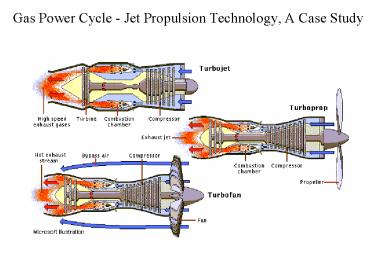
Jet Propulsion Cycle
4
T
Pconstant
qin
- 1-2, inlet flow decelerates in the diffuser
pressure and temperature increase - 5-6, outlet flow accelerates in the nozzle
section, pressure and temperature decrease
3
5
6
2
qout
Pconstant
1
s
7
Propulsive Power
Jet Engine
Mass flow out
Action force, FA
Mass flow in
Inlet velocity, Vin
Exit velocity, Vexit
Reaction force, FR
8
PW8000 Geared Turbofan Engine
- Twin-spool configuration H-P turbine drives H-P
compressor - L-P turbine drives L-P compressor, on separated
shafts - Gearbox to further decrease the RPM of the fan
- More fuel efficiency
- Less noise
- Fewer engine parts
From Machine Design Magazine Nov. 5, 1998
Recommended

