

Professional Misconduct In The Medical Domain PowerPoint PPT Presentation
1 / 26
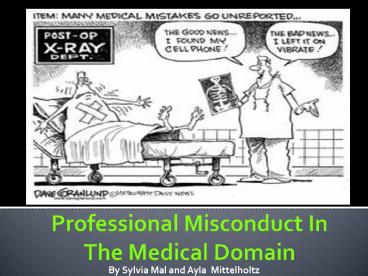
Title: Professional Misconduct In The Medical Domain
1
Professional Misconduct In The Medical Domain
- By Sylvia Mal and Ayla Mittelholtz
2
Definition
- Medical Malpractice
- An act or omission by a health care provider
which deviates from accepted standards of
practice in the medical community and which
causes injury to the patient
3
Statistics
- Up to 100,000 US patients die each year because
of preventable adverse effects - Proportion of hospitalized patients affected by
medical errors estimated to be 5-10 - it has
approached 50 in some studies - Mizrahi found that 47 of internal medicine
residents reported making serious errors during
their training
4
Techniques of NeutralizationSykes and Matza
(Thio)
1. Denial of Responsibility
2. Denial of Injury
3. Denial of the Victim
4. Condemnation of the Condemners
5. Appeal to Higher Loyalties
5
Denial Of Responsibility
- The act is justified because the individual has
no control over it
6
Denial Of Injury
- Individuals claim that no one was harmed so
nothing deviant or wrong has occurred
7
Denial Of The Victim
- The individual argues that whoever is harmed by
the deviance deserves the harm
8
Condemnation Of The Condemners
- The Individual claims that those who disapprove
of the act are hypocrites who have done much
worse
9
Appeal To Higher Loyalties
- The individuals attachments to norms other than
those of the larger society hold preeminence
10
Four Models of the Physician-Patient
Relationship
1. The Paternalistic Model
2. The Informative Model
3. The Interpretive Model
4. The Deliberative Model
11
The Paternalistic Model
- The physician-patient interaction ensures that
patients receive the intervention that best
promote their health and well-being - Doctors try to find medical tests and treatments
that are most likely to restore patients health - Promoting the patients well-being independent of
the patients current preferences
12
The Informative Model
- The physician presents all relative information
to the patient and the patient selects the
medical intervention he/she wants
13
The Interpretive Model
- Supplying relevant information
- Helps to define patient values by suggesting what
medical interventions should be given
14
The Deliberative Model
- Aim of the physician-patient interaction is to
help the patient determine and choose the best
health related values - Physician and patient engage in deliberation on
what kind of intervention should take place - Physician is seen more as a friend
15
5th Model of Physician-Patient ModelThe
Instrumental Model
- The patients values are irrelevant
- The physician aims for some goal independent of
the patient - E.g. Furtherance of scientific knowledge
(Tuskegee syphilis experiment)
16
Trust
- Trust provides moral foundation for any
physician-patient relationship - There is a need for patients to trust their
physicians because of the knowledge gap that
exists between them - Society tends to trust physicians to understand
the need to respect patients and act in their
best interest
17
Informed Consent
- Seen as not merely a legal requirement and not
merely a formality it is a substantial
requirement of morality (Baylis et al., 2004) - Medically valid consent includes giving the
patient all the information required in order to
make a responsible decision
18
Misdiagnosis Case
- Darrie Eason Misdiagnosed with cancer
- Because of mislabeled tissue sample that led to a
misdiagnosis, Darrie had both of her breasts
removed to save her from a cancer that she never
had
19
Surgical Errors
- A second major issue within medical malpractice
is when patients leave the hospital with surgical
instruments inside them - Some studies have discovered that leaving
instruments inside people is more likely to
happen under stressful situations such as
emergency operations - It is believed that there could be many cases
that never get reported because patients never
find out and are unaware of the medical mistake
20
Surgical Errors - Case
- Victor Hutchinson
- 76 year old
- Father of five
- Heart bypass surgery in September 2003
21
(No Transcript)
22
Theoretical Perspectives
- Labeling Theory (Gomme Chapter 6)
- Patients who enter medical hospitals and
especially mental hospitals tend to be
stigmatized into a deviant sick role - Throughout the process of stigmatization patients
gain a notion of having a master status of a sick
person - With this master status comes a feeling of
dependency on doctors and health care providers
23
Theoretical Perspectives
- Quinneys Conflict Theory (Gomme Chapter 8)
- 3 of the 6 propositions
- Crime is a definition of human conduct that is
created by authorized agents in society - Criminal definitions describe behaviors that
conflict with the interests of the segments of
society that have the power to shape public
policy - Criminal definitions are applied by the segments
of society that have the power to shape the
enforcement and administration of criminal law
24
Theoretical Perspectives
- Functionalism Durkheim (Gomme Chapter 4)
- Crime is functional in society because it
promotes solidarity, collective consciousness,
and change - When medical malpractice occurs it forces society
to change the way the health care system is run - It forces doctors of all kinds to be more
cautious throughout all stages of medical
intervention
25
Medical Malpractice
26
Discussion Questions
- In the Greys Anatomy clip, Dr. Burke is dealt
with leniently, do you feel that this happens
frequently when doctors make mistakes? - Do you think there should be stricter protocols
when medical errors occur? - Do you feel that something should be done to
break the physician-patient barrier? Do you feel
doctors should be more attentive to their
patients needs?
Recommended

