

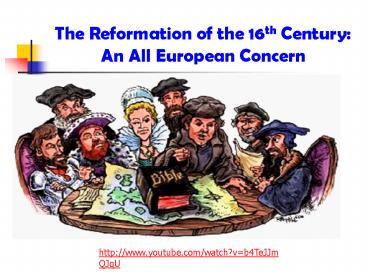
The Reformation of the 16th Century: An All European Concern PowerPoint PPT Presentation
1 / 22
Title: The Reformation of the 16th Century: An All European Concern
1
The Reformation of the 16th CenturyAn All
European Concern
http//www.youtube.com/watch?vb4TeJJmQJqU
2
Grace
Faith
Christ
Did Medieval Christians Hold to These?
Yes!! Of Course They Did! So What was the
Reformation About?
3
The Reformation of the 16th Century
- Reformation Age terminology
- catholic
- means universal
- encompasses Trinitarian-Christological orthodoxy
- thus all classic Christians (Protestant,Roman
Catholic, Eastern Orthodox)are catholic in
THIS sense of theword think of the affirmations
of theNicene Creed - evangelical
- the original designation of the Reformation
movement - focuses on the positive dimension of the
movement - the idea of proclaiming the Gospel (good news
from Greek euangelion) of Christ - the movement in all its tributaries saw the
needfor reform in the Church especially
concerningthe creedal article the forgiveness
of sins - protestant
- originally a political designation
- 1529 overture of Evangelical Princes in the Holy
Roman Empire protesting the harsh measures of
Emperor Charles V against their territories and
hence Protest - ant
4
- One needs to keep in mind what was going on
contextually - dawn of the 16th century
- time of great socio-cultural changes in Europe
but also - ecclesiastically, everyone concerned with the
life of the Church thought reform of some kind
was needed NOW - remember Lateran V called by Julius II (who did
not really want to call it but felt pressure)
which said that reform was necessary in head and
members - the question by 16th Century Christians of the
church catholic in the Latin West - does the church catholic need only r moral
reform (Roman position) - OR is R doctrinal Reform necessary in the
church catholic as well as r moral reform in
order to clarify the true Gospel (Evangelical
position)
Pope Julius IIFountain Penby Montblanc
5
- TWO main streams arose out of the concern by 16th
century European Christians that vital reform was
needed for the Medieval Latin Western CHURCH
CATHOLIC the ROMAN (yes, Rome had a
reformation) and the EVANGELICAL (which itself
has FOUR tributaries) - Roman (Council Trent small r reform)
- Evangelical
- Lutheran
- Reformed (Calvinism)
- Anglican an intriguing story tied of course to
political events in England YET NOTE that the
original Reformation Anglicanism seen in
Archbishop Cranmers Book of Common Prayer and 42
Theological Articles (which would become The 39
Articles under Elizabeth) was tied to the
Reformed in a number of ways but with a classic
episcopal polity and a historically traditional
liturgical structure - Anabaptist the most radical in seeking change
YET the Evangelical Anabaptists did uphold the
Trinitarian and Christological beliefs of the
church catholic and the solae of the Reformation
6
- Christian Salvation andthe Medieval World
- Previous calls for Reform in a R fashion come
close in some ways to the Reformation solae but
the solae dont truly have full voice until the
16th century with Luther and the other Reformers - PRE-REFORMERS? yes in a way ex. WALDES (13th
c.), JOHN WYCLIFFE (14th c.), GREGORY OF RIMINI
(14th c.), TH. BRADWARDINE (14th c.), and JOHN
HUS (15th c.) - a number of the reform movements coming from
these men (esp. Waldes, Wycliffe, and Hus)
continued into the Reformation era andthe
people in them eventually merged with established
evangelical groups
7
- Christian Salvation and the Medieval World
- Augustines mixed legacy
- iustificare a status and a process Augustine
did not work with the Greek text so he did not
see the contextual nuances of the Greek word for
justification diakasûné - YET it is crucial to note that in Augustine,
while justification and Christian growth are
somewhat twinned, there is the VERY STRONG
emphasis that ALL IS OF GRACE!!! - REMEMBER WITH THIS No express conciliar or
creedal statement on justification prior to the
16th Century
8
- Christian Salvation and the Medieval World
- Justification before God as seen in theHigh
(1000-1300) and Late (1300-1500) Middle Ages - the dominant soteriological ( doctrine of
salvation) view was the infused righteousness
model - some like Thomas Aquinas more oriented toward
sovereign grace -- some like Gabriel Biel more
oriented toward human free will - the donum superadditum lostin the Fall leads to
need for new righteousness our deprivation
seen as very strong by Thomas weaker for Biel - from Aristotle (whom almost all the medieval
scholastic doctors used) like is known by like
one moves toward the goal (telos) of the hoped
for like by habitus (new habitat leading to new
habits)
9
- Christian Salvation and the Medieval World
- Justification before God as seen in the "High"
(1000-1300) and "Late" (1300-1500) Middle Ages - the dominant soteriological viewwas the infused
righteousness model - sacramental system as means ofinfusing grace
into a person initial sacrament of baptism
starts the habitus - a strong sacerdotal soteriology sacraments
mediated through the priesthood in the church
from womb to tomb (Lateran IV in 1215 announces
the Seven) - the operating sacramental grace leads to
cooperating grace seen in works of love where
one is becoming like God habitually and thus is
brought to full rightness before God in a
processive way
10
- Christian Salvation and the Medieval World
- Justification before God as seen in the "High"
(1000-1300) and "Late" (1300-1500) Middle Ages - the dominant soteriological viewwas the "infused
righteousness" model - Late Middle Ages tilts strongly in the Biel
direction (focus on cooperating grace and works
operating grace still there but in a do what
lies within you orientation) Luthers direct
historical context - God will not deny grace to the one who does
what lies within himself . - Christ the Judgew/sword and lily
- Koldes Mirror
- the viator status
11
- Ladder of Virtues Heaven
- angels
- charity
- hermit
- monk in a cloister
- mendicant monk
- nun
- priest
- laywoman
- soldier
- demons
- Earth
- Whoever falls can start climbing againthanks to
the remedy of penance
hope
faith
12
(No Transcript)
13
- Martin Luther (1483-1546)
- Luther's "pilgrimage" to his "Reformation
Breakthrough" - early years Eisleben, Magdeburg/Eisenach,Erfurt
(BA MA in shortest time possible) - post-grad Erfurt Law then the thunderstorm
- Erfurt still 1505 (monastery) and1507
(ordination) - Augustinians recognize his abilities1510
(Rome), 1511 (school in Wittenberg), 1512
(doctorate and professorship) - in his teaching, gradual movement away from
Medieval four-fold method of exegesis to a more
textual-grammatical-historical-redemptive based
method - seen in his lecture courses of the 1510s
- 1513-1514 (Psalms)
- 1515 (Romans)
- 1516 (Galatians)
- 1517 (Hebrews)
- 1518 (Psalms again)
14
- Martin Luther (1483-1546)
- Luther's "pilgrimage" to his "Reformation
Breakthrough" - his struggles and his breakthrough (1510s)
- anfechtüng (seen all the way back to early 1500s)
- overwhelming anxiety, dread in response to
reflection on the righteousness and holiness of
God (iustitia Dei) the Medieval teaching
whenever one encounters the idea of the
righteousness of God, one must see God as
righteous judge who by the very right of His
holiness condemns all unrighteousness teaching
terrified Luther - YET one needs to be careful here
- ALTHOUGH Luther truly faced these struggles and
anxieties, he also NEVERTHELESS lived a very
normal healthy life at the monastery in the midst
of them his fellow Augustinians fully
recognized this and in fact kept giving him
preferments - the importance of Johann von Staupitz instead
of focusing on contrition and what satisfactions
are necessary in confession, focus on Christ and
His cross
15
- Martin Luther (1483-1546)
- Luther's "pilgrimage" to his "Reformation
Breakthrough" - his struggles and his breakthrough (1510s)
- his development in the early professorial years
of the 1510s (AND YES HE WAS BECOMING FAMOUS EVEN
BEFORE THE 95 THESES) a growing concern and
awareness that something was wrong with the
infusion model especially as had been taught
him (but also overall) -- so - step 1 a look to the mystics
- step 2 a theology of humility
- step 3 finally, a new view of
justification/righteousness (diakasûné) comes in
-- a new appreciation about what is meant by
Gods righteousness/ justice (iustitia Dei) and a
corresponding criticism of the teaching on
justification and faith from the scholastic
doctors of the Medieval centuries especially in
what he deemed an overuse of Aristotelian
categories (he was not being anti-reason here
but thought that the tail had come to wag the
dog)
step i moved him away from cooperation to
contemplation on Gods love and our response of a
total burning and passionate love but he knew in
his sin he couldnt love God like that step ii
brought a change from looking at the xn life in
terms of virtues gained on a balance sheet to
looking at it in terms of need for grace and
living under grace in X in humble morality BUT
still within a strongly infused way of speaking
16
- Martin Luther (1483-1546)
- Luther's "pilgrimage" to his "Reformation
Breakthrough" - his struggles and his breakthrough
- Luther viewed his quest to see the grace of God
as not merely personal but catholic - it was consonant with his own calling as a
"Doctor of Sacred Scripture - he was continuing the conversation of 1500 years
a conversation that was always to be obedient
to Gods Word in the Bible - STILL, it was also personal
- Luther had tried the three primary ways of piety
that teachers contended could lead one to peace
with God and found them all wanting - those ways monasticism, mysticism, moralism of
a Renaissance kind - indeed after trying them all
- he found only an angry vindictive God who
punished the sinner b/c of the sinners
unrighteousness (God had the right to do this) - BUT all this made it virtually impossible for the
sinner to be right with the one true God and find
peace in Him because the demand to be like God
was so enormous
17
- Martin Luther (1483-1546)
- The Reformation Breakthrough
- the 1545 autobiographical fragment
- turmerlebnis (tower experience) sometime between
1513 and 1518 - note the concern not only with Scripture but
with the Fathers (in particular Augustine
remember as said before that even with the mixed
legacy, Augustine always emphasized grace) - faith is no longer seen as a virtue to be
formed over time but rather as open handed
trust in a totally free gift of grace found
solely in Jesus Christ - iustitia Dei (Romans 117) testament rather
than pact meaning of diakasûné in Romans as
declared given a gift - what of good works yes we do them but because
therefore instead of if then
18
- Martin Luther (1483-1546)
- The Reformation Breakthrough
- rocking the late 1510s
- three disputations
- a true scholastic life should see less Aristotle,
more Bible as well as Augustine and other Church
Fathers - the true treasure of the church
- a true theology theology of the cross
- three debates well one debate sandwiched
between two no debate, just recant - the material principle
- sola gratia, sola fide, solo Christo
- "passive" or alien righteousness as a KEY idea
our active or proper righteousness only
follows and never contributes to justification
before God - imputation (declared counted as
forgiveness AND clothing Gen 156)
19
- Martin Luther (1483-1546)
- the Reformation of the 1520s
- the Three Reformation Treatises of 1520
- the increasing emphasis on sola scriptura (the
formal principle) - sola NOT nuda
- already with Eck at the Leipzig debate of 1519
- the stand before the Emperor at Worms
- translating in the castle of the birds
- the Word did it all
- the continuing emphasis on grace
- debating Erasmus
- a testament
- The Smaller Catechism
- Augsburg 1530 letting Master Philip have the
first standardized Confessional word
20
So Medieval/Tridentine View
Christs Blessed Merits (and
indeed to some degree the
merits from the treasury of the
saints) brings
Operating Grace by the Spirit through
the Church
via the Sacraments to
the faithful recipient
(one who accepts
church teachings) who thenvia cooperating
grace works with this infused substance/operation
al grace which over timebrings full
justification justification and sanctification
twinnedC GO (Sacr) F CGW over time
J (final full) Final Faith
Formed by Charity/Love Infused and Cooperated
when this happens one is now in a fully just
state because one is in a creaturely way indeed
righteous as one stands now before the righteous
God like is known by like.
21
Reformation View Christ has completely
Merited/Accomplished Salvationthrough His Once
For All Death and Resurrection through the Word
preached and the (2 Dominical)sacraments (Gods
visible words) rightly administered the Holy
Spirit brings Christ and His benefits to a person
SO Grace (the unmerited favor of God) ALONE
received through Faith (trust not in my
faith BUT in Gods promises) ALONE because of
and resting on Christ (WHO He is and What He
has done as SOLE MEDIATOR) ALONE brings
Justification (right standing before God
through the imputed merits of Christ ALONE and
thus both forgiveness and clothing in the
righteousness of Christ)which leads to Good
Works done in GRATITUDE (sanctification)
(because of NOT in order to)Heidelberg Catechism
of 1563 Guilt ?Grace ? Gratitude
22
Reformation View continuedG(A) F(A) b/c C(A)
J GW
(Gratitude)Faith totally rests on Christs
work (justified through faith NOT by or
because of faith propter Christum) also if
the medieval scholastic form language used (and
generally it is not but it can be) TRUST not love
would be the form of faith thus faith would
be formed at the beginning of the Christian
pilgrimage b/c of Christ and our growth in love
would be the RESULT of true faith in Christ.
Recommended

