

The Effect of Turbulence on GPS Signals: Theory and Measurements PowerPoint PPT Presentation
1 / 34
Title: The Effect of Turbulence on GPS Signals: Theory and Measurements
1
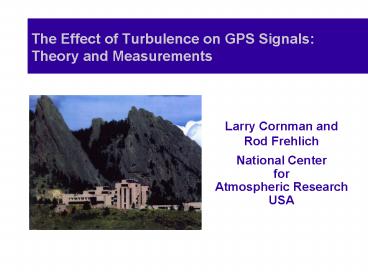
The Effect of Turbulence on GPS SignalsTheory
and Measurements
- Larry Cornman and Rod Frehlich
- National Center
- for
- Atmospheric Research
- USA
2
Measurements of Turbulence from GPS Signals
- Is there signal in the signal?
- or
- What is one persons noise is anothers signal
GPS/MET occultation through turbulence?
3
Theoretical Background for GPS Occultations
Through Turbulence
- As a microwave signal passes through a field with
fluctuating index of refraction, the signal
amplitude and phase will fluctuate. - The statistics of the fluctuations can be
calculated for certain conditions.
4
- Occultation Geometry
R is the distance from the GPS to the LEO, and z1
is the distance from the GPS to the turbulence.
5
Assumptions
- Narrow angular scattering by turbulence.
- Parabolic wave equation is valid.
- Background gradient in refractive index has
linear dependence over scattering region (tilt
only no focusing). - Locally homogeneous turbulence.
6
Assumptions, cont.
- The transmitter and receiver velocities are
constant over the sampling time. - Ionospheric effects are negligible
- Effects of attenuation can be removed by
detrending.
7
Phase Screen Approximation
- Turbulence occupies small region compared to path
length - GPS signal experiences only phase fluctuations
after passing through turbulence - Intensity fluctuations grow with distance from
the turbulence from interference of scattered
waves
8
GPS Measurements
- Electric field at the receiver
- A(x,R) - amplitude
- S(x,R) - phase
9
Accuracy of the Mean Estimates
- Variance of mean amplitude over measurement
length L - Leff - effective correlation length
- Defined by correlation of A
- is the number of independent samples
10
Effective Correlation Length
- For homogeneous turbulence
- ltAgt - ensemble average of A
- s,r - distance along receiver track
11
Scintillation Statistics
- Normalized amplitude fluctuations (modulation
index) - normalized amplitude spectrum
12
Weak Scattering Theory
- Normalized amplitude fluctuations are small mlt0.5
- Phase screen statistics are isotropic
- Amplitude and phase spectrum have simple form
13
- Occultation Geometry
R is the distance from the GPS to the LEO, and z1
is the distance from the GPS to the turbulence.
14
- Theoretical amplitude frequency spectrum in the
coordinate system of the GPS - Where, the effective velocity is
15
- Spectrum of phase fluctuations under the phase
screen approximation - is the local spectrum of the
- refractive index
fluctuations. - Using a von Karman spectrum gives
16
Theoretical phase frequency spectrum in the
coordinate system of the GPS
17
- Therefore, the proportionality between the
measured amplitude spectrum and the turbulence
spectrum given all the inherent assumptions
is - Where is the integral from above.
- The phase spectrum has a similar structure.
- The turbulence intensity information is contained
in the term , which unfortunately is a
function of the unknown size of the turbulent
region.
18
EXAMPLES OF GPS TURBULENCE
- GPS/MET data from upper troposphere, lower
stratosphere - Negligible humidity effects.
- Altitude of commercial transport aircraft in
cruise. - Amplitude time series (SNR) was detrended
(normalized by best-fit polynomial). - Phase time series was detrended (subtracted best
fit polynomial). - Amplitude and phase spectrum compared to theory.
19
- Occultation 546 Raw Amplitude and Altitude (via
phase)
20
- Occultation 546 Raw and detrended amplitude
21
- Occultation 546 Raw and detrended phase
22
- Occultation 546 Amplitude and Phase Spectra,
- Measured and Model
23
Occultation 586 Raw Amplitude and Altitude (via
phase)
24
Occultation 586 Amplitude and Phase Spectra,
Measured and Model
25
Occultation 641 Raw Amplitude and Altitude (via
phase)
26
Occultation 641 Amplitude and Phase Spectra,
Measured and Model
27
Application to Aircraft Platforms
- Unfortunately, the number of GPS-LEO occultations
is limited and hence not very useful in an
operational sense. - What about using GPS receivers on commercial
aircraft?
28
Turbulence Scales of Motion
Turbulent eddies
Large eddies
Small eddies
10s km
cm
Aircraft responds to scales from few m few km
energy cascade
Energy
turbulence
no turbulence
Mesoscalemodelresolution
NWPresolution
1 eddy size
29
Theoretical Amplitude and Phase Spectra for an
Aircraft 50 km from Turbulence
Noise Floor From GPS-Met
30
Aircraft Flight Track with GPS Occultations
31
Aircraft Flight Track with GPS Occultations
32
Elevation angle from Aircraft to Intersection
Point
Angle, In Deg.
-
33
3 Hours of MDCRS Data (Met reports from
commercial aircraft)
34
Summary
- Occultation data from GPS-MET is consistent with
theoretical turbulence and scattering models
especially amplitude data. - Aircraft platform seems to be feasible more
work is required to fully understand the issues.
Recommended

