

Assessing smallholder Participation in Vegetable value chains tomato, bell pepper, cucumber, broccol PowerPoint PPT Presentation
1 / 20
Title: Assessing smallholder Participation in Vegetable value chains tomato, bell pepper, cucumber, broccol
1
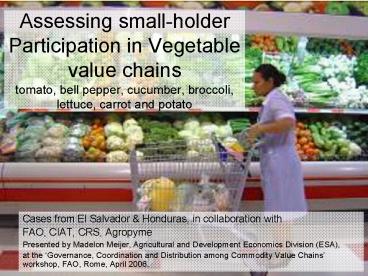
Assessing small-holder Participation in Vegetable
value chainstomato, bell pepper, cucumber,
broccoli, lettuce, carrot and potato
- Cases from El Salvador Honduras, in
collaboration with - FAO, CIAT, CRS, Agropyme
- Presented by Madelon Meijer, Agricultural and
Development Economics Division (ESA), - at the Governance, Coordination and Distribution
among Commodity Value Chains workshop, FAO,
Rome, April 2006.
2
Structure of the presentation
- Purpose of the study
- Brief note on the methodology used
- Results of the analysis
- Points of reflection/discussion
3
Purpose of the study
- Confront the barriers of linking small farmers
with the supermarket supply chain - ?
- Identify bottlenecks
- Facilitate strategic alliances
4
General scheme for value chain analysis and
intervention plan (from SNV-Peru)
5
Analysis
Define the space of analysis Territory
Product
Product flow
USE OF NATURAL RESOURCES
INFLUENCE OF EXTERNAL FACTOR
- SINTHESIS OF ANALYSIS
- Competitiveness
- Comparative advantages
- Bottlenecks
- Sustainability
ACTORS AND INTERRELATIONS
Production
Wholesale
Retail
Consumption
Services
HISTORY
MARKET AND CONSUMER DEMAND
6
Evolution of the relation supermarket producer
7
Vegetable chain in Honduras
Supermarket n51 43 FM
8
COHORSIL 185 members Annual sales US
89.000
APRHOFI 110 members Annual sales US
184.000
ACOPO 23 members Annual sales US
140.000
PHOC 143 members Annual sales US 96.000
AGROLEMPA 70 members Annual sales US
177.000
9
Growth of the lead farmer model
10
Analysis
- Margins, costs and benefits
- Gap analysis requirements vs. what small farmers
can currently offer - NRM Impact
11
1. Distribution of final consumer price among
supply chain actors in Honduras
12
Tomato, wholesale price in TGU y SPS
(Lps/Lb)
9.00
Perí
odo de
análisis de precios en la cadena
ZONAL BÉLEN
8.00
MEDINA CONCEPCIÓN/DANDY
7.00
6.00
5.00
4.00
3.00
2.00
1.00
2004
2005
0.00
Jan 04
Jan 14
Jan 25
Aug 06
Aug 16
Aug 24
Sep-03
Sep-13
Sep-21
Oct-01
Oct-11
Oct-22
Nov-02
Nov-12
Nov-22
Nov-30
Dec 10
Feb-04
Feb-14
Feb-22
Apr 01
Apr 11
Apr 20
Apr 29
Jun-07
Jun-17
Jun-27
Jul-05
Jul-15
Jul-25
Mar-04
Mar-14
May-10
May-20
May-30
Date
Fuente www.agroemprendedor.org, basado en
precios SIMPAH
13
Tomato (03 april 2005- 04 june 2005)
Lps/Libra
12.00
10.00
8.00
Wholesaler SELL max. average
7.48
6.00
Wholesaler SELL average
4.55
4.00
Wholesaler SELL min. average
2.48
2.00
-
Los precios Mayorista VENTA máximo promedio,
promedio y mínimo promedio corresponden a un
período de dos años Los demás valores corresponde
n a valores promedio de diferentes actores en
cada eslabón en diferentes ciudades para el
período del 03 de abril al 04 de junio del 2005.
14
Resumen de aspectos relevantes en la cadena de
Tomate de mesa
Técnicos
Comerciales
- La plántula para el transplante es producida
principalmente en invernaderos comerciales. Dado
el alto costo de la semilla híbrida, esta
práctica es cada vez más común. - Los suelos deben estar bien nivelados para
obtener un buen drenaje y reducir la incidencia
de enfermedades. Se prefieren los suelos sueltos
en época lluviosa. - Los tomates para el mercado fresco son cultivados
en forma arbustiva, con soporte y cosechados en
estado verde-maduro (aproximadamente de 80 a 110
días después del transplante). - En la zona de siguatepeque, se utiliza mayormente
el riego por goteo, con rendimiento promedio de
42 toneladas por hectárea (60 de primera calidad
y el 40 de segunda o tercera). - Las principales enfermedades son mancha
bacteriana, tizón temprano y tizón tardío
(Xanthomonas campestres, Alternaria solani y
Phytophthora infestans respectivamente). - Se debe transportar al mercado de destino
clasificados en canastas.
- Los supermercados en Hondura demandan 28.5
Toneladas por semana. - La presentación de mayor venta es a granel.
También se encuentra empacado en bandejas de foam
2 (cinco a seis tomates) y en mallas plásticas
(pesos variables). El peso promedio por unidad es
de 130 gramos en bandeja y de 232 gramos a
granel. - La única marca Hondureña es Zamorano, las demás
marcas son importadas de Guatemala (La Carreta,
San Lucas Fresh y BELUGAS). - LA CARRETA y BELUGAS (San Lucas Fresh) están
certificados por la PIPAA de Guatemala en cuanto
a inocuidad de alimentos que garantiza el
cumplimiento con buenas prácticas agrícolas
(BPAS) y buenas prácticas de manufactura (BPM). - Las normas de calidad para comercializar tomate
manzano exigen forma y tamaño uniforme, turgente,
libre de enfermedades, libre de daño mecánico,
con un mínimo de 50 de coloración roja, sin
deformaciones, sin sucio. - El precio por caja de 25 libras es de USD 4.62
para el tomate de primera y de USD 2.56 para el
tomate de segunda. La variación de precios se
puede apreciar en la gráfica adjunta.
15
Required investment - tomato
16
3. NRM impact
- To meet requirements Investment needed in
- Management techniques
- waterharvesting and drip irrigation
- contour planting
- soil conservation / IPM / GAP
- Organizational issues
- scaled planting
- post-harvest management
- marketing
17
Vegetable chain in Honduras
THE ENABLING ENVIRONMENT
70s Veg.production on scale
MINAG agricultural policy
Competitive framework for the horticultural
sector
CAFTA
Imports
Ag. hhs 317.000 Veg. producers 15.000
Supermarket n51 43 FM
Specialized wholesaler
Large producers 0.12
Restaurant
Lead farmer n13
Hotel
Medium producers 24.6
Producer organization n395
Hospital
Small producers 72
Traditional retailer
Traditional wholesaler
Unorganised farmer
Traditional informal trader
HARVESTER COORDINATION
STORAGE BULKING UP
ROAD TRANSPORT
ORGANIZATION
LABELS AND STANDARDS
BUSINESS SERVICES
QUALITY CONTROL
MARKET INFORMATION
TECHNOLOGICAL EXTENSION
PACKAGING
CEL PHONES
18
Conclusions
- Regarding horizontal coordination Low
levels of organization among small holder
producers - Regarding vertical coordination Lack of
coordination among supply chain actors - Regarding the enabling environment Public
policies of of step with chain reality
19
Main recommendations
- strengthen the espacios de concertación.
- develop alternative organizational models
- improve the linkage between supply and demand of
service provision, esp. financial services
(credit, leasing, compra de facturas and ag.
insurance) - improve public policies, aimed at both making the
chain more competitive and with a fair
distribution of benefits
20
Discussion points
- Replicability of PO support
- Experience in alternative organizational /
business models - Implications for policy
- Further empirical work required
Recommended

