

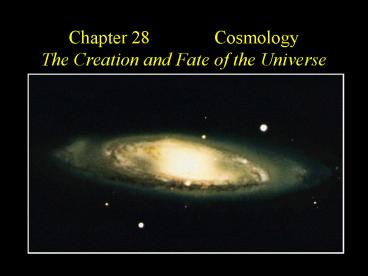
Chapter 28 Cosmology The Creation and Fate of the Universe PowerPoint PPT Presentation
1 / 28
Title: Chapter 28 Cosmology The Creation and Fate of the Universe
1
Chapter 28 CosmologyThe Creation
and Fate of the Universe
2
Guiding Questions
- What does the darkness of the night sky tell us
about the nature of the universe? - As the universe expands, what, if anything, is it
expanding into? - Where did the Big Bang take place?
- How do we know that the Big Bang was hot?
- What was the universe like during its first
300,000 years? - How is it possible to measure how the universe is
curved? - What is dark energy?
- Has the universe always expanded at the same
rate? - What will happen if the universe keeps expanding
forever?
3
Some Vocabulary
- Universe
- All matter, energy, and spacetime -- in other
words, everything that is. - Cosmogony
- A belief system that describes where the universe
came from and why it is here. - Cosmology
- The scientific investigation of the origin,
structure, and evolution of the universe. - Cosmetology
4
The darkness of the night sky tells us about the
nature of the universe.
- If space goes on forever, then eventually every
space should be filled with light, yet thats not
what we see when we look up. - Olbers paradox is that the sky is actually dark
in places. - We live in an expanding universe and all of the
light in the universe has not yet reached us.
5
The universe is expanding
- Hubbles law shows that the more distant galaxies
have higher recessional velocities. - Hubbles law is the same in all directions
(called isotropic). - Hubbles law allows to play the scenario
backwards and determine an age of the universe. - Doppler red shifts are caused by an objects
motion whereas cosmological redshifts are caused
by the expansion of spacetime.
6
The 3D universe is expanding rather like the 2D
surface of the balloon.
As there is no central point on the 2D surface,
there is no center to our 3D space volume.
7
Greater separation ? faster separation
8
The expanding universe emerged from an event
called the Big Bang.
- In the 1940s, based on Hubbles Law, George Gamow
proposed the universe began in a colossal
explosion. - In the 1950s, the term BIG BANG was coined by an
unconvinced Sir Fred Hoyle. - In the 1990s, there was an international
competition to rename the BIG BANG with a more
appropriate name, but no new name was selected. - Big STRETCH is better, as the expansion is NOT
really an explosion.
9
BIG BANG is a relatively simple idea
- If the universe is expanding, it must have been
smaller in the past. - If it was smaller in the past, then something
must have made it begin to expand. - This event is called the BIG BANG.
- The age of the universe is the distance to the
furthest galaxies divided by their recessional
speed - Current figures date the universe at about 13
billion years. - What caused the expansion? A quantum fluctuation
in the primordial vacuum?
10
The farther we look into space, the farther back
in time we are seeing.
11
The microwave radiation that fills all space is
evidence of a hot Big Bang.
12
The spectrum of the Cosmic Microwave Background
Radiation reveals a temperature of 2.73K.
13
Variations in the microwave sky are due to the
motion of Earth through the cosmos.
14
Earth orbits Sun, Sun orbits in the Milky Way,
and our Galaxy moves too.
15
The universe was a hot, opaque plasma during its
first 300,000 years.
- Everything in the early universe falls into two
categories matter or energy. - Mass density of radiation, rad
- rrad 4sT4/c3 s 5.67 x 10⁻⁸Wm-2K-4
- for T 2.73K, rrad is 4.6 x 10⁻³¹ kg/m3
- Average density of matter, rmass
- present day rmass is about 2 to 4 x 10-27 kg/m3
16
The universe was a hot, opaque plasma during its
first 300,000 years.
The early radiation dominated universe became
todays matter dominated universe.
17
(No Transcript)
18
Light could not stream freely through matter
until 300,000 years after BB.
At t 300,000 years, the universe was finally
cool enough from its initial primordial fireball
that electrons and protons could combine to form
atoms (era of recombination).
19
The shape of the universe indicates its matter
and energy content.
- The shape of our universe depends on the combined
average mass density of all forms of matter and
energy. The three possibilities are - ZERO CURVATURE Two parallel beams of light
never intersect the universe is FLAT. - POSITIVE CURVATURE Two initially parallel beams
of light gradually converge the universe is
spherical and is CLOSED. - NEGATIVE CURVATURE Two initially parallel beams
of light gradually diverge the universe is
hyperbolic and is OPEN most likely.
20
Tiny temperature variations of about 3 x 10⁻⁴ K
in the CMB may have provided the seeds of the
large-scale structure of the Universe as observed
by Geller and Huchra.
21
(No Transcript)
22
The shape of the universe indicates its matter
and energy content.
- Critical density of the universe
- rc 3H02 / 8pG
- H0 is the Hubble constant and G is the universal
constant of gravitation. - For H0 70 km/s/Mpc, rc 9.2 x 10⁻²⁷ kg/m3
- Density parameter W0
- W0 r0/rc
- r0 is the combined average mass density.
23
The shape of the universe indicates its matter
and energy content.
24
The universe appears to be filled with dark
energy.
- Our observations suggest that the universe is
flat or slightly open. - This conflicts somewhat with our observation that
all known radiation, matter, and dark matter only
account for 20 to 40 of the total density of
the universe. - There must be an additional source somewhere
dark energy.
25
Observations of distant supernovae indicate that
we live in an accelerating universe.
26
(No Transcript)
27
The matter and dark energy in the universe
determine its future evolution.
- Deceleration parameter (q0)
- If q0 0, then the universe expands forever at a
constant rate. - If q0 ½, then the universe is marginally
bounded and just barely is able to continue
expanding. - If q0 lt ½, then the universe is unbounded when
the universe expands at a decreasing rate, but
never stops. - If q0 gt ½, then the universe is bounded and will
eventually collapse in on itself ending in a big
crunch.
28
Guiding Questions
- What does the darkness of the night sky tell us
about the nature of the universe? - As the universe expands, what, if anything, is it
expanding into? - Where did the Big Bang take place?
- How do we know that the Big Bang was hot?
- What was the universe like during its first
300,00 years? - How is it possible to measure how the universe is
curved? - What is dark energy?
- Has the universe always expanded at the same
rate? - What will happen if the universe keeps expanding
forever?
Recommended

