

Abstinence and indulgence in Captain Corellis Mandolin PowerPoint PPT Presentation
1 / 8
Title: Abstinence and indulgence in Captain Corellis Mandolin
1
Abstinence and indulgence in Captain Corellis
Mandolin
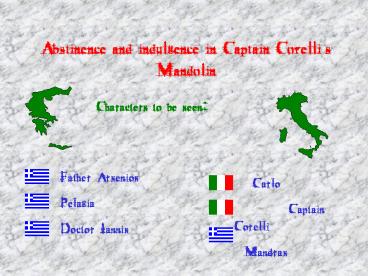
Characters to be seen
2
Father Arsenios
He was notorious for having been an adulterer and
for having come from Epirus because he wanted to
remarry. He was suspect of being interested in
widows, an extremely unethical and blasphemous
idea for the Greeks. His infamy also arose from
the fact that he often consumed irreligiously
large volumes of alcohol, particularly Robola
wine. The priest was also extremely fat, and his
movement was described as waddling. As a
consequence, he was continually perspiring
heavily. He was an unorthodox priest who
abstained from normal religious practice, but the
Greeks still sought him for comfort and guidance.
His indulgence in food, drink and women stopped,
however, with the arrival of the war, where he
instantly became immensely indulgent in religion,
God and philosophical and utopian ideas. By the
end of his life, he was a thin man who had turned
insane with his constant maniacal preaching at
the Italians and Germans.
Father Arsenios case is a strange one, because
it shows a complete reversal in the things he
indulged in and those which he abstained from.
3
Pelagia
She is forced to abstain from sex with Corelli
(she never appears to desire sex with Mandras)
because if she were to have a child, it would be
illegitimate. Marrying the captain was out of the
question, for if he were to get killed, she would
be an unwanted widow for the rest of her life and
she would be called a whore, as the doctor curtly
points out to her. Besides, the child would grow
up fatherless.
Pelagia never indulges in anything, but she has a
passion for several things, such as medicine and
everything she feels very attached to,
particularly her goat and her father.
She also demonstrates an enormous capacity to
love a person (although, quite often, she does
not seem to show it). This is proven by her
relationship with her father and her love for the
captain (and previously Mandras). One could say
she brims over with love, but it would be
incorrect to say she indulges in it, for
indulgence is excessive and usually damaging.
Pelagia is certainly not a damaging person. What
is sad is that she became damaged.
4
Dr Iannis
The doctor is a professional man who has a loving
passion for medicine and Cephallonia, which he
has transferred to Pelagia. He is not obsessed by
medicine, though, because he leads a relatively
varied life and rarely does anything in excess.
The doctor is evidently a generous man who is
against the beating of women and the other types
of immoral treatment inflicted upon them in most
Greek households. However, he seems to abstain
from any type of useful work except for his
medical practice. All the housework and
physically demanding labour is performed by
Pelagia.
Dr Iannis can be seen as a man who does not go to
extremes very often, he abstains from being too
conspicuous, except when it comes to religion,
according to Father Arsenios who accuses him of
being a notoriously godless man. An example of
this is his views on his politics, where he is a
moderate venizelist. However, he enjoys
criticising politics, especially when he goes to
the kapheneion to stun people like Kokolios with
his devastating critique of Communist economics.
As a rather romantic and wet sort of view, the
doctor can be
seen as a man who indulges in life and beauty.
5
Background sunset in Cephallonia
Carlo
Although he was huge in strength and size, Carlo
never harmed anyone (except in battle) and always
appeared as a gentle, quiet, modest and saddened
man. This was because he was a homosexual and
had to keep his sexual desires to himself,
because he would be expelled from the army,
publicly humiliated and mentally devastated.
Consequently, he had to abstain from many of the
fun activities engaged in by the boys of La
Scala, and, as a result, from the life he would
have liked to live without having to feel
uncomfortable about his sexual desires.
In his farewell letter to the captain, Carlo
sadly says I hope you are not disgusted, and I
hope that you will be able to forgive me and
remember me without contempt. I hope that you
will remember all the times that we have embraced
as comrades and brothers, and that you will not
shudder with retrospective horror because they
were the caresses of a degenerate... I trust that
for this you will not despise me as some might
think that I deserve.
Carlo never indulged in anything, nothing was
ever excessive, if anything, there was not enough
in his life. He was alien to the rest of his
world, but only to himself he could not let
himself be free, he had to abstain from a more
worthwhile life in order to fit in and not be
ostracised. Although some people would have
understood, like Corelli, he simply could not
take the risk of publicising the fact that he was
a homosexual.
6
Captain Corelli
The captain is a very emotional and passionate
man who appears as a very good-humoured,
entertaining and respectable invader. Although he
is initially made to feel like a flea by the
doctor, the latter learns to ignore the fact that
he is an invader and labels him our charming yet
uninvited guest.
Corellis life is his music, and everything else
falls behind it. He also loves the army, women,
football and observing the world around him,
which is what makes him such a culturally rich
man, even though he has not travelled round the
world like the doctor. Pelagia notes this and
desperately falls in love with him, but she does
not realise this until the episode in which they
go on a quest for snails.
It is difficult to say that Corelli abstains from
anything, since his life is so varied and
colourful. He is, however, forced to abstain from
sex and marriage with Pelagia for practical
reasons, but this does not prevent them from
loving each other. I do not think the captain
indulges in anything because he does not need to.
Although music is his paramount passion, it is
not an obsession, and hence not an indulgence. He
does not do anything in excess, like most
characters.
7
Mandras
Mandras thought he was not doing anything useful
with his life and that Doctor Iannis doesnt
think hes good enough. While fishing, he
thinks I love Pelagia, but I know that I will
never be a man until Ive done something
important, something I can live with, something
to be esteemed... Ill be worth a dowry then. He
was very excited and anxious to marry Pelagia,
but he sensibly thought they would be better off
marrying after the war. Consequently, Mandras
(and Pelagia) had to hold themselves back in
relation to their sexual desires.
During the war he fought alongside Hector, who
brainwashed him, turning him into a violent,
ruthless and mindless Communist. Together with
Hector he killed collaborators and raped women
in order to satisfy his primitive necessities (he
had been seeing Pelagia for about a year and they
had not slept together. Besides, raping was
routine procedure). So, while with ELAS he
ceased his long abstinence. His animal behaviour
became so violent that he was unable to control
it.
When he got back home he saw Pelagia and couldnt
resist his impulses. By that time he had indulged
so long in murdering and raping that he tried to
violate her just like the peasant women he had
disgraced previously.
It could be said that by the time he was
idolising Hector he was abstaining from a true,
moral and useful life. He became what he had
sworn never to be.
8
Most characters do not indulge in anything, most
human beings do not. Excesses are negative and to
be avoided, hence a non-indulging person is
usually decent and likeable. Many characters have
vivid and varied lives without indulgences of any
kind, but, sadly, they also have to abstain from
certain things that would complete their
existences.
Having to do this eventually ruins the happiness
and even the lives of certain characters such as
Carlo and perhaps Pelagia and the captain. The
limitations they have to keep to are the product
of the war, which is one of the many ways the
novel illustrates the horrors and the misery
caused by the useless and counterproductive
dreams of a few tyrants. Corelli bluntly and
rather pathetically points out that the war was
going so badly for the Italians because the Duce
got some big ideas. More to the point is the
explanation given in the pamphlet produced by
Carlo and Dr. Iannis This Ludicrous Buffoon has
rearmed Germany, Belgium, and Austria, leaving
His own army to fight scandalously unjustifiable
wars without weapons... This Moral and
Intellectual Pygmy... Has said The more enemies,
the greater the honour, and so we have created
enemies out of thin air and gone out to fight
them without boots on our feet, and in armoured
cars whose barrels are made of wood...
Rafael Holt
Recommended

