

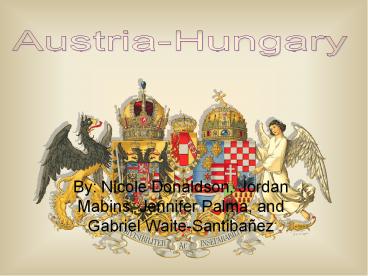
By: Nicole Donaldson, Jordan Mabins, Jennifer Palma, and Gabriel WaiteSantibaez PowerPoint PPT Presentation
1 / 10
Title: By: Nicole Donaldson, Jordan Mabins, Jennifer Palma, and Gabriel WaiteSantibaez
1
- By Nicole Donaldson, Jordan Mabins, Jennifer
Palma, and Gabriel Waite-Santibañez
2
Francis Joseph
- He was born in 1830.
- At the age of 18 years old, Francis Joseph
inherited the Hapsburg throne. - He ruled as emperor of Austria.
- He also ruled as king of Hungary.
- His time on the throne ended in 1916 due to his
death.
3
Francis Joseph
4
Ferenc Deak
- Ferenc Deak was a moderate Hungarian leader.
- He helped work out a compromise that created a
new political power known as the Dual Monarchy.
5
Dual Monarchy
- A political power
- The Dual Monarchy was the kingdom of
Austria-Hungary from 1867-1918. - Austria and Hungary were separate states
- Each had its own constitution and parliament
6
Dual Monarchy
7
The Hapsburg Empire Declines
- Napoleon dissolved Holy Roman Empire Austrias
center of power shifted to central Europe. - Under this new power, Austrian emperor Francis I
upheld conservative goals against liberal forces - The gov. limited industrial production, resulting
in the stir of socialism caused by the growth of
cities and worker discontent - Urgent nationalists demands disturb old order
while Hapsburg presides a multicultural empire
made up of mostly Hungarians and Italians. - Hapsburg ignores demands and nationalists revolt
in 1848 and the gov. crushes them - Francis I takes the throne in 1848
- During his reign he made limited reforms and
granted a constitution.
8
Formation of the Dual Monarchy
- In 1887, Ferec Deak creates a new political power
known as the Dual of Monarchy of Austria-
hungary. - Under the Dual of Monarchy, Austria and Hungary
are separate states each consists of their own
constitution and parliament. - Although they were separated, they shared
ministries of finance, defense and foreign
affairs. - Hungarians welcomed compromise, though
restlessness increased amongst Slavic groups. - Slavics were called to unite and insisting only
though liberty, equality, and fraternal
solidarity could they fulfill their mission.
9
Musicia
- 1)Nationalitydescendants of past singers and
musicians - 2)languagesinging (English)
- 3)cultureeverything is normal except that they
never stop listening to music. Everyone is
open-minded to explore all genres of music. - 4)historycreated in 1927 when musicians and
singers wanted freedom to hear whatever they want
and to sing and play freely without protests - In April 1927, famous musicians around the world
pronounced - Musicia a free nation.
- 5)religionMusictology-the way of thinking which
involves believing that music can heal anything
and bring happiness - 6)territory official name- Land of Harmony
- An island off of the tip of Italy
10
(No Transcript)
Recommended

