

Sexual Maturity and Aggressive Behavior in Parrots and Iguanas PowerPoint PPT Presentation
1 / 34
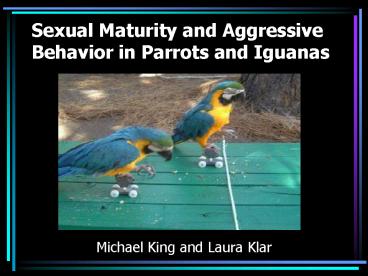
Title: Sexual Maturity and Aggressive Behavior in Parrots and Iguanas
1
Sexual Maturity and Aggressive Behavior in
Parrots and Iguanas
- Michael King and Laura Klar
2
When is my parrot sexually mature?
- Can range from 2 ½ to 5 years of age depending on
the breed.
3
Why the aggression?
- It comes down to normal behavior
- Acting on impulses
4
When to expect this type of behavior
- When removing the bird from its cage or any area
it regards as its alone - When strangers or disliked family members
approach while the bird is with its favorite
person displaced aggression - When someone regarded with less authority is
handling the bird
5
Removing the bird from the cage
- Prepared owners will expect to be bitten
- Always follow through and never back down
- Be consistent
- If necessary, use a towel or a stick to safely
obtain the bird
6
Displaced Aggression
- Generally a result of exclusively bonding to one
individual - Will try and bite owner when others enter the
room - This relationship will intensify during sexual
maturity
7
A question of authority
- Spouses usually fall victim to this
- Try and let the bird and the disliked person work
it out - Taking the bird out of the situation may only
reinforce the behavior - If necessary, the favored person can act as
disciplinarian
8
Avoid increasing sexual behavior
- May inadvertently increase sexual behavior with
physical affection - Avoid petting under the wing, pulling on the
tail, encompassing the body, touching near the
vent or beak wrestling
9
(No Transcript)
10
Set yourself up for success
- Establish good behavior patterns early in life
- Consistency is key
- Dont back down
- Be willing to accept some distance during the
breeding season - Dont place yourself in compromising positions
11
a compromising position ?
12
Pharmaceutical treatment
- Lupron (luprolide acetate) human GNRH analogue
expensive as hell 3 injections once every 2
weeks very effective. Used for chronic egg
laying, ovavian cysts and feather picking - Haldol antipsychotic leads to a very sedate
bird - Prozac TCA again, very sedate
13
Surgical Treatment
- Salpingohysterectomy removal of the uterus and
the oviduct - Commonly indicated to alleviate pathologic egg
laying - Castration this is still a very risky procedure
with a low post surgical survival rate
14
(No Transcript)
15
Reptile Behavior
- Besides husbandry, one of the most important
aspects of client education - Understanding enhances the human animal bond
- Important when handling animals for treatments
16
Green Iguanas (Iguana iguana)
- Common, inexpensive
- Can be challenging to own - not a great first
reptile to recommend for a novice owner - Lifespan gt 12 years
- Large - up to 6.5 feet
- Now living long enough to reach sexual maturity
seeing behavioral issues in males
17
Iguana Communication
- Posture
- Movement Gait
- head bob
- dewlap movement
- lateral torso compression
- Use of three-dimensional space
- placement in enclosure
- seeking height or flattening out
18
Defensive Aggression
- May exhibit if threatened
- Stand sideways to the threat
- Swallow air to increase their size
- Stand high off the ground to look larger
- Lash at the threat w/tail
- May gape or bite if provoked
19
Offensive Aggression
- Less common
- Usually involves sexually mature males during
mating season (Dec. - March) - Now living long enough to reach sexual maturity
- 1.5 - 6 yrs dep.on husbandry
- sudden change in behavior or color
- investigate medical cause but be suspicious if
male
20
Offensive Aggression
- May attack anyone entering their territory
attempt to bite - cage confinement? - Wearing certain colors may provoke attacks
- Female owners menstruation/ovulation -
pheromones?
21
Offensive Aggression
- Males may try to mate (display mating behaviors,
including bites) with female owners - May see other human males as competition
22
Offensive Aggression
- Neutering does not completely resolve this
problem - Research continues in this area - identify causes
besides testosterone - Photoperiod? Variation from diurnal schedule?
Too small enclosure? etc.
23
What to do?
- Towels, stuffed lizards, toys towards which to
direct their sexual aggression - Always be aware alert
- Bites - wave alcohol-soaked gauze in front of
nose. Cover head with towel - may relax let go - Negative reinforcement
24
Non-breeding Aggression
- Does occur
- May involve a male lizard being dominant over its
human owners - Prevent by proper handling and interaction
25
Iguana Body Language Dewlap
- Fully tucked up under chin, relaxed floppy
non-aggressive - Rigidly extended /- sideways presentation of
body threatening.
26
Iguana Body Language Head Bobbing
- Several meanings?
- Warning
- Visual equivalent of scent-marking?
- Territoriality?
- Greeting?
27
Iguana Body Language Hissing
- Low, guttural click
- Mouth wide open, tongue arched
- Body in full compression
- Dewlap flared
- Last straw warning!
- Careful - shhh sound may be interpreted as an
offensive hiss
28
Iguana Body Language Open Mouth
- Fully open mouth, pink-red color (engorged),
tongue up out anti-predator - Body tensed, mouth only slightly open
aggressive or dominance - NOT a smile. - Differentiate from dyspnea over-heating
29
Summary - Clients
- Be aware of challenges of ownership - educated,
informed decision to buy an iguana - Protect themselves
- Enhance the human-animal bond by better
understanding their pet
30
Summary - Veterinarians
- Education of clients
- Protect yourself when handling and treating these
patients - Owning reptiles yourself
31
Alternatives for novice clients?
- Bearded dragons!
- Pogona spp., native to Australia
- Smaller (males up to 2 feet)
- Lifespan 5-12 ? years
- Excellent temperament
- Docile, easily handled
- Aware, social, responsive
32
Alternatives for novice clients?
- Leopard Geckos
- Smaller can keep in 10 gallon tank
- Beautiful lots of color variation
- Easier husbandry no veggies, no UV
- Great personalities
33
References
- Cogger, H.G. and R.G. Sweifel. 1998.
Encyclopedia of Reptiles and Amphibians.
Academic Press, CA. - Grenard, S. 1999. An Owners Guide to the
Bearded Dragon. Howell Book House, NY. - Mader, D.R. 1996. Reptile Medicine and Surgery.
W.B. Saunders Co. PN. - Zoffer, D. and T. Mazorlig. 1997. The Guide to
Owning a Bearded Dragon. T.F.H. Publications,
Inc. NJ. - http//www.anapsid.org/
- www.reptilecare.com
34
Thank You! Questions?
Recommended

