

How the India Power Tools Market is Positioned? PowerPoint PPT Presentation
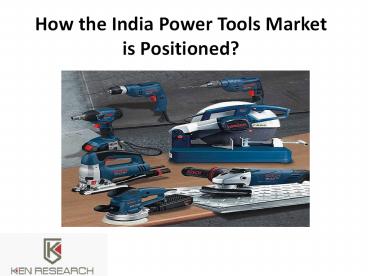
Title: How the India Power Tools Market is Positioned?
1
How the India Power Tools Market is Positioned?
2
Power Tools is an import driven market in India.
The expansion of manufacturing industry, rising
number of infrastructure projects in the country,
increasing allocation of budget to the
construction sector by the government has given
the impetus to the power tools industry in India.
The power tools market has expanded in past few
years owing to the increase in the end users
such as metal and wood industrys prosperity and
also at the same time the changing lifestyle and
adoption of Do-It-Yourself products increasing
the demand of power tools.. The Market for Power
tools had witnessed a robust growth in past few
years. Power tools market had increased from INR
Million in FY2011 to INR Million in FY2016,
growing at a CAGR of during the period. The
Make in India initiative by the government has
fostered the manufacturing sector which had
attracted many companies to open their offices
and start operations in India. The massive growth
of E-commerce sector had majorly driven the
market of power tools. Additionally, increasing
cheap imports from China has also catalyzed the
growth of power tools market in India.
3
- In India, the massive growth in construction
sector, manufacturing sector, and e-commerce
sector had majorly driven the market of power
tools. The increase in demand for portable
products had also surged the demand of cordless
power tools in the residential sector of the
country. Power tools have succeeded in changing
the lifestyles of people especially in Tier 1
cities due to incline in DIY activities. It has
also helped in making manufacturing and
construction activities easier through portable
power tools. Power tools have not only increased
the efficiency but also have effectively speeded
processes thereby saving time and energy. - The Competitive landscape of vendors is diverse,
from international companies, to fast-growing
domestic companies. Examples include Bosch,
Makita, Hilti, Hitachi Koki, FEIN Power Tools and
other organized players. - The power tools market has been segmented on the
basis of technology. The four major segments are
Electric, Pneumatic, Hydraulic and
Powder-Actuated Power tools. In India, majority
of the end users have been using electric power
tools since it is cheaper and finds application
in various sectors. Additionally, most of the
electric power tools manufactured by key players
are available on online portals. The electric
power tools had contributed to INR million In
FY 2016. The number of companies manufacturing
electric power tools is higher than any other
kind of power tools.
4
- The percentage share of electric power tools had
increased from in FY2011 to in FY2016. - The power tools market was also segmented based
on demand from Tier 1, 2 and 3 cities in India.
Tier 1 cities had dominated the power tools
market in terms of revenue in FY2016. The vendor
companies generated most of the revenues majorly
from these cities owing to excellent distribution
networks in these cities. - Which Segments have
Driven the Power Tools Market? - Electric Power Tools
- Electric power tools were the most popularly used
products out of all the types of power tools. The
revenue from electric power tools was recorded to
be around INR million in FY2011 which rose to
INR million in FY2016. This rise was owing to
the increase in PDI that led to an increase in
users propensity to spend. Electric breakers
generated maximum revenues in the electric power
tools segment in FY2016 since they are expensive
as compared to other electric power tools.
Organized sector dominated the market of electric
power tools in FY2016. Most of the power tools
were sold through dealers rather than direct or
online sales. Dealers contributed to INR
million in FY 2016. The construction industry
created of the revenues from electric tools in
FY2016 followed by manufacturing industry and
others. of the end users was non-residential
in FY2016 followed by residential end users.
5
- The gradual shift in purchasing pattern of
electric power tools from physical stores to
online portals had fueled the growth of electric
power tools in the country. - On the basis of type of product, electric power
tools market can be segmented by Drills,
Screwdrivers, Routers, Planers, Grinders, Saws
and Breakers. Electric breakers contributed
maximum to the revenues, around INR million in
FY2016. Portable electric power tools
contributed INR Million in FY2016 as compared
to INR Million by stationary counterparts. By
application, bulk of the demand was generated by
the construction industry followed by the
manufacturing industry and metal working
industry. Non-residential users generated about
of the revenues as compared to residential users.
Dealers contributed for higher revenues than
direct sales. Online sales generate the least
revenue. The organized sector occupied a greater
market share as compared to the unorganized
sector in terms of revenue. - Pneumatic Power Tools
- Pneumatic power tools were the second largest
revenue generator in the power tools segment. Its
market accounted for INR Million in FY2011
which rose to INR Million in FY2016. A vast
majority of the demand for pneumatic power tools
was generated from the construction projects all
across the country. Pneumatic hammers contributed
the most in the revenue from in FY2016 since
their cost of manufacturing was lesser than the
others.
6
- Organized sector dominated the market of
pneumatic power tools in FY2016. Most of the
power tools were sold through dealers rather than
direct or online sales. Dealers contributed to
INR million in FY 2016. - The construction industry created of the
revenues for pneumatic tools in FY2016 followed
by manufacturing industry and others. of the
end users was non-residential in FY2016 followed
by residential end users. This was owing to large
number of non-residential projects which
attracted the utilization of pneumatic power
tools in the country. - On the basis of type of products, pneumatic power
tools market can be segmented by buffers, nailing
and stapling guns, buffers, riveting guns,
nailing and stapling guns, sanders, wrenches and
others. Stationary pneumatic power tools
contributed INR Million in FY2016 as compared
to INR Million by portable ones. By
application, the largest revenue was generated by
the construction industry followed by the
manufacturing industry and metal working
industry. Non-residential users generate more
revenue than residential users. Dealers
contributed for higher revenues than direct sales
as majority of the companies focused on their
operation which includes manufacturing the
products rather than distributing it, which was
mostly outsourced to the dealers. The organized
sector held a higher market share than the
unorganized sector owing to end users preference
for branded and quality products.
7
Hydraulic Power Tools Hydraulic power tools
market was about INR million in FY2011 which
inclined to INR million in FY2016. The
increase in imports from China was one of the
major reasons behind this increase. Demolition
hammer was the most popular tool in this segment
which was largely used in the construction
projects all across the country. Since the
demolition hammer find applications on concrete,
brick wall and masonry all of which form parts of
construction activities, the construction
industry created of the revenues from
pneumatic tools in FY2016 followed by
manufacturing industry and automobile sector.
Stationary products were preferred over portable
ones owing to higher power and torque generated
by them. Organized sector was responsible for
generating most of the demand for hydraulic power
tools in FY2016. Most of the power tools were
sold through dealers rather than direct sales
since most companies opted for indirect channels
of distribution. Dealers generated revenues worth
INR million in FY2016. of the end users was
non-residential in FY2016 owing to limited usage
of the demolition hammer in residential
sector. Stationary hydraulic power tools
contributed for INR million in FY2016 as
compared to INR million by portable ones. By
application, the largest revenue was generated by
the construction industry followed by the
manufacturing industry and automobile industry.
The organized sector contributes more than the
unorganized sector to the revenue of Hydraulic
power tools owing to high commercial usage of the
tool.
8
- Powder Actuated Power Tools
- Powder-Actuated Power tools generated the least
revenues in the power tools segment. The market
was worth INR million in FY2011 which
subsequently rose to INR million in FY2016.
Powder-Actuated tools are fasteners used to join
hard substances like metals. The only type of
tool included in this segment is the nailing and
fastening gun largely used in the construction
projects all across the country. of the
revenue was generated from stationary
powder-actuated power tools in FY2016. This was
because powder-actuated processes require high
power which is usually not provided by portable
devices. Powder-actuated tools relatively
generated most revenue from unorganized players
among all the four types of power tools. Dealers
generated more revenue since they are preferred
in cases of bulk sales and commercial end users
were responsible for the bulk of the purchases.
of the revenues in FY2016 was generated by
construction industry followed by manufacturing
industry and metal sector. - Non-residential end users were far more than
residential users owing to the hazardous nature
of the product. Stationary powder-actuated power
tools contributed to INR million in FY2016.
Dealers contributed for higher revenue than
direct sales owing to dealers providing a fair
comparison among different brands of the same
product. The organized sector contributed for
maximum revenue as compared to unorganized
sector. Powder-actuated tools relatively
generated most revenue from unorganized players
among all the four types of power tools.
9
How is the Competition Structured in India POWER
TOOLS Market? India Power Tools market is
dominated by few large multinationals. These
companies are offering wide variety of products
and excellent after sales services to the
customers. Bosch India was a leading player in
the industry in FY2016. The company was a
trusted brand name in the country and generated
revenues worth INR million in FY2016 in
overall Power Tools market in the country.
Stanley Black Decker was the second largest
player in India with the revenue generation of
INR million in power tools industry in the
country. The company has three brands under
Stanly Black Decker with plans to enhance
localization to 50 percent and set up
manufacturing plants in India. FEIN had a
relatively less market share with a revenue
generation of INR million since it manufactured
only electric power tools. Most key players
imported their products from China, Germany and
other countries while Bosch manufactures of
its products in India.
10
- What are the Future Prospectes for India power
tools market? - India Power Tools Market is expected to increase
from INR million in FY2017 to INR million in
FY2021, growing at a CAGR of during the
period. The market is anticipated to be driven by
the FDI inflows of international companies to
benefit from the Make in India initiative. The
rise in number of smart cities such as in the
future will also accelerate the demand of power
tools in the construction industry. - The increasing construction projects and
manufacturing units of companies developing power
tools in Tier 2 and 3 cities is due to increase
the demand of power tools leading to increase in
revenue. Innovations in design ( a shift from
corded to cordless power tools), technology and
quality will also trigger the demand power tools
by various end users especially in the
residential sector. - Companies Covered in the Report
List of Companies - Major Players
Bosch India -
Stanley BlackDecker
India -
Hitachi Koki -
Hilti -
Makita -
FEIN Power Tools
11
- Key Factors Considered in the Report
- Comprehensive analysis of the India Power Tools
market and its segments - Listed major players and their positioning in the
market - Identified major industry developments in last
few years and assessed the future growth of the
industry - Decision making process by different sectors to
select the Power Tools firm. - To know more on the Power Tools Market in
India, click on the following link - https//www.kenresearch.com/energy-and-utilities/p
ower/india-power-tools-market-statistics/46154-103
.html - Related Reports
- India Electronic Security Industry Potential to
2020 - Growing System Integrators Market with
Real Estate Development in Upcoming Smart Cities
12
India Online Consumer Electronics Market Outlook
to 2020 - Lucrative Discounts and Escalating
Internet Users to Foster Growth India LED
Television Market Outlook to 2018 - Rising Price
Competition With New Players Entry Contact
UsKen ResearchAnkur Gupta, Head Marketing
CommunicationsAnkur_at_kenresearch.com91-901537824
9
13
(No Transcript)
Recommended

