

Making Sense of Sustainability: The Reality of Costs and Benefits PowerPoint PPT Presentation
1 / 44
Title: Making Sense of Sustainability: The Reality of Costs and Benefits
1
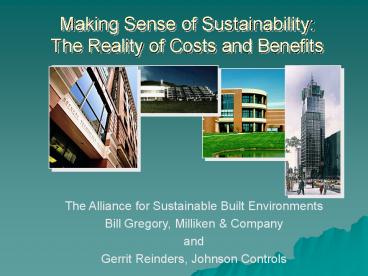
Making Sense of Sustainability The Reality of
Costs and Benefits
The Alliance for Sustainable Built
Environments Bill Gregory, Milliken
Company and Gerrit Reinders, Johnson Controls
2
Making Sense of Sustainability The Reality of
Costs and Benefits
Bill Gregory Director of Sustainable
Strategies Milliken Company The Alliance for
Sustainable Built Environments
3
Classic Definition of Sustainability
Economy
Ecology
Equity
Triple Bottom Line
4
Organizational Commitment to Sustainability
Green Buildings
Total Commitment to Sustainability
5
Environmental Impact of Buildings
Americans spend as much as 90 of time indoors.
- Buildings
- Consume almost 40 of all energy.
- Add 40 to atmospheric emissions.
- Use 68 of all electricity.
- Use 12 freshwater, 88 potable water.
- Take up to 40 municipal solid waste stream.
- Exploit significant amounts of land.
- Today 80 of Americans live in cities. By 2050,
90 will.
6
Characteristics of Green Buildings
- Optimal environmental and economic performance
- Increased efficiencies, saving energy and
resources - Satisfying, productive, quality indoor spaces
- Whole-building design, construction, and
operation over entire life cycle - Fully integrated approach teams, processes,
systems
7
Life Cycle Cost of Buildings
Typical Building Life 40 yrs.
8
Economic Benefits of Green Design
- Lower Construction Costs
- Reduced site preparation and landscaping
- Reduced construction waste disposal costs by 50
to 98 - Rightsized equipment (mechanical, electrical,
plumbing, etc.) - Reduced Operating Costs
- Average decrease 8-9 across industry
- Reduced utility costs by 20 to 50
- Reduced water use (indoor/outdoor) 20-50
- Reduced maintenance costs
- Rightsized equipment reduced OM costs
- Higher Valuation of Building
- Average increase building value 7-8
- Up to 4 increased valuation for every 1 spent.
- Average ROI enhanced by 6.7
- Average Occupancy Ratio increase 3.4
- Average Rent increase 3
- Rule of Thumb divide reduction in annual
operating costs by 10 to get increased value of
building.
9
Economic Benefits of Green Design
- More Productive Environment
- Better tenant and worker attraction/retention
- Less absenteeism by 45
- Higher productivity up to 16
- Reduced Insurance and Risk of Liability
- Reduced Insurance costs average savings 5
- Healthy occupants, greater occupant satisfaction
- Lower environmental impacts
- Streamlined regulatory approvals
- Higher Visibility and Marketability
- Employer/building of choice
- Free and effective PR
- First mover advantage
10
Risk of inaction?
- As green goes mainstream, standard buildings
will rapidly become obsolete and lose value. To
avoid this problem, building owners should carry
out green renovations. corporations no longer
have an excuse for eschewing the environmental
and economic sustainability - they have access to
tools that are proven to lower overhead costs,
improve productivity, and strengthen the bottom
line. - Charles Lockwood, Harvard Business ReviewJune
2006
11
U.S. Green Building Council
- National coalition representing all sectors of
the building industry. - Promotes design, construction, operation of
environmentally responsible, profitable, healthy
places to live and work. - Launched Leadership in Energy and Environmental
Design (LEED) in 2000. - Nov 2006 USGBC was officially designated ANSI
accredited standards developer - Explosive Growth
- 7,200 member organizations (representing
millions of employees) - Chapters each State (50) and 12 countries
- 92,000 Actively engaged individuals
- 33,000 LEED-AP
12
LEED Programs
- Building Certification
- Green, Silver, Gold, Platinum
- Professional accreditation
- Training workshops
- Educational resources
- Web site www.usgbc.org
13
Point System under LEED
Source US Green Building Council (USGBC)
LEED NC Green 26 pts, Silver 33 pts, Gold 39
pts, Platinum 52 pts LEED EB Green 28 pts,
Silver 36 pts, Gold 43 pts, Platinum 57 pts
14
Key Market Developments
- 20 states, 59 cities and some of the biggest
names in the industry have committed to LEED - HOK, Gensler, Turner, Durst, Hines, Thomas, and
Silverstein to name a few - GSA (largest landlord in USA) and 10 other
Federal Agencies endorse LEED - White House
- GSA, DOD, Interior, State, EPA, Army, Air Force,
Navy, USDA
20 States Have Adopted LEED
Source USGBC - updated November 2006
15
Boston Green Building Initiative
- Boston will be one of first major cities in U.S.
to implement green building requirements for
public and private buildings - Washington, D.C. is currently voting on similar
legislation - Pasadena, Calif., and Montgomery County, Md.,
adopted the standards in 2006 - Affects projects of 50,000 sq. ft. or more
- Must meet at least 26 of about 70 areas of design
and construction requirements (LEED-based) - Developer certifies and city confirm builders
measures - No Third-Party Involvement or Certification
- Faster Turn Around
- Less Expensive
16
Making Sense of Sustainability The Reality of
Costs and Benefits
Gerrit Reinders Director of Sustainable Energy
Strategies Johnson Controls The Alliance for
Sustainable Built Environments
17
Brengel Technology Center
LEED-Certified BuildingMilwaukee, Wisconsin
18
Brengel Technology Center
- Built in 2000
- 16 million technology customer center
- 130,000 square feet on 7 floors
- Complements 100-year-old building next door
- Minimized footprint by building on existing site
in citys center
Example of urban redevelopment
19
Brengel Sustainable Features
Open green-area courtyard in city center
Personal environments for desktop control by
employees
Abundant use of natural daylight with advanced
lighting technology
20
Building Automation System
- Optimal energy efficiency and performance with
Metasys Building Automation System - Remote Access
- Easy to identify energy savings opportunities
- Energy sub-metering
- Load profiling
- Cost report generation
21
LEED Silver to Gold
- Modified housekeeping specifications
- Improved exterior landscaping and snow removal
procedures - Replaced compact fluorescent with low-mercury
- Reduced water consumption on existing fixtures
- Upgraded copying machines for better indoor
environmental quality - Additional parking for environmentally preferable
transportation - Expanded MV
- Ongoing recycling
- Daylighting strategies
22
Brengel Financial Impact
- 130,000 sq. ft. added (i.e. 45 growth
- no additional maintenance personnel
- 20 decrease in energy (BTU/sf)
- Integrated control system saved 225,000 during
construction - Building consumes 2.5 W/sf
- Lighting system consumes only 0.86 W/sf
- 35 reduction in operating costs
- 76,000 in annual energy savings
4.2 Million Savings Over the Next 10 Years!
23
National Geographic Society
World HeadquartersWashington, D.C.
24
National Geographic Society
- One of the worlds largest scientific and
educational non-profit organizations - Headquarters complex has four buildings
17th Street 40 years old
Hubbard Hall 100 years old
16th Street 60 years old
M Street 20 years old
25
Sustainable Upgrades
- Sustainable Site
- White roof replacement
- Increased bike rack capacity
- Reduced exterior light pollution
Close to public transportation, bike racks,
showers lockers
26
Sustainable Upgrades
- Energy Atmosphere
- Boiler/cooling tower upgrades
- Chiller replacements with HFC refrigerants
- Air-handling unit upgrades, zone dampers, and fan
VFDs - Building automation system (BAS) DDC conversion
upgrade - Green Power
27
Sustainable Upgrades
- Indoor Environmental Quality (IAQ)
- Complete asbestos abatement
- Ventilation and exhaust air flow verification
- BAS based CO2 monitoring system
- Improved temperature and humidity control through
upgraded BAS control and window film
Air-handling unit upgrades
28
Sustainable Upgrades
- Water Efficiency
- Efficient flush valve diaphragm replacements
- Low flow faucet aerators and controls
- Irrigation system rain gauge controls
Water Sensor
29
Adopted Operating Policies
- Site
- Erosion control during site improvements
- Hybrid vehicle parking and telecommuting
- Green landscaping, snow and pest management
- Energy
- Benchmark regularly, using ENERGYSTAR
- Measurement Verification plan
- Materials Resources
- Construction waste management
- Resource reuse and recycled content
- Procure EnergyStar rated products
- Certified wood
- Green housekeeping management
- Contractor materials management and reporting
policy - Indoor Environmental Quality
- Construction IAQ management plan
30
National GeographicFinancial Impact
- Tremendous savings
- 600,000 in total savings
- 10 reduction in energy expenses (300K)
- 300K annual savings in other operating costs
- Lower water consumption, waste disposal expenses
- Increased Market Value
- 7 million investment increased real estate value
by 24 million - Improved equity, credit rating, debt borrowing
capacity. Reduced cost of money! - Results align with National Geographic Society
mission
31
- Key Learning
- things you can do right now
32
Commission your building
- Only 1 of buildings are commissioned (US DOE)
- Commissioning typically discovers 28 problems in
new buildings, 11 in existing buildings (Alan
Whitson RPA) - Most common problem HVAC
- Commissioning is a pre-requisite in LEED
- ROI can be significant - typical business case
() - EB Cost 0.30/sf. Energy Savings 18 Payback
lt9-mths - NC Cost 1.20/sf. Payback 4.8-yrs.
- Additional savings (reduced change orders and
other non-energy savings of - Existing Building Savings 0.18/sf
- New Construction Savings 1.24/sf
() Source Portland Energy Conservation, Inc.
33
Top 10 Deficiencies
- Incorrect scheduling of HVAC and Lighting
equipment - Incorrect cooling and heating sequences of
operation - Incorrect calibration of sensors and
instrumentation - Lack control strategies for comfort and efficient
operation - Malfunctioning air and water side economizers
- Under utilized computer based control systems
- Short cycling HVAC equipment causing premature
failure - Non adherence to design intent and missing
building documentation - Lack of training for building operators or
service contractors on complex systems - Missing specified and paid-for equipment
Source Portland Energy Conservation, Inc.
34
Control Your Energy Spend
- Energy consumption monitoring and reporting
- Track energy and utility usage against baselines
and determine root cause of fluctuations - Check your bills are they accurate?
- Ensure youre on the right rate/tariff and energy
usage billed is in-line with monitored and
calculated values - Create Energy dashboard for C level
- Ensure quantifiable energy performance data is
readily available and deliver in metrics they
understand - eg. /kW or /kWh or /square foot, employee,
bed, unit of production, etc
35
Assure Accurate Data Hire a utility bill
processing firm
Validation Variance Tests
- Prior Balance - reviewed payment history
- Duplicate Bill - invoice already processed
- Missed consumption period - call utility
- Meter Read Dates Out of Sequence
- New, Deleted or Modified Meter - current count or
reading compared to last count - Compare Bill Total to Sum of Line Items
- Utility Vendor Not Recognized - vendor must match
Utility Account Database - Utility Account Number Not Recognized
- Late Fees On Bill - causes identified waivers
pursued if due to vendor error - Date Field Validation - all dates compared to
current date to each other
Is it billed Correctly? How much are we
paying? How efficient are we? Whats the trend
line?
- Cost/period
- Usage/period
- Cost/unit
- Demand
- Power Factor
- Cost/day
- Usage/day
36
Embrace energy efficiencyConsider hiring an ESCO
- Source New Buildings Institute for USGBC.
- Analysis of 420 LEED-NC version 2 certified
buildings through July 2005
37
Think Life Cycle
- With all purchases (capital operating)
- Proper levels of maintenance
- Apply correct levels of Reactive, Preventative,
Pro-active and Preemptive maintenance - Eliminate low-value maintenance routines and use
savings to increase the frequency of high-value,
high return routines - Track maintenance and repair
- Employ CMMS to
- Assess equipment useful and economic life cycles
- Forecasting operating and capital budgeting needs
- Provide audit trails for accreditation
certification
38
Keep it Green - Life Cycle
- Optimize your BAS and control systems
- Track
- Run times
- Filter conditions
- Ventilation rates
- Setpoint error
- Air quality
- Pressurization
- Continual recommissioning
- Employ
- Proven energy management routines
- CO2 monitoring to control outdoor air intake
- Alarm monitoring and reporting
- Base building systems integration
39
Focus on the Indoor Environment
- A green-managed, indoor environment promotes the
well-being of staff - Safety
- We are entrusted and liable for the well-being of
those who work in our buildings. Elimination of
toxins such as asbestos, VOCs, harsh chemicals
and cleaning agents reduce liability - Health
- Sick building syndrome is not an urban myth,
buildings do become toxic - Productivity
- Even a slight increase in productivity
significantly impacts the largest element of most
organizations budgets payroll!
40
Tools Offered Through IFMA
- SEEC Sustainability educational program
delivered via Web - Green Compass Web-based building assessment,
management and certification tool (LEED based) - To access go to IFMAs Green Zone
- www.ifmagreenzone.org
41
SEEC Sustainable Energy Environmental
Communication
- Key Manager Employee Modules For Online
Training - Support materials and resources
- Internal recognition programs
- External communication program
- Audit reporting vehicles to verify
accomplishments
Available at IFMA GreenZone (www.ifmagreenzone.org
)
42
Transforming the Marketplace
- Segmented Into
- Five Distinct Processes
- Building Assessment
- ROI Evaluation and
- Project Scope Development
- Green Building
- Project Management
- Certification Preparation
- Facility Management
Available at IFMA GreenZone (www.ifmagreenzone.org
)
43
Energy and Environmental InformationYour
Footprint
44
Making Sense of Sustainability The Reality of
Costs and Benefits
The Alliance for Sustainable Built
Environments Bill Gregory, Milliken
Company and Gerrit Reinders, Johnson Controls
Recommended

