

Van Nuys Testbed Simulation Laura N. Lowes University of Washington PowerPoint PPT Presentation
1 / 14
Title: Van Nuys Testbed Simulation Laura N. Lowes University of Washington
1
Van Nuys Testbed Simulation Laura N. Lowes -
University of Washington
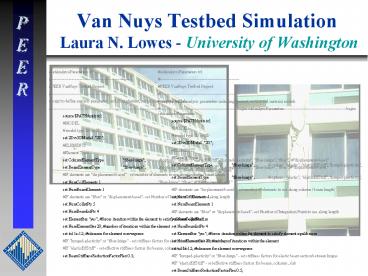
setAnalysisParameters.tcl ----------------------
------------------------------------- PEER
VanNuys Testbed Project -------------------------
---------------------------------- script to
define analysis parameters including element,
section and material models --------------------
--------------------------------------------------
--------------------------------------------------
------------------begin setAnalysisParameters sou
rce PATH/units.tcl MODEL model type 2D or
3D set 2Dvs3DModel "2D" ELEMENTS Element
Types set ColumnElementType "fiber-hinge"
options "elastic", "elasticEffStiff","lumped-plas
ticity", "fiber-hinge", "fiber",
"displacement-based" set BeamElementType
"fiber-hinge" options "elastic",
"elasticEffStiff","lumped-plasticity",
"fiber-hinge", "fiber", "displacement-based" I
F elements are "displacement-based" - set number
of elements to use along column / beam
length set NumColElements 1 set NumBeamElements
1 IF elements are "fiber" or "displacement-based
"- set Number of Integration Pointsto use along
length set NumColIntPts 5 set NumBeamIntPts
4 set ElementIter "yes" forces iteration
within the element to satisfy element
equilibrium set NumElementIter 20 number of
iterations within the element set tol 1e-12
tolerance for element convergence IF
"lumped-plasticity" or "fiber-hinge" - set
stiffness factors for elastic beam section
between hinges IF "elasticEffStiff" - set
effective stiffness factors for beams, columns,
slab set BeamStiffnessReductionFactorFlex 0.5
setAnalysisParameters.tcl ----------------------
------------------------------------- PEER
VanNuys Testbed Project -------------------------
---------------------------------- script to
define analysis parameters including element,
section and material models --------------------
--------------------------------------------------
--------------------------------------------------
------------------begin setAnalysisParameters sou
rce PATH/units.tcl MODEL model type 2D or
3D set 2Dvs3DModel "2D" ELEMENTS Element
Types set ColumnElementType "fiber-hinge"
options "elastic", "elasticEffStiff","lumped-plas
ticity", "fiber-hinge", "fiber",
"displacement-based" set BeamElementType
"fiber-hinge" options "elastic",
"elasticEffStiff","lumped-plasticity",
"fiber-hinge", "fiber", "displacement-based" I
F elements are "displacement-based" - set number
of elements to use along column / beam
length set NumColElements 1 set NumBeamElements
1 IF elements are "fiber" or "displacement-based
"- set Number of Integration Pointsto use along
length set NumColIntPts 5 set NumBeamIntPts
4 set ElementIter "yes" forces iteration
within the element to satisfy element
equilibrium set NumElementIter 20 number of
iterations within the element set tol 1e-12
tolerance for element convergence IF
"lumped-plasticity" or "fiber-hinge" - set
stiffness factors for elastic beam section
between hinges IF "elasticEffStiff" - set
effective stiffness factors for beams, columns,
slab set BeamStiffnessReductionFactorFlex 0.5
2
The Objectives
- Develop a model of the Van Nuys building within
OpenSees that can be used to - Simulate building response under variable levels
of earthquake loading results support loss
estimation. - Determine the impact of epistemic uncertainty on
predicted response results support development
of the PEER methodology. - Support development of new element models within
OpenSees. - Predict the post-peak response of the Van Nuys
building.
3
Deliverables
4
Gen. II Model
- Basic model
- Comparable to SAP model developed by Degenkolb
- 2D model one exterior one interior frame (3D
with slaving) - Modeling assumptions
- BeamWithHinges element model, rigid joints, x
3 - Concrete steel material response per FEMA 356
- Effective stiffnesses used to generate an initial
period of 0.89 sec - No gravity load representation (waiting on new
element that includes distributed loading) - No representation of shear failure for columns
- Inadequate representation of splice failure for
columns - reduced strength not ductility
capacity)
5
Gen. II III Models
- Parameterized model
- For use is assessing the impact of epistemic
uncertainty - 2D model one exterior one interior frame
- Modeling parameters
- Element type BeamWithHinges / NonlinearBeamcolumn
/ EffectiveStiffness / DisplacementBased - Column failure mechanisms Splice failure / shear
failure - BC Joints Rigid / center-line dimensions /
strength stiffness degrading - Material models Variable material models /
variable material data (stiffness strain
capacity) - Level of discretization Displacement-based
elements / sections - Effective stiffness values BeamWithHinges /
EffectiveStiffness model - Damping
6
What is the form of the model?
- VanNuys.tcl
- model BasicBuilder -ndm 3 -ndf 6
- source setAnalysisParameters.tcl - define
parameters for this particular analysis - source setFrameGeometry.tcl - write data
structure defining frame geometry - (story height, bay width, etc.)
- source setFrameMemberSectionProperties.tcl -
write data structure defining frame member
geometry (column/beam/slab prop.) - source setMaterialProperties.tcl - write data
structure defining material properties (each
column/beam/slab has concrete steel material
properties - source setElasticElementProperties.tcl - write
data structure defining elements elastic section
properties (all elements have elastic
properties - Torsional stiff.) - source setNodalMass.tcl - nodal / distributed
mass for dynamic analysis - source defineStructuralMaterials.tcl - execute
OpenSees command to generate required materials - source defineSections.tcl - execute OpenSees
command to generate required sections - source defineNodes.tcl - execute OpenSees command
to generate required nodes - source defineElements.tcl - execute OpenSees
command to generate required elements - source defineBoundaryConditions.tcl - execute
OpenSees command to establish required boundary
conditions
7
setAnalysisParameters.tcl
- setAnalysisParameters.tcl
- MODEL
- Model Type options 2D, 3D
- set 2Dvs3DModel "2D"
- ELEMENTS
- Element Types - options "elastic",
"elasticEffStiff", "lumped-plasticity",
"fiber-hinge", "fiber", disp - set ColumnElementType "fiber-hinge"
- set BeamElementType "fiber-hinge"
- SECTIONS
- IF fiber section - Define maximum fiber
dimension - set MaxFiberDim expr 0.5in
- MATERIALS
- set ConcreteMaterialType "Concrete01"
options Concrete01",Concrete02", - set SteelMaterialType "Steel02" options
Steel01, Steel02 - ANALYSIS
- set AnalysisType - options "Gravity",
"Eigen", "Dynamic", "Pushover" - set AnalysisType "Pushover
- OUTPUT
- options Columns 1, 4, 8
8
Basic Model Push-Over Analysis
Roof Displacement (in.)
Roof Displacement (in.)
9
Basic Model Simulated Response NR vnuy
Ground Acceleration Northridge Eq. - Building
Instrumentation
Roof Acceleration (in./sec.)
Acceleration (in./sec.)
10
Basic Model Simulated Response NR vnuy
Ground Acceleration Northridge Eq. - Building
Instrumentation
Roof Displacement (in.)
Displacement (in.)
11
Basic Model Response to Dynamic Loading
Hazard Level 10 in 50 yr.
12
Results Parameterized Model
FEMA 356 load distribution
Roof Displacement (in.)
13
Distribution Documentation
- Web-based distribution
- Accessible from UW website
- Data from numerical simulation Gen II basic
model - Documentation of modeling decisions
- Tcl script defining Van Nuys building
- To be developed - version control for models
14
Current Tasks
- Issue of model period
- predicted period 0.9 seconds, observed is 1.5
sec. - May need to run model through San Fernando record
to pre-damage the building - Gravity loading this determines point of
yielding - Shear / splice failure
- Distrubiton of results (story drift acc.)
Recommended

