

Main types of organic molecules PowerPoint PPT Presentation
1 / 37
Title: Main types of organic molecules
1
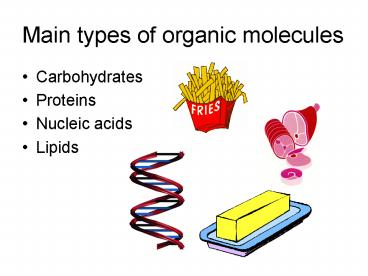
Main types of organic molecules
- Carbohydrates
- Proteins
- Nucleic acids
- Lipids
2
Typical composition of organisms by mass
3
CARBOHYDRATES
- carbon chain with equal numbers of OH and H and a
few carbonyl - general formula "CH2O"
- Includesmonosaccharides (simple sugars) and
polysaccharides (complex carbohydrates)
4
Monosaccharides
- Simple sugars small chains or ring structure,
with H, OH, and one O - Triose, tetrose, pentose, hexose sugars name
depends on number of carbons in the chain - Sugars may be aldose or ketose depending on
whether aldehyde or ketone
5
The structure and classification of some
monosaccharides
6
Monosaccharides, continued
- Important as fuel for energy metabolism
(glycolysis, cellular respiration) - Building blocks (monomers) for polysaccharides
such as starch, cellulose - Monosaccharide example glucose
7
Glucose
- An aldose hexose C6H12O6
- Primary fuel for cells
- Linear and ring forms (structural isomers)
8
(No Transcript)
9
Polysaccharides
- polymers (chains) of monosaccharides
- condensation reactions link monosaccharides
- hydrolysis reactions separate them
10
Polymers
- Large molecules built from chains of smaller
molecules (monomers) - Important polymers include
- Polysaccharides (polymers of ring-form hexose
sugars) - Proteins (polymers of amino acids
- Nucleic acids (polymers of nucleotides)
11
Condensation reactions make polymers from monomers
12
Hydrolysis reactions take polymers apart
13
Example of a condensation (or dehydration)
synthesis the disaccharide maltose formed from
two glucose monomers by 1-4 linkage
By the waynames for short chains Mono-, di-,
tri-, tetra-, penta-, etc. and oligo-
14
Functions of polysaccharides
- Fuel storage - small molecules such as glucose
affect the osmotic concentration of body fluids
must be sequestered to store in large quantities - Structural long molecules used to toughen and
support cells and tissues
15
Glucose storage polysaccharides
- starch in plants and glycogen in animals
- Both are polymers of the glucose isomer a-glucose
- Helical filaments, differ in branching pattern.
16
Alpha-glucose
a and ß glucose are structural isomers of glucose
Beta-glucose
17
Storage polysaccharides
18
Structural polysaccharides
- Cellulose is a polymer of ß-glucose.
- Plant cell-walls
- Most abundant (greatest mass quantity) of any
organic molecule on earth - Straight chains cross-linked by hydrogen bonds.
19
The arrangement of cellulose in plant cell walls
20
Starch and cellulose structures
21
(No Transcript)
22
Structural polysaccharides, continued
- Chitin
- cell walls of fungi, exoskeletons of arthropods
- Tough, resistant to digestion
- Similar to cellulose but with acetylamino
attached to each glucose - Chitinase - enzyme to break down chitin produced
by certain microorganisms and plants but not
animals
23
Cellulose
Chitin
24
LIPIDS
- Diverse molecules, grouped mainly because of
hydrophobicity - Mostly hydrocarbon few polar functional groups
- Types of lipids include fatty acids,
triglycerides, waxes, phospholipids, and steroids
25
Fatty acids
- Carboxyl group at one end of a long hydrocarbon
tail - ionized at physiological pH
26
A fatty acid
The sodium salt of a fatty acid (soap)
amphipathic
Na
27
How Soap works
Na
Na
Na
Na
Na
Na
28
Triacylglycerol (fats and oils)
- Three fatty acids joined to glycerol.
- Important energy stores in animals- hydrocarbons
to be used as metabolic fuel. - Fats are H-saturated, have higher melting
temperature - Oils are H-unsaturated, so have lower melting
temperature
29
Saturated and unsaturated fatty acids
30
Unsaturated fat
31
Triacylglycerol synthesis
1. Dehydration linkage of a fatty acid to
glycerol
32
Triacylglycerol synthesis
2. Completed triacylglycerol molecule
33
Phospholipids
- Two fatty acids plus hydrophilic phosphate head
attached to glycerol - Amphipathic molecules ionized, hydrophilic
head and hydrocarbon, hydrophobic tails - important structural functions
34
The structure of a phospholipid
35
Phospholipid functions
- Cell membranes phospholipid bilayer
Water outside cell
Water inside cell
36
Phospholipid functions
- Lung surfactant interface between air and moist
surface - Breakfast cereal additive?
37
Steroids
- Another class of lipids, but structurally
unrelated to FA and triglycerides - Example cholesterol is a component of cell
membranes - also precursor of steroid hormones, including
androgens and estrogens
Recommended

