

SolutionBased Dispersion, Sorting, and Placement of Carbon Nanotubes NIRTGOALI PowerPoint PPT Presentation
1 / 1
Title: SolutionBased Dispersion, Sorting, and Placement of Carbon Nanotubes NIRTGOALI
1
Solution-Based Dispersion, Sorting, and Placement
of Carbon Nanotubes (NIRT/GOALI)
A. Jagota, M. Zheng, Y-M. Chiang, S.V.
Rotkin, C. Kiely (PIs Program Officer Jimmy
K. Hsia) W.C. Carter, R.S. McLean, C-Y. Hui_at_,
S. Lustig, R.H. French, T. Tang C. Khripin,
R. Rajter, S. Snyder, S. Suresh, Deping
Xue Lehigh University DuPont MIT _at_Cornell
University University of Alberta
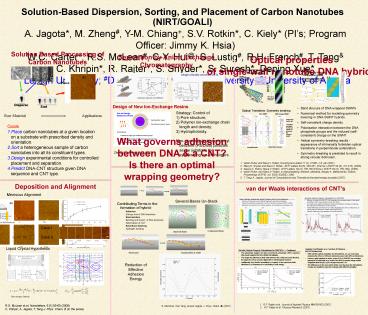
Solution Based Processing of Carbon Nanotubes
Separation by Anion Exchange Chromatography
Optical properties of single-wall nanotube DNA
hybrids
Design of New Ion-Exchange Resins
- Band strucure of DNA-wrapped SWNTs
- Numerical method for modeling symmetry lowering
in DNA-SWNT hybrids. - Self-consistent charge density
- Polarization interaction between the DNA
phosphate groups and the induced
(self-consistent) charge on the SWNT - Helical symmetry-breaking results - appearance of
intrinsically forbidden optical transitions in
perpendicular polarization. - Symmetry-breaking is predicted to result in
strong circular dichroism.
- Strategy Control of
- Pore structure
- Polymer ion-exchange chain length and density
- Hydrophobicity.
- Non-porous polystyrene/divinyl benzene (PS/DVB)
particles as the substrate for synthesizing
ion-exchangers.
Raw Material
Applications
- Goals
- Place carbon nanotubes at a given location on a
substrate with prescribed density and
orientation. - Sort a heterogeneous sample of carbon nanotubes
into all its constituent types. - Design experimental conditions for controlled
placement and separation. - Predict DNA-CNT structure given DNA sequence and
CNT type.
Zheng Semke, JACS (2007)
,
- Vadim Puller and Slava V. Rotkin, Europhysics
Letters 77 (2), 27006--1-6 (Jan 2007). - Stacy E. Snyder and Slava V. Rotkin, JETP Letters
84 (6), 348-351, (Pis'ma v ZhETF 84 (6),
411-415), (2006). - Alexey G. Petrov, Slava V. Rotkin, JETP Letters
84 (3), 156-160 (Pis'ma v ZhETF 84 (3), 185-189),
(2006). - Vadim Puller, and Slava V. Rotkin, in
Nanomodeling, Akhlesh Lakhtakia, Sergey A.
Maksimenko, Editors Proceedings of SPIE, vol.
6328, 63280D, 2006. - T. Tang, A. Jagota, Journal of Computational and
Theoretical Nanotechnology accepted (2007).
What governs adhesion between DNA a CNT?Is
there an optimal wrapping geometry?
van der Waals interactions of CNTs
Deposition and Alignment
(ns)
Meniscus Alignment
Several Bases Un-Stack
Contributing Terms in the formation of
hybrid Adhesion Entropy loss of DNA
backbone Electrostatics Bending and torsion of
DNA backbone Deformation of CNT Base-Base
Stacking Hydrogen bonding
Case I Case II
Unstacked BAse
Stacked Base
Liquid Crystal Hypothesis
Minimized
Equilibrated at 300K
Reduction of Effective Adhesion Energy
free energy density
- R.F. Rajter et al. Journal of Applied Physics 101
054303 (2007). - R.F. Rajter et al. Physical Review B (2007).
R.S. McLean et al. Nanoletters, 6 1 55-60
(2006) C. Khripin, A. Jagota, T. Tang J. Phys.
Chem. B (in the press)
S. Manohar, Tian Tang, Anand Jagota, J. Phys.
Chem. B, (2007)
Recommended

