

Distributed Microsystems Laboratory: Developing Microsystems that Make Sense PowerPoint PPT Presentation
Title: Distributed Microsystems Laboratory: Developing Microsystems that Make Sense
1
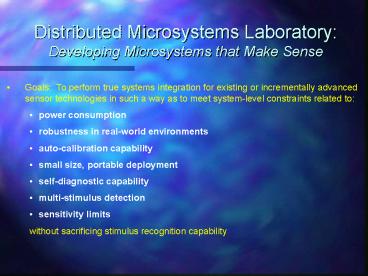
Distributed Microsystems LaboratoryDeveloping
Microsystems that Make Sense
- Goals To perform true systems integration for
existing or incrementally advanced sensor
technologies in such a way as to meet
system-level constraints related to - power consumption
- robustness in real-world environments
- auto-calibration capability
- small size, portable deployment
- self-diagnostic capability
- multi-stimulus detection
- sensitivity limits
- without sacrificing stimulus recognition
capability
2
Distributed Microsystems LaboratoryDeveloping
Microsystems that Make Sense
- Areas of Research in Microsystems Development
- Chemical Sensing Microsystems
- Modeling of front-end olfaction in sensor array
design and architecture to enhance system
robustness, resilience to broken sensors,
auto-calibration capability, and sensitivity
floor (detection limit). - Streamlining of signal processing to adapt
chemical discrimination algorithms to
lower-overhead equivalents for implementation in
portable systems - Sensor platform development for extraction of
multiple features from a single micro-sensor in
an array (including instrument development) - Miniaturization of existing larger chemical
sensors and systems - Optimization of signal conditioning and readout
circuits to reduce superfluous information and
enhance signal-to-noise ratios
3
Distributed Microsystems LaboratoryDeveloping
Microsystems that Make Sense
- Areas of Research in Microsystems Development
- Chemical Sensing Microsystems Available Sensor
Technologies - ChemFETs
- streamlined signal processing,
- sensor platform development,
- miniaturization of systems,
- optimization of signal conditioning.
- Composite Polymer Sensors
- olfactory modeling,
- streamlined signal processing,
- sensor platform development,
- miniaturization
- Metal-oxide Sensors
- olfactory modeling,
- sensor platform development
- SPR (surface plasmon resonance)
- streamlined signal processing
- miniaturization of systems
4
Distributed Microsystems LaboratoryDeveloping
Microsystems that Make Sense
- Areas of Research in Microsystems Development
- Other Microsystems
- Development of application specific integrated
CMOS imagers and auditory systems modeled after
biology - Development of imaging and auditory microsystems
for streamlined, low-power implementation - Development of integrated pressure sensors for
characterizing and controlling biopsy sample
preparation - Development of integrated platforms for
evaluating fluorescence of living, dead, and
lysed cells - Radio Frequency Identification systems for
monitoring health of trees to increase their
market value (and thereby decrease the number of
trees that need to be cut down).
5
Distributed Microsystems LaboratoryDeveloping
Microsystems that Make Sense
- What Drives Research in this Laboratory? (e.g.
the Vision) - LINK TO INDUSTRY THE APPLICATIONS
- Environment
- Environmental monitoring and remediation
(groundwater and airborne pollutants) - Protecting health and welfare of human beings
- Chemical and Biological Warfare Sensor Systems
useful for widespread distributed implementation - Improved Sensor Systems for Biomedical Research
- ENGINEERING PERSPECTIVE SYSTEMS INTEGRATION
- MAUV
- SCIENCE PERSPECTIVE MODELLING OF BIOLOGY
- Olfactory, Auditory, and Vision Modelling
6
Distributed Microsystems LaboratoryDeveloping
Microsystems that Make Sense
- What Drives Research in this Laboratory? (e.g.
the Vision) - PERSONAL PERSPECTIVE AND CONVICTIONS
- Teaching
- Classes critical thinking are weighted as
heavily as topical skills - Laboratory teamwork, maturity and
responsibility, long-term potential and vision of
students should be developed with as much
seriousness as the topical experience. Dont
clone graduate students! - Use (constructive) criticism and high
expectations as a tool to driving students toward
reaching their potential. - Research
- No weapons of mass destruction ever
- Keep making the world a better place at the top
of the priority list - Service
- Be kind, give easily, dont get overextended.
7
SPR (Surface Plasmon Resonance) Chemical Sensing
Microsystems
8
SPR (Surface Plasmon Resonance) Chemical Sensing
Microsystems
9
Chemical Sensing MicroSystems Modeled after
Front-End Olfaction
10
Chemical Sensing Systems What does
front-end olfaction tell us?
- Fact Olfactory Mucous pre-concentration ignores
odors beyond a saturation level and below a
threshold level - Engineering Implication concentration detection
and odor discrimination should be performed
independent of one other
Source Kendall and Schwartz Principles of
Neural Science
11
Scale-Invariant A/D Conversion applied to a CMOS
Imager
- System Architecture
Focal Plane Processing, Integrating/Reset Circuits
Pixel Selection, Digital Readout
Circuits, Readout Amplifiers
12
Scale-Invariant A/D Conversion applied to a CMOS
Imager
- Ratio-based A/D Conversion Example
75/25 high/low
50/50 high/low
13
Chemical Sensing Microsystems Scaling
Down Larger Systems
14
Chemical Sensing Microsystems Overcoming
CMOS Compatibility Issues
Recommended

