

HealthRelated Methods Development Projects for the National Childrens Study PowerPoint PPT Presentation
1 / 1
Title: HealthRelated Methods Development Projects for the National Childrens Study
1
Health-Related Methods Development Projects for
the National Childrens Study Pauline Mendola1,
Jane Gallagher1, John Rockett1, Suzanne Fenton1,
Danelle Lobdell1, Suzanne McMaster1, Robert
MacPhail1, Stan Barone2, Tara Lyons-Darden1 1U.S.
Environmental Protection Agency, Office of
Research and Development, National Health and
Environmental Effects Research Laboratory 2U.S.
Environmental Protection Agency, Office of
Research and Development, National Center for
Environmental Assessment
Results/Conclusions
Methods/Approach
- Behavioral Indicators Animal and Human Studies
- Developmental disorders in humans are linked to
fundamental processes that are common to humans
and laboratory animals. - Exposure scenarios that are suspected to affect
development in human infants can be replicated,
amplified and/or disaggregated in the laboratory.
Animals can be exposed to the same environmental
conditions observed in homes and day care
settings. This will provide the bridge needed to
link environmental exposures to clinical
outcomes. - Working with the SHR, a popular model for ADHD,
we are studying responses selected to evaluate a
common characteristic of children with ADHD
failure to habituate to a familiar environment.
Science Question
- Whole blood and hair follicles yield sufficient
quantity and quality of RNA to conduct microarray
analysis, suggesting that hair samples may be
used as a surrogate tissue for gene expression
profiling studies - Human sperm contain a common set of RNAs
reflective of spermatogenesis and male fertility,
with variation in gene expression suggesting the
utility of sperm RNA as a biomarker of
reproductive exposures. - Uroepithelial cells are of insufficient quality
(and in some cases quantity) to be a useful
source of RNA for gene expression profiling
studies. - Our studies on finger nails suggest we can
evaluate exposure and susceptibility in infants
because the first nail clippings form in utero
and reflect critical windows of exposure and
development that are otherwise difficult to
measure. - We were able to use peripheral whole blood as a
source of neurodevelopmental markers including
neurotrophins (nerve growth factor, brain-derived
neurotrophic factor, neurotrophin-3, and
neurotrophin-4), cytokines (interleukin-6 and
tumor necrosis factor alpha), and neuropeptide Y.
Can we identify and validate comparable biologic
markers in both test animals and humans that can
be used to investigate the risk and mechanism of
environmental exposures associated with
functional impairments of the reproductive and
nervous systems Can we determine the key
genetic and physiologic factors that modify
associations between exposures and outcomes in a
similar fashion in both animal and humans?
Research Goals
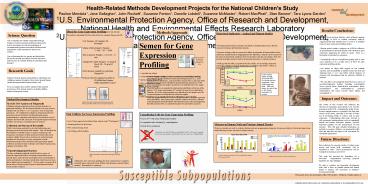
Levels of motor activity for SHR (N18) and WKY
(N18) rats from two experiments. Each symbol
represents mean SEM total activity for each of
four or five 30-min consecutive test sessions.
Maximize human-animal extrapolation by
identifying and validating common biomarkers from
observational human studies and experimental
animal studies and Focus on samples that
could be obtained with minimal invasiveness from
human subjects, including children, infants and
pregnant women.
Impact and Outcomes
Method Development Studies MALDI-TOF Analyses of
Fingernails Obtaining biological specimens from
newborn humans is a particular challenge. We
developed methods to use non-invasive samples
that can reflect in utero exposures, such as
fingernail specimens. We validated the
usefulness of fingernail DNA for assessing
relevant metabolic and detoxification genetic
polymorphisms, comparing nail results to blood
and buccal cell samples and found that a MALDI
TOF high throughput technique could be used in
place of standard genetic analysis. Collection
and Storage of Breastmilk Work is also being
conducted to develop fractionation and freezing
protocols for breast milk samples. This will
facilitate the development of reliable assays to
measure endogenous and exogenous constituents of
fresh and frozen breast milk, and to evaluate
whether blood, saliva, and urine are useful
surrogate mediums for the analysis of some
constituents of milk. Preliminary analyses have
determined the appropriate sample collection and
preservation techniques and subjects began giving
samples in December 2004. Neurodevelopmental
Markers We have evaluated peripheral whole blood
as a source of neurodevelopmental markers
including neurotrophins (nerve growth factor,
brain-derived neurotrophic factor,
neurotrophin-3, and neurotrophin-4), cytokines
(interleukin-6 and tumor necrosis factor alpha),
and neuropeptide Y. We were able to measure all
of the proteins of interest using Enzyme-Linked
ImmunoSorbent Assay (ELISA) analysis.
The results of this research will influence the
selection of biomarkers and methods to be used
for assessment in the NCS. Evaluating the
utility of non-invasive sample matrices is
essential to the long term success of this study,
especially if we hope to make use of developing
fields of science such as gene expression.
Understanding data needs relevant to risk
assessment implementation, such as comparable
animal and human biological markers, provides
important guidance for the measurement of NCS
outcome. EPA will gain valuable information on
methods to measure childrens environmental
health risks and data that can improve risk
assessment for susceptible populations.
Mercury in Human Nails and Various Animal
Tissues We have extended our work to evaluate
whether nails are an appropriate dosimeter of
exposure relative to blood and target tissue
brain following in utero exposure to methyl
mercury.
Future Directions
Data collection for ongoing studies of infant
motor activity and breast milk constituents will
be completed in 2005. These measurements will be
evaluated for inclusion in the NCS. This work
has provided the foundation for a successful
computational toxicology proposal headed by Dr.
Jane Gallagher. We plan to continue our
biomarker development work with a focus on
parallel animal and human studies to advance risk
assessment in childrens environmental health.
Levels of mercury observed in blood and
fingernail samples from human subjects.
Methyl mercury levels in various rodent tissues
Recommended

