

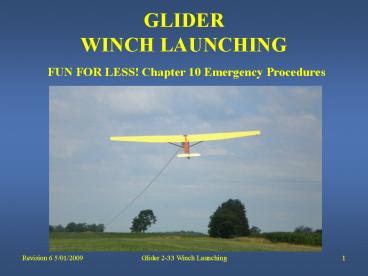
GLIDER WINCH LAUNCHING FUN FOR LESS Chapter 10 Emergency Procedures PowerPoint PPT Presentation
1 / 50
Title: GLIDER WINCH LAUNCHING FUN FOR LESS Chapter 10 Emergency Procedures
1
GLIDERWINCH LAUNCHING FUN FOR LESS! Chapter 10
Emergency Procedures
2
Winch Failure
- A winch failure can be
3
Winch Failure
- A winch failure can be
- A gradual loss of winch power
4
Winch Failure
- A winch failure can be
- A gradual loss of winch power
- A sudden loss of winch power
5
Winch Failure
- A winch failure can be
- A gradual loss of winch power
- A sudden loss of winch power
- A towline break
6
Winch Failure
- These failures can happen at any time!!
7
Winch Failure
- These failures can happen at any time!!
- A gradual deceleration in rate of climb, a nose
bob, and/or airspeed loss may be the sign of one
of these malfunctions
8
Winch Failure
- These failures can happen at any time!!
- A gradual deceleration in rate of climb, a nose
bob, and/or airspeed loss may be the sign of one
of these malfunctions - In any of these cases, pull release and land as
appropriate. How and where to land are covered
in the following slides
9
Towline/Winch Failure
- Towline/winch failure thinking and altitudes are
different in winch tow than in aerotow
10
Towline/Winch Failure
- Towline/winch failure thinking and altitudes are
different in winch tow than in aerotow - 300 feet and below, land straight ahead
11
Towline/Winch Failure
- Remember, at 300 feet in a winch tow you are not
even a third of the way down the length of the
runway!
12
Towline/Winch Failure
- In the case of a towrope or winch failure
13
Towline/Winch Failure
- In the case of a towrope or winch failure
- Get the nose down IMMEDIATELY!
14
Towline/Winch Failure
- In the case of a towrope or winch failure
- Get the nose down IMMEDIATELY!
- Get the nose down with enough push that the pilot
feels almost 0 G
15
Towline/Winch Failure
- In the case of a towrope or winch failure
- Get the nose down IMMEDIATELY!
- Get the nose down with enough push that the pilot
feels almost 0 G - Get the nose way down so far that you are not
just floating down to the ground, you are aiming
AT the ground!
16
Towline/Winch Failure
If rope breaks very early, land straight ahead
and avoid the towline
17
Towline/Winch Failure
If the break happens airborne at low altitude get
the nose way down IMMEDIATELY and promptly land
straight ahead
18
Towline/Winch Failure
Do not exceed the pitch targets for 50, 100, and
200 feet to avoid stalling if the towline breaks
19
Towline/Winch Failure
Pulling the release after the break is a good
idea to get rid of the excess rope if time permits
20
Towline/Winch Failure
- Once the nose is down, check altitude
21
Towline/Winch Failure
22
Towline/Winch Failure
23
Towline/Winch Failure
Turning back to the runway immediately, as in
aerotow, is not the best idea, as shown in this
example. The glider gets to 300 feet before the
1/3rd point of the runway.
24
Towline/Winch Failure
Instead, fly a flight path that will use more of
the available runway, and land ahead.
25
Towline/Winch Failure
Have your plan in mind BEFORE you launch
26
Towline/Winch Failure
Between 300 and 400 feet AFL there may still be
enough runway to land straight ahead
27
Towline/Winch Failure
Once above 300 feet and higher, the possibility
of a turn around exists
28
Towline/Winch Failure
X
You can see that an immediate turn around, as in
aerotow, is a bad idea!
29
Towline/Winch Failure
At 400 feet AGL and above a full pattern can be
attempted
30
Release Failure
31
Release Failure
- The SGS 2-33 is rated at 4.67 Gs. Most gliders
are above 4 Gs. Some are rated at over 5 Gs
32
Release Failure
- The SGS 2-33 is rated at 4.67 Gs. Most gliders
are above 4 Gs. Some are rated at over 5 Gs - The weak link at the glider end of the towline is
rated at a maximum of 2 Gs
33
Release Failure
- The SGS 2-33 is rated at 4.67 Gs. Most gliders
are above 4 Gs. Some are rated at over 5 Gs - The weak link at the glider end of the towline is
rated at a maximum of 2 Gs - As a result, the towline will break before doing
any damage to the glider
34
Release Failure
35
Release Failure
If no release, overfly the winch at Best L/D
speed so that the automatic back release feature
will work to release the towline
36
Release Failure
If the back release doesnt work the safety link
should break at this point
37
Release Failure
If the link doesnt break and the glider is
pulled down, fly in a circle around the winch at
Best L/D speed. Be careful not to let the wing
snag the towline
38
Release Failure
At this time the winch operator will be also be
using the guillotine on the towline
39
Questions
- If suffering a rope or winch failure at 300 feet
AGL on a normal winch launch, approximately how
far down the runway is the glider?
40
Questions
- If suffering a rope or winch failure at 300 feet
AGL on a normal winch launch, approximately how
far down the runway is the glider? - No more than 1/3rd down the runway length
41
Questions
- If suffering a rope or winch failure below 300
feet AGL on a normal winch launch, and after the
release is actuated, what should the pilot do?
42
Questions
- If suffering a rope or winch failure at or below
300 feet AGL on a normal winch launch, and after
the release is actuated, what should the pilot
do? - The pilot should land straight ahead
43
Questions
- If suffering a rope or winch failure between 300
feet and 400 feet AGL on a normal winch launch,
and after the release is actuated, what should
the pilot do?
44
Questions
- If suffering a rope or winch failure between 300
feet and 400 feet AGL on a normal winch launch,
and after the release is actuated, what should
the pilot do? - The pilot may land ahead if enough runway exists,
or maneuver for a turn around and a downwind
landing
45
Questions
- If suffering a rope or winch failure above 400
feet AGL on a normal winch launch, and after the
release is actuated, what should the pilot do?
46
Questions
- If suffering a rope or winch failure above 400
feet AGL on a normal winch launch, and after the
release is actuated, what should the pilot do? - Above 400 feet AGL a full pattern may be
contemplated depending on conditions
47
Questions
- If the towrope does not release when commanded by
the pilot, what should the pilot do first?
48
Questions
- If the towrope does not release when commanded by
the pilot, what should the pilot do first? - Overfly the winch, at or above L/D speed, to
allow the back release function of the tow hook
to actuate.
49
Questions
- If the towrope does not release when commanded by
the pilot, and overflying the winch at L/D speed
does not cause a back release, what should the
pilot do next?
50
Questions
- If the towrope does not release when commanded by
the pilot, and overflying the winch at L/D speed
does not cause a back release, what should the
pilot do next? - Circle the winch at L/D speed while the winch
operator activates the guillotine. Take care to
not snag the rope with the wing tip. Also, the
tow rope, rated at 2x glider gross weight max,
may break
Recommended

