

Empower Your Business with a Robust E-Commerce Portal Solution PowerPoint PPT Presentation
Title: Empower Your Business with a Robust E-Commerce Portal Solution
1
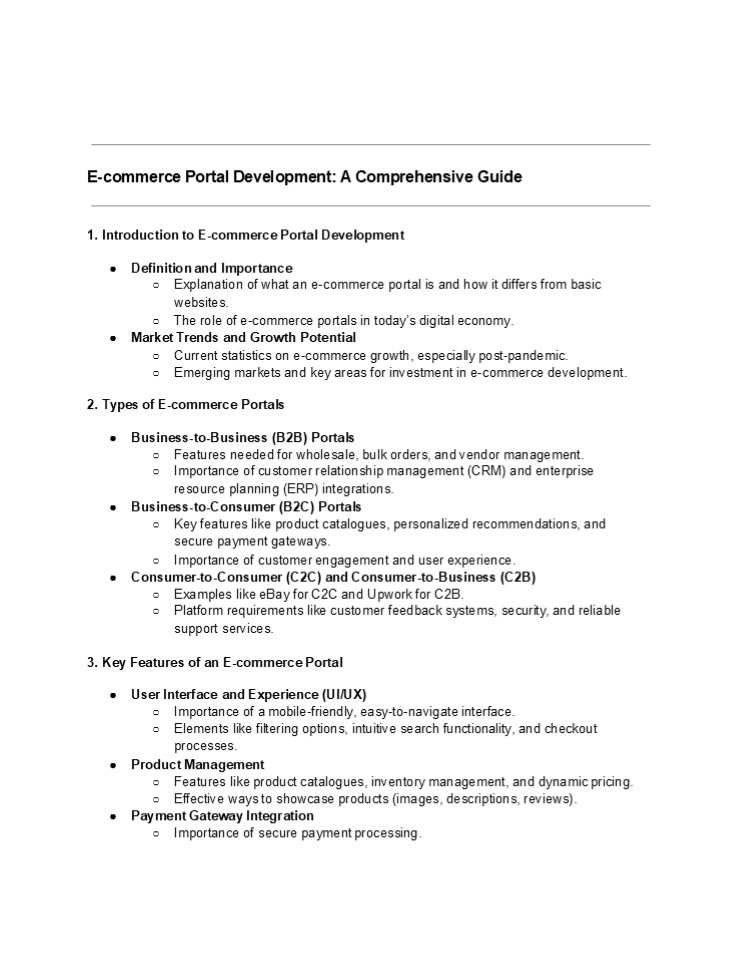
- E-commerce Portal Development A Comprehensive
Guide - Introduction to E-commerce Portal Development
- Definition and Importance
- Explanation of what an e-commerce portal is and
how it differs from basic websites. - The role of e-commerce portals in todays digital
economy. - Market Trends and Growth Potential
- Current statistics on e-commerce growth,
especially post-pandemic. - Emerging markets and key areas for investment in
e-commerce development. - Types of E-commerce Portals
- Business-to-Business (B2B) Portals
- Features needed for wholesale, bulk orders, and
vendor management. - Importance of customer relationship management
(CRM) and enterprise resource planning (ERP)
integrations. - Business-to-Consumer (B2C) Portals
- Key features like product catalogues,
personalized recommendations, and secure payment
gateways.
2
- Options for multiple payment methods, digital
wallets, and Buy Now Pay Later (BNPL) services.
- Security and Compliance
- Discussing SSL certificates, data encryption, and
PCI compliance. - Importance of regular security audits and GDPR
compliance for international customers.
- Order Management and Tracking
- Features for tracking, real-time notifications,
and order history. - Integrating shipping partners for streamlined
logistics.
3
- Steps to Develop an E-commerce Portal
- Planning and Research
- Market analysis, competitor benchmarking, and
user demographics study. - Setting goals for the portal increasing sales,
improving customer experience, etc. - Choosing the Right Technology Stack
- Overview of popular tech stacks like MEAN, MERN,
and LAMP. - Discussion on CMS options like Shopify,
WooCommerce, Magento, and custom development. - Design and Development
- Importance of designing a responsive layout.
- Creating a scalable back-end and database
architecture to manage high traffic and
transactions. - Testing and Quality Assurance
- Types of testing functional, usability,
security, and load testing. - Importance of real-time error handling and
monitoring tools. - Launch and Post-Launch
- SEO optimization, marketing, and soft-launch
approach. - Maintenance, updates, and scaling based on
customer feedback. - Advanced Features and Future of E-commerce
Portals
4
- Conclusion
- Future of E-commerce
- Trends like omnichannel retailing, eco-conscious
shopping, and hyper-personalization. - Getting Started with Your E-commerce Portal
- Summarizing key takeaways.
- Encouragement to start planning based on business
goals and market needs. - ?
5
(No Transcript)
Recommended

