

Making Knowledge Work for the Rural Poor PowerPoint PPT Presentation
1 / 45
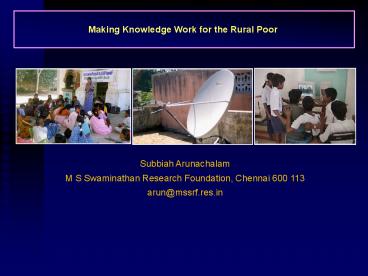
Title: Making Knowledge Work for the Rural Poor
1
Making Knowledge Work for the Rural Poor
Subbiah Arunachalam M S Swaminathan Research
Foundation, Chennai 600 113 arun_at_mssrf.res.in
2
I N F O R M A T I O N P R O D U C E R S
1992
Universities
Information Resources Centre
National Information Centres
Value Adders
Remote Sensing Centres
Knowledge Centres
Rural Families
The concept of an Information Village
3
Reaching the poorest of the poor January 1998
Information Knowledge(Locale Specific and
Demand Driven)
Value Adders
Supported by International Development Research
Center
4
Communication resources in surveyed Pondicherry
villages (1998)
House Poverty - Popula- Telephones TV
Sets Post Village holds Holds. tion Public Privat
e Total Cable Office Sorapet 626 264 3,052 1 3 3
00 150 y Vampupet 160 118 786 1 0 100 10 n Sel
lipet 424 313 1,899 2 0 110 50 y Thondamanatham
472 51 2,394 1 8 300 45 y Ramanathapuram
356 50 1,613 1 3 50 50 n Pillayarkuppam 421 54 2
058 1 1 75 50 y Olavaikal 106 12 733 1 0 14 0 n
Oussudu 444 5 2,227 1 0 25 0 n Uruvaiyaru 531
45 2,513 1 4 50 n. a. n Sathamangalam
433 268 2,095 1 4 75 30 y Kizhur
400 120 2,095 1 4 30 30 y Totals 4,373 1,300 21,
465 12 27 1,129 424 not workingpoverty
annual household income lt 16,000 Rupees (
400) Source M. S. Swaminathan Research
Foundation, June 1998
5
Information Linkages in Rural Systems (1998)
Company
Radio TV
Govt. Dept.
Univ.
KVK
External
Input supplier
Bank Credit
AO
BDO
Supra Local
Market
Trader
Other farmers
Other farmers
Farmer
Local
Strong Linkage
Weak Linkage
6
The Hub and Spokes Model
Information Knowledge(Locale Specific and
Demand Driven)
Nallavadu
Veerampattinam
Spread spectrum
Thirukanchipet
Periyakalapet
VHF
Pillayarkuppam
Embalam
Poornangkuppam
Koonichampet
Villianur (hub)
Kizhur
Kalitheerthalkuppam
Moorthykuppam
7
(No Transcript)
8
- Important news from local newspapers
- Meteorological report / Wave Height Map
- Vegetable prices at various markets including
farmers market - Bullion prices
- Acquisition / Purchase price of paddy / crop
varieties - Bio-Fertiliser Pesticide stock at go down
- Details of paddy (seed) at go down
- Employment News
- Govt. announcements / entitlements / training
details - Health Information
- Education (Entrance examination questions
answers, scolarship details etc.) - Agriculture Information (Farmers Dairy Animal
Husbandry / Agriculture) - Important / Emergency Telephone Numbers
- National / International postage rates
- Group insurance details
- Agricultural wages fixed by Social welfare
department - Information on Citizen Charter, Legal rights,
Potential Fishing Zone map etc. - Microenterprises information / training,
historical information on village etc.
9
http//www.nemoc.navy.mil/Library/Metoc/IndianOce
an/BayofBengal/Models/Swaps/SigWavHtandDir
Series/index.html
Info gathered using high-tech but delivered
through low-tech
10
Potential Fishing Zone DetailsPartnership
Indian National Center for Ocean Information
Services
11
Bridging the Digital Divide a powerful Tool
for bridging the gender divide Partnership
District Rural Development Agency, Banks,
District Information Center
12
Self-Help Group Accounting Software Partnership
District Rural Development Agency Banks
13
Sustainable Livelihoods for All The Micro
Enterprise cum Micro Credit Revolution
Partnership District Information Centre and
Rural Artisans
14
Software Hardware Training
15
Nammavur Seithi Twice-monthly News Letter
Partnership Govt. Departments, NGOs and All
India Raio
16
Rural Yellow Page Index (Sample)
Agricultural Equipment (Rental) Auto Works
Banks Address Barber Shop Stationary Shop
Brick Sellers Building and Hut Contractor
Cable TV Operators Cattle Agents Cattle Food
Centres Cement Agencies Cool Drink Shops
Co-operative Milk Society Cycle Store
Education Electrical Electronic Shops
Factories Fertilizer, Pesticides Shops Gas
Agencies Government Institutions Hospitals and
Clinics Hotels Industries Institutions
Library Lottery Agencies Narpani Mandram News
Paper Agent Panchayat Office Pawn Broking
Agency and Jewell Shop Post Office Pot Maker
Printing Press Grocery Shop Ration Shop Real
Estate Rice Mills Sweet Stall Tailoring
Shops Temples Textiles Timber Shop Tom Tom Troop
for Death Ceremony Travels Agents Video and
Studio Waste Paper Mart etc
17
Interactions on Nature Cure and Herbal
Remedies Partnership SEVA (NGO)
18
Knowledge of Animal Husbandry through Touch
Screen Databases
Partnership Rajiv Gandhi College of Veterinary
Animal Sciences (RGCOVAS)
19
Partnership Aravind Eye Hospital
20
Partnership Centre for Science, Society and
Culture
21
Policy Makers Workshop October 8-9, 2003
Every village a knowledge centre There is a need
for developing a master plan coupled with a
business plan for extending the benefits of ICT
to all the 600,000 villages in India by 2007,
which marks the 60th anniversary of our
Independence. The master plan should help to link
technology-knowledge-rural women and men in a
symbiotic manner. The investment needs will have
to be estimated and business plans prepared. A
National Alliance for ICT for Poverty Eradication
may be established for launching the Every
Village a Knowledge Centre movement. Such an
alliance should include the private sector,
cooperatives, NGOs, R D institutions, womens
associations, mass media and appropriate
government agencies.
22
National Alliance for Mission 2007 Platform for
partnership
Web of Partners
General Body
Steering Committee
Task Forces Connectivity Space
Applications Content and Application Policy Manage
ment of Knowledge Centers ICT SHGs Resources
23
Major Outcomes
- The National Alliance for Mission 2007
representing a coalition of the concerned, will
facilitate and accelerate the spread of the rural
knowledge centre movement and will function, like
the Consultative Group on International
Agricultural Research (CGIAR), without a legal
structure. - At the village level, on the basis of local
dynamics a committee will be formed in
consultation with the Gram Sabha for managing
knowledge centers. This committee will help to
organize training, building capacity,
peer-to-peer learning among the knowledge workers
and local entrepreneurs. These may be Panchayats,
Self-help groups, common interest groups, human
networks and community-based organizations.
24
Major Outcomes
- There are numerous ICT tools Internet, Cable
TV, Radio, Cellphone and vernacular press. The
National alliance doesnt believe in the absolute
superiority of any particular tool, rather in
using an appropriate mix of these tools that
would benefit the people the most. - The constitution of a Steering Committee for
Mission 2007 comprising governmental and civil
society organizations and the media, private
sector, professionals and academia. - The Mission will be implemented on the principle
of social inclusion, social relevance and gender
equity. Transaction costs will be kept low and
sense of ownership will be created by fostering
the growth of an ICT-SHG movement.
25
National Alliance Founding Members
- M S Swaminathan Research Foundation, Chennai
- NASSCOM Foundation, New Delhi
- OneWorld South Asia, New Delhi
- Netaji Subhas Open University (NSOU)
- Tata Sons Limited, Mumbai
- Tamil Nadu Agricultural University, Coimbatore
- Dr B R Ambedkar Open University (BRAOU)
- Asian Disaster Preparedness Center
- State Bank of India, Mumbai
- Indian Institute of Information Technology and
Management, Kerala - Madras Institute of Development Studies
- Development Alternatives, New Delhi
- Indian Institute of Technology-Madras
- International Crops Research Institute for the
Semi-Arid Tropics - Department of Agriculture, Maharashtra
- National Foundation for India
- Indira Gandhi National Open University
26
Facilitating multistakeholder partnerships
between CSOs, Govt. agencies, research
institutes, academic institutions, corporates..
May 2004 40 organisations October 2004..80
and counting January 2005.100 and counting
27
We have not only lost lives, but also our
livelihood. It may take months, perhaps years for
us to recover. Our future is totally dark.
Fishermen at Periayakalapet
28
Delivering relief materials in an organized way
29
Jamsetji Tata National Virtual Academy for Rural
Prosperity NVA
ICT-enabled knowledge flow Lab to Lab, Lab to
Land, Land to Lab, Land to Land
Satellite
Web based interactive portal
State Level Hub (MSSRF) Data Managers (both
connectivity and content)
Data Generators Providers
Data Users (Rural families)
Block level hub
30
ISRO MSSRF Village Resource Center VRC
Tele-Agriculture Tele-Fisheries Tele-Medicine Tele
-Health Tele-Education
MSSRF-Chennai
Sempatti
Rameswaram
Thiruvaiyaru
31
suitably blending the information derived from
earth observation satellites with ground derived
and weather related information, locale-specific
community advisory services can be provided.
Community based vulnerability and risk related
information, provision of timely early warning
and dissemination of severe weather related
information can lead to reliable disaster
management support at the village level.
32
India Meteorological Department (IMD) has brought
out two atlases on the Tracks of storms and
depressions in the Bay of Bengal and the Arabian
Sea for the period of 1877-1970 and 1971-1990.
As per the analysis of the data for the last
100-year period, there have been 1318 cyclonic
storms and 551 super cyclonic storms. From the
data, we found Nagapattinam with 5.5 is the
most vulnerable site in Tamil Nadu Probable
Maximum Storm Surge.
33
National Center for Medium Range Weather
Forecasting
District Level Value Adders (integrated advisory
system with the help of research institutes,
policy makers and meteorological department)
India Meteorological Department
Block Level Information Resources Center
Rural Knowledge Centres
Rural Families
34
Agriculture Scenario
- More than Rs.60 million worth of agricultural
crops have been washed away in Nagapattinam
District. - More than Rs.600,000 worth of horticulture crops
have also been damaged. 26 agricultural villages
have been affected in 4 taluks of Nagapattinam
District. - The seawater intrusion has polluted the
surrounding sub soil water source through
seawater entering into the rivers (upto 10 km
inland). - An analysis of 264 soil samples in 46 villages 5
taluks in Nagapattinam district 11 days after
the Tsunami attack revealed salt level (EC) of
the soils in the affected areas has risen to 22
dsm from lt1.0 dsm
35
Hub - India
Hub - Africa
Internet
Access Points
Access Points
36
(No Transcript)
37
Ham Radio and Hambulance
38
Beyond Tsunami Agenda and Action
- Ecological Rehabilitation establishment of
bio-shields along the coast involving raising
plantations of mangroves, salicornia, atriplex,
causarina, bamboo and other appropriate salt
tolerant species (halophytes) - Agronomic Rehabilitation developing a detailed
strategy for helping farm families affected by
seawater ingress - Livelihood Rehabilitation establishing coastal
biovillages with concurrent attention to sea
based and land based livelihood opportunities - Information Empowerment through a Network of
Knowledge Centres connectivity, content,
capacity building and care and management
39
Bioshield - Mangroves are a group of trees and
shrubs growing in muddy substratum in the places
where river water mixes with seawater
40
Specialized Root System
Grow in Rows and Act as a Barrier
41
Saved Life and Property During Tsunami in the
Pichavaram region
2004
Bay of Bengal
MGR Nagar
Killai fisher colony
Mangroves
Pichavaram
T.S.Pettai
42
Multiple Micro-enterprises for livelihood
security - Biovillage
43
Networking of Coastal Knowledge Centers
44
Organizational Considerations
- Social Mobilization and Need / Demand Assessment
- Community Participation
- Connectivity
- Content
- Hub and Spokes Model
- Management, Monitoring and Evaluation
- Services Multipurpose Centre
- Partnership
- Capacity Building
- Sustainability
45
Conclusion
- Managing technology and connectivity
- Managing content creation, gathering, validation
and dissemination - Managing delivery of content on time
- Managing for improving the well-being of the
whole community - Going beyond ICT, content and knowledge center
giving a human touch to the whole programme
Recommended

