

THE MID CANADA LINE TECHNICAL ADVISORY TEAM and PROJECT UPDATE PowerPoint PPT Presentation
1 / 54
Title: THE MID CANADA LINE TECHNICAL ADVISORY TEAM and PROJECT UPDATE
1
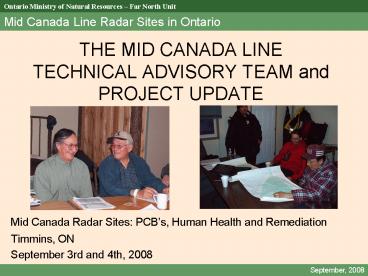
THE MID CANADA LINETECHNICAL ADVISORY TEAM and
PROJECT UPDATE
- Mid Canada Radar Sites PCBs, Human Health and
Remediation - Timmins, ON
- September 3rd and 4th, 2008
2
(No Transcript)
3
Technical Advisory TeamWho They Are and What
They Do
- Assembly of First Nation and Ontario Government
representatives - Review technical documents and information
- Advice on TEK studies and review translations of
summary documents - Advice on communication with community from a
community perspective, and utilize the most
appropriate medium/strategy (radio, community
channel, community meeting etc.) - Develop recommendations for a Remediation
Strategy and Environmental Clean Up Options
4
Guiding Principals to Develop a Remediation
Strategy
- To protect human health.
- To protect the environment.
- To ensure public safety.
- To ensure compliance with legal and policy
requirements. - To ensure First Nation concerns are addressed in
the planning and reclamation process (eg.
TEK-Sabotowan). - To outline realistic, cost effective options for
site cleanup or mitigation of hazards. - To keep Communities well informed
5
Remediation Strategy
- Full remediation of all remaining sixteen (16)
sites over six (6) years that includes removing
hazardous waste, land filling non-hazardous
waste/debris, demolition of all buildings and
structures, on-site treatment of hydrocarbon
contaminated soils and off-site treatment or
disposal of other contaminated soils and debris.
6
Examples of Waste
- Hazardous Waste
- Waste defined by legislation that poses a higher
risk for public health and the environment and
must be destroyed, provided the technology exists
(eg. Higher level PCB soil) - Non-hazardous Waste
- Waste defined by legislation that poses a lower
risk and can be placed in an approved engineered
landfill (e.g. clean steel, concrete etc.) - Hydrocarbon Contaminated Soils
- Can be treated using landfarming (e.g. soil
contaminated with fuel oil)
7
Remediation Standards
- Options for a Remediation Standard are based on
Property Use and include - Agriculture or Other Property Use (eg. PCB in
soil gt0.5 ppm) - Residential/Parkland/Institutional Property Use
(eg. PCB in soil gt5 ppm) - Industrial/Commerical/Community Property Use (eg.
PCB in soil gt25 ppm)
8
Project Remediation Standard
- Agriculture or Other Property Use (eg. PCB in
soil gt0.5 ppm) - The remediation standard will follow the Soil,
Ground Water and Sediment Standards for Use Under
Part XV.1 of the Environmental Protection Act
March 9, 2004 Table 2 Full Depth Generic Site
Condition Standard in a Potable Water Condition
and the Agriculture or Other property use is
consistent with the remediation strategy as this
does nor limit future land use designations.
9
- Relay - Site 06
10
Map of Mid Canada Line Radar Sites in Ontario
17 sites in total
11
Historic Site Photo
Relay Site 06
12
Site Map
Relay Site 06
13
Site Visit August 2007
Relay Site 06
14
Site Visit August 2007
Relay Site 06
15
- Kempis Mountain -Site 07
16
Map of Mid Canada Line Radar Sites in Ontario
17 sites in total
17
Aerial View
Kempis Mountain Site 07
18
Floor Slab of Building
Kempis Mountain Site 07
19
Southern Sites (060, 070)
- Hazardous Waste
- All hazardous waste by definition will be shipped
off-site for treatment. - Non-Hazardous Waste
- All non-hazardous waste will be treated and/or
landfilled at an existing licensed facility
capable of accepting this waste. On-site
landfills are not required as these sites are
readily assessable.
20
- Site 415 at Cape Henrietta
- (includes site 416, 418 and 421)
21
Map of Mid Canada Line Radar Sites in Ontario
17 sites in total
22
Radar Dishes
Cape Henrietta Site 415
23
Cape Henrietta Site 415
Site Field Work (Delineation) with MERC/MNR
Partnership July 2007
24
Cape Henrietta Site 415
Site Field Work (Delineation) with MERC/MNR
Partnership July 2007
25
Cape Henrietta Site 415
Site Field Work (Delineation) with MERC/MNR
Partnership July 2007
26
Cape Henrietta Site 415
Site Field Work (Delineation) with MERC/MNR
Partnership July 2007
27
- Winisk - Site 500
- (include sites 503, 506, 427 and 424)
28
Map of Mid Canada Line Radar Sites in Ontario
17 sites in total
29
Barrel Pile
Winisk Site 500
30
Town Site
Winisk Site 500
31
Airport Hanger and Air Traffic Control Tower
Winisk Site 500
32
Northern Sites Winisk, Cape Henrietta Maria and
the seven (7) small Doppler Sites in Polar Bear
Provincial Park
- Hazardous Waste
- All hazardous waste by definition will be shipped
off-site for treatment. - Non Hazardous Waste
- Non-hazardous waste will be land filled at site
415 and 500 (exceptions include low level pcb
contaminated soils and asbestos shipped
off-site). Hydrocarbon contaminated soils at
sites where volumes exceed gt10 m3 will be treated
at Site 500 and 415 (landfarming)
33
Other Landfill Options Considered for Winisk and
Cape Henrietta Maria
- Landfills at all Sites
- Landfills at Site 415 and 500 only
- Landfill at Site 500 only
- No on-site landfills
34
- Fort Albany Site 05
- Clean Up 2001
35
Cleanup Program of 2001
Fort Albany Clean-up Site 05
36
5,000 Tones of PCB Contaminated Soil was Removed
and Shipped to an Off Site Treatment Facility
Fort Albany Clean-up Site 05
37
Transfer Loaded Containers to Awaiting Ship
Fort Albany Clean-up Site 05
38
Sea Transport
Fort Albany Clean-up Site 05
39
Loaded Truck En Route to Destruction Facility
Fort Albany Clean-up Site 05
40
Debris Pile
Fort Albany Clean-up Site 05
41
Construction of Engineered Landfill for Disposal
of Non-Hazardous Waste
Fort Albany Clean-up Site 05
42
Construction of Engineered Landfill for Disposal
of Non-Hazardous Waste
Fort Albany Clean-up Site 05
43
- Fort Severn Sites
- (Sites 509, 512, 515, 518 and 521)
44
Map of Mid Canada Line Radar Sites in Ontario
17 sites in total
45
Small Site
Small Sites
46
Scattered Debris
Small Sites
47
Fort Severn Sites
Road Mapping Project with Fort Severn/MNR
Partnership April 2007
48
Fort Severn Sites
Road Mapping Project with Fort Severn/MNR
Partnership April 2007
49
Fort Severn Sites
Road Mapping Project with Fort Severn/MNR
Partnership April 2007
50
Northern Sites Fort Severn Sites 509 521
(Five Sites)
- Hazardous Waste
- All hazardous waste by definition will be shipped
off-site for treatment. - Non-Hazardous Waste
- All non-hazardous waste (including hydrocarbon
contaminated soils gt10 m3) will be landfilled at
an existing licensed facility capable of
accepting this waste (eg. Fort Severn, Manitoba
etc.)
51
Project Schedule
may expedite Fort Severn Sites earlier in
project timelines
52
Project Update Ontario/Canada Negotiations for
Cost Sharing
- 2005 March 2008
- MNR is directed to seek a cost sharing agreement
with the federal government for a full clean up
of all the Mid Canada Line radar sites that is
expected to cost 85 - 100 Million - March 2008 - MNR negotiates a final draft
Contribution Agreement for federal funding agree
to coordinate final approval early June - March 2008 Present
- MNR receives approval from Ontario June 4th 2008
to sign the Contribution Agreement with Canada
and fund our of share project - DND was not able to secure the federal
government approval as scheduled in June 2008
the item is to be considered in the fall - Implications of a Federal election call are
uncertain at this time
53
Next Steps
- MNR (Ontario) to Sign Cost Sharing Agreement with
DND (Canada) once negotiated cost sharing
agreement is approved by Federal Government - Complete the Requirements of the respective
Provincial and Federal Environmental Assessment
Processes - Complete Agreements with key First Nation
Communities
54
Bruce Mighton (bruce.mighton_at_ontario.ca) Far
North Project Coordinator Ministry of Natural
Resources (705) 272-7142 (800) 667-1940
Recommended

