

Distributed Microsystems Laboratory: Developing Microsystems that Make Sense PowerPoint PPT Presentation
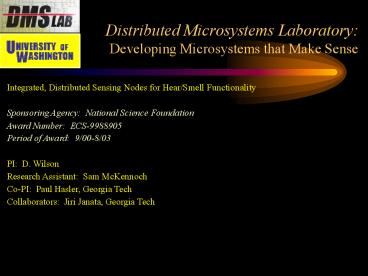
Title: Distributed Microsystems Laboratory: Developing Microsystems that Make Sense
1
Distributed Microsystems LaboratoryDeveloping
Microsystems that Make Sense
Integrated, Distributed Sensing Nodes for
Hear/Smell Functionality Sponsoring Agency
National Science Foundation Award Number
ECS-9988905 Period of Award 9/00-8/03 PI D.
Wilson Research Assistant Sam McKennoch Co-PI
Paul Hasler, Georgia Tech Collaborators Jiri
Janata, Georgia Tech
2
Distributed Microsystems LaboratoryDeveloping
Microsystems that Make Sense
- Goals To combine the functions of hear and
smell (auditory and chemical sensing) into
two-chip sensing nodes for distributed (multiple
location) sensing. - Chip 1
- Auditory Processing
- Chemical Sensor control and preprocessing
- Chip 2 8-element ChemFET array
- Applications for 3-node proof-of-concept system
- Consumer redundant breath alcohol analysis
- Environmental pipeline leak monitoring
- Military ground vehicle identification
- Hear enables smell to reduce system power
dissipation
3
Distributed Microsystems LaboratoryIntegrated,
Distributed Sensing Nodes for Hear/Smell
External Microphone
Microprocessor Sensor Power Control Final
Decision Making Signal Recognition
Chip 1
Vapor Airflow
Chip 2
4
Distributed Microsystems LaboratoryIntegrated,
Distributed Sensing Nodes for Hear/Smell
- Chip 1 Auditory Processing
- Distributed, High-Density Bandpass Filter Bank
- Biologically-inspired by mammalian cochlea
- Distributes auditory signal into multiple
frequency bands using continuous windowing
(analog) in time - Auditory Signal Processing
- Extracts cepstral coefficients and other features
relevant to distinguishing sounds of interest
from each other and from interferents - Chemical Sensor Signal Processing
- Baseline compensation forces sensor outputs to
same value at baseline (no-stimulus state), with
minimal distortion - Signal Preprocessing provides communicaton
among signals, preprocesses for
concentration-independent analyte discrimination
and low-noise concentration determination (and
alarm generation)
5
Distributed Microsystems LaboratoryIntegrated,
Distributed Sensing Nodes for Hear/Smell
- Chip 2 Chemical Sensor Array
- Eight independent ChemFETs
- Polymer-based coatings
- Coating matrix modified to provide heterogeneous
functionality - Custom-fabricated at Georgia Tech
- Chip 3 Microcontroller
- Turns power-on to Chip 2 when a sound of interest
is detected - Performs final pattern recognition
- Preprocessed auditory signals from Chip 1
- Preprocessed chemical signals (when available)
from Chip 1 - Provides Control Functions
- Sampling of ChemFET sensors
- Extraction of ChemFET signals
- Controls auto-calibration cycles of auditory and
chemical modes
6
Distributed Microsystems LaboratoryIntegrated,
Distributed Sensing Nodes for Hear/Smell
- Recent Results Baseline Compensation
- AZBLC compensates for an unknown initial sensor
state (an artifact of the sensor manufacturing
process not correlated with chemical
concentration) to produce an output that is
representative only of the differential sensor
state change.
Uncompensated Outputs
Compensated Outputs
7
Distributed Microsystems LaboratoryIntegrated,
Distributed Sensing Nodes for Hear/Smell
- Recent Results Baseline Compensation
- Justification for Baseline Compensation
- Uncompensated outputs can cause baseline
variations to consume resolution of the
subsequent A/D converter, leaving little
resolution allocated to signal differentiation - Baseline compensation without distortion requires
the tailoring of the baseline compensation
circuits to the chemical model of the sensor
involved. Minimal distortion ensures that
sensors can be replaced or adjusted for drift
without requiring a new calibration model. - Current Status
- Discrete baseline compensation circuits are
complete and tested for - Carbon black composite polymer films
- ChemFETs
- Integrated baseline compensation circuits for
processing signals from composite, chemically
sensitive, polymer films are in fabrication - Integrated baseline compensation circuits for
ChemFETs are currently in design
8
Distributed Microsystems LaboratoryIntegrated,
Distributed Sensing Nodes for Hear/Smell
- Chemical Sensor Modeling
- Initial sensor model results are shown for
sensors that have different initial volume
percentages of the conductor carbon-black. - As the ratiometric volume changes (due to
swelling caused by a chemical), the sensor
resistance also increases. - The sharp increases in dr/r at CB .34 to .37
are due to the sensor passing through its
percolation point, i.e. this is the point (not
accounting for electron tunneling) at which there
are no longer any conduction paths through the
insulating matrix. - Similar models are in progress for the ChemFET to
facilitate effective signal preprocessing
circuits and architectures.
Recommended

