

CASE IH PUMA 140 Tractor Service Repair Manual Instant Download PowerPoint PPT Presentation
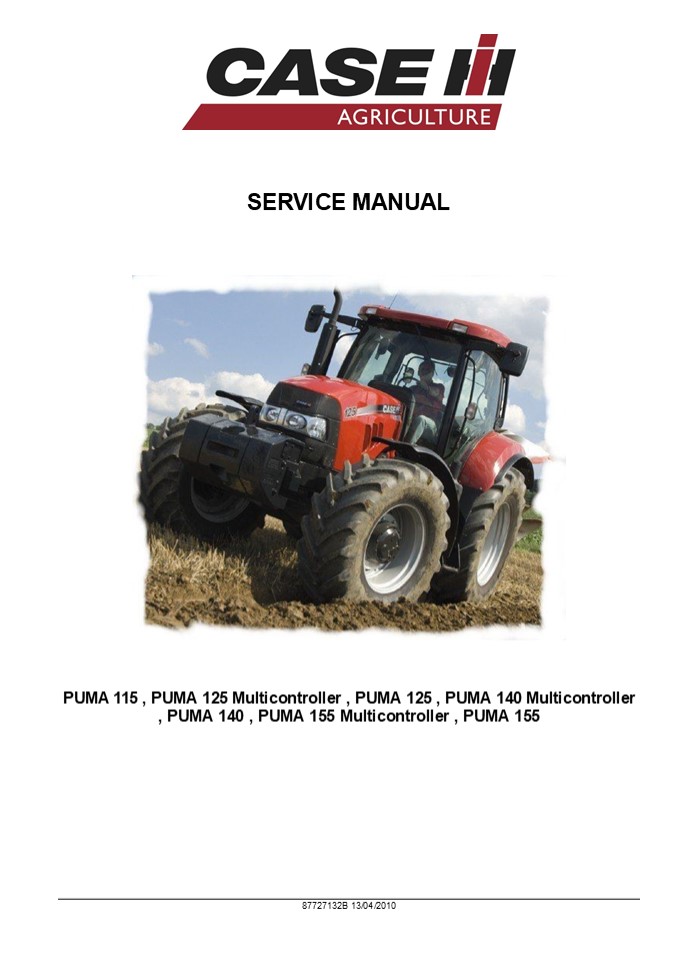
Title: CASE IH PUMA 140 Tractor Service Repair Manual Instant Download
1
SERVICE MANUAL
PUMA 115 , PUMA 125 Multicontroller , PUMA 125 ,
PUMA 140 Multicontroller , PUMA 140 , PUMA 155
Multicontroller , PUMA 155
87727132B 13/04/2010
2
Contents
INTRODUCTION HYDRAULIC - PNEUMATIC - ELECTRICAL -
ELECTRONIC SYSTEMSA PRIMARY HYDRAULIC POWER
SYSTEM . . . . . . . . . . . . . . . . . . . . .
. . . . . . . . . . . . . . . . . . . . . . . . .
. A.10.A PRIMARY HYDRAULIC POWER SYSTEM Closed
center mechanical remote valve . . . . A.10.B
PRIMARY HYDRAULIC POWER SYSTEM Electro-hydraulic
remote valve . . . . . . . . . . . . . .
A.10.C SECONDARY HYDRAULIC POWER SYSTEM. . . . .
. . . . . . . . . . . . . . . . . . . . . . . . .
. . . . . . . . . . . . . A.12.A PNEUMATIC
SYSTEM . . . . . . . . . . . . . . . . . . . . .
. . . . . . . . . . . . . . . . . . . . . . . . .
. . . . . . . . . . . . . . . . . . . . . .
A.20.A ELECTRICAL POWER SYSTEM . . . . . . . . .
. . . . . . . . . . . . . . . . . . . . . . . . .
. . . . . . . . . . . . . . . . . . . . . . .
A.30.A ELECTRICAL POWER SYSTEM . . . . . . . . .
. . . . . . . . . . . . . . . . . . . . . . . . .
. . . . . . . . . . . . . . . . . . . . . . .
A.30.A ELECTRONIC SYSTEM . . . . . . . . . . . .
. . . . . . . . . . . . . . . . . . . . . . . . .
. . . . . . . . . . . . . . . . . . . . . . . . .
. . . . A.50.A FAULT CODES . . . . . . . . . . .
. . . . . . . . . . . . . . . . . . . . . . . . .
. . . . . . . . . . . . . . . . . . . . . . . . .
. . . . . . . . . . . . . . . A.50.A ENGINE AND
PTO IN ...........................................
......................... B ENGINE . . . . . . .
. . . . . . . . . . . . . . . . . . . . . . . . .
. . . . . . . . . . . . . . . . . . . . . . . . .
. . . . . . . . . . . . . . . . . . . . . . . . .
. B.10.A FUEL AND INJECTION SYSTEM. . . . . . .
. . . . . . . . . . . . . . . . . . . . . . . . .
. . . . . . . . . . . . . . . . . . . . . . . . .
B.20.A AIR INTAKE SYSTEM . . . . . . . . . . . .
. . . . . . . . . . . . . . . . . . . . . . . . .
. . . . . . . . . . . . . . . . . . . . . . . . .
. . . . . . . B.30.A EXHAUST SYSTEM. . . . . . .
. . . . . . . . . . . . . . . . . . . . . . . . .
. . . . . . . . . . . . . . . . . . . . . . . . .
. . . . . . . . . . . . . . B.40.A ENGINE COOLANT
SYSTEM . . . . . . . . . . . . . . . . . . . . .
. . . . . . . . . . . . . . . . . . . . . . . . .
. . . . . . . . . . . . . . B.50.A LUBRICATION
SYSTEM . . . . . . . . . . . . . . . . . . . . .
. . . . . . . . . . . . . . . . . . . . . . . . .
. . . . . . . . . . . . . . . . . . . .
B.60.A STARTING SYSTEM . . . . . . . . . . . . .
. . . . . . . . . . . . . . . . . . . . . . . . .
. . . . . . . . . . . . . . . . . . . . . . . . .
. . . . . . . B.80.A TRANSMISSION, DRIVE AND PTO
OUT.........................................C TRAN
SMISSION Powershift . . . . . . . . . . . . . . .
. . . . . . . . . . . . . . . . . . . . . . . . .
. . . . . . . . . . . . . . . . . . . . . .
C.20.E ADDITIONAL REDUCERS Creeper. . . . . . . .
. . . . . . . . . . . . . . . . . . . . . . . . .
. . . . . . . . . . . . . . . . . . . . .
C.30.C ADDITIONAL REDUCERS Overdrive . . . . . .
. . . . . . . . . . . . . . . . . . . . . . . . .
. . . . . . . . . . . . . . . . . . . . .
C.30.D REAR PTO Hydraulic. . . . . . . . . . . .
. . . . . . . . . . . . . . . . . . . . . . . . .
. . . . . . . . . . . . . . . . . . . . . . . . .
. . . . . . . C.40.C TRANSMISSION Semi-Powershift
. . . . . . . . . . . . . . . . . . . . . . . . .
. . . . . . . . . . . . . . . . . . . . . . . . .
. . . . . C.20.D AXLES, BRAKES AND
STEERING..........................................
........D FRONT AXLE . . . . . . . . . . . . . .
. . . . . . . . . . . . . . . . . . . . . . . . .
. . . . . . . . . . . . . . . . . . . . . . . . .
. . . . . . . . . . . . . D.10.A REAR AXLE . . .
. . . . . . . . . . . . . . . . . . . . . . . . .
. . . . . . . . . . . . . . . . . . . . . . . . .
. . . . . . . . . . . . . . . . . . . . . . . . .
. D.12.A 2WD-4WD SYSTEM Hydraulic . . . . . . . .
. . . . . . . . . . . . . . . . . . . . . . . . .
. . . . . . . . . . . . . . . . . . . . . . . . .
. D.14.C
87727132B 13/04/2010
3
STEERING Hydraulic. . . . . . . . . . . . . . . .
. . . . . . . . . . . . . . . . . . . . . . . . .
. . . . . . . . . . . . . . . . . . . . . . . . .
. . . D.20.C STEERING AutoPilot . . . . . . . . .
. . . . . . . . . . . . . . . . . . . . . . . . .
. . . . . . . . . . . . . . . . . . . . . . . . .
. . . . . . . . . . . D.20.E SERVICE BRAKE
Mechanical . . . . . . . . . . . . . . . . . . .
. . . . . . . . . . . . . . . . . . . . . . . . .
. . . . . . . . . . . . . . . . D.30.B SERVICE
BRAKE Hydraulic. . . . . . . . . . . . . . . . .
. . . . . . . . . . . . . . . . . . . . . . . . .
. . . . . . . . . . . . . . . . . . . .
D.30.C SERVICE BRAKE Pneumatic . . . . . . . . .
. . . . . . . . . . . . . . . . . . . . . . . . .
. . . . . . . . . . . . . . . . . . . . . . . . .
. . D.30.E PARKING BRAKE Mechanical . . . . . . .
. . . . . . . . . . . . . . . . . . . . . . . . .
. . . . . . . . . . . . . . . . . . . . . . . . .
. . . D.32.B BRAKE CONNECTION Hydraulic . . . . .
. . . . . . . . . . . . . . . . . . . . . . . . .
. . . . . . . . . . . . . . . . . . . . . . . . .
. D.34.C SUSPENSION Hydraulic . . . . . . . . . .
. . . . . . . . . . . . . . . . . . . . . . . . .
. . . . . . . . . . . . . . . . . . . . . . . . .
. . . . . D.40.C WHEELS AND TRACKS Wheels. . . .
. . . . . . . . . . . . . . . . . . . . . . . . .
. . . . . . . . . . . . . . . . . . . . . . . . .
. . . D.50.C PARKING BRAKE Electronic . . . . . .
. . . . . . . . . . . . . . . . . . . . . . . . .
. . . . . . . . . . . . . . . . . . . . . . . . .
. . . . . D.32.D FRAME AND CAB ...................
..................................................
.... E FRAME Primary frame . . . . . . . . . . .
. . . . . . . . . . . . . . . . . . . . . . . . .
. . . . . . . . . . . . . . . . . . . . . . . . .
. . . . . . . E.10.B SHIELD . . . . . . . . . . .
. . . . . . . . . . . . . . . . . . . . . . . . .
. . . . . . . . . . . . . . . . . . . . . . . . .
. . . . . . . . . . . . . . . . . . . . . . .
E.20.A USER PLATFORM . . . . . . . . . . . . . .
. . . . . . . . . . . . . . . . . . . . . . . . .
. . . . . . . . . . . . . . . . . . . . . . . . .
. . . . . . . . E.34.A ENVIRONMENT CONTROL
Heating, ventilation and air-conditioning. . . .
. . . . . . . . . . . . . . . . E.40.D HITCH AND
WORKING TOOL .....................................
...................H HITCH Front hitch . . . . .
. . . . . . . . . . . . . . . . . . . . . . . . .
. . . . . . . . . . . . . . . . . . . . . . . . .
. . . . . . . . . . . . . . . . . . H.10.B HITCH
Rear hitch. . . . . . . . . . . . . . . . . . . .
. . . . . . . . . . . . . . . . . . . . . . . . .
. . . . . . . . . . . . . . . . . . . . . . . . .
. . . H.10.C HITCH Electronic draft control. . .
. . . . . . . . . . . . . . . . . . . . . . . . .
. . . . . . . . . . . . . . . . . . . . . . . . .
. . . . . . . H.10.D
87727132B 13/04/2010
4
https//www.ebooklibonline.com Hello dear
friend! Thank you very much for reading. Enter
the link into your browser. The full manual is
available for immediate download. https//www.eb
ooklibonline.com
5
INTRODUCTION
87727132B 13/04/2010 1
6
INTRODUCTION Foreword Technical
Information This manual has been produced by a
new technical information system. This new system
is designed to deliver technical information
electronically through CD-ROM and in paper
manuals. A coding system called ICE has been
developed to link the technical information to
other Product Support functions e.g.
Warranty. Technical information is written to
support the maintenance and service of the
functions or systems on a customers machine.
When a customer has a concern on his machine it
is usually because a function or system on his
machine is not working at all, is not working
efficiently, or is not responding correctly to
his commands. When you refer to the technical
information in this manual to resolve that
customers concern, you will find all the
information classified using the new ICE coding,
according to the functions or systems on that
machine. Once you have located the technical
information for that function or system then you
will find all the mechanical, electrical or
hydraulic devices, compo- nents, assemblies and
sub assemblies for that function or system. You
will also find all the types of information that
have been written for that function or system,
the technical data (specifications), the
functional data (how it works), the diagnostic
data (fault codes and troubleshooting) and the
service data (remove, install adjust, etc.). By
integrating this new ICE coding into technical
information , you will be able to search and
retrieve just the right piece of technical
information you need to resolve that customers
concern on his machine. This is made possible by
attaching 3 categories to each piece of technical
information during the authoring process. The
first category is the Location, the second
category is the Information Type and the third
category is the Product
- LOCATION - is the component or function on the
machine, that the piece of technical information
is going to describe e.g. Fuel tank. - INFORMATION TYPE - is the piece of technical
information that has been written for a
particular component or function on the machine
e.g. Capacity would be a type of Technical Data
that would describe the amount of fuel held by
the Fuel tank. - PRODUCT - is the model that the piece of
technical information is written for.
Every piece of technical information will have
those 3 categories attached to it. You will be
able to use any combination of those categories
to find the right piece of technical information
you need to resolve that customers concern on his
machine. That information could be
the description of how to remove the cylinder
head a table of specifications for a hydraulic
pump a fault code a troubleshooting table a
special tool
87727132B 13/04/2010 3
7
INTRODUCTION How to Use this Manual This manual
is divided into Sections. Each Section is then
divided into Chapters. Contents pages are
included at the beginning of the manual, then
inside every Section and inside every Chapter. An
alphabetical Index is included at the end of a
Chapter. Page number references are included for
every piece of technical information listed in
the Chapter Contents or Chapter Index. Each
Chapter is divided into four Information types
Technical Data (specifications) for all the
mechanical, electrical or hydraulic devices,
components and, assemblies. Functional Data (how
it works) for all the mechanical, electrical or
hydraulic devices, components and
assemblies. Diagnostic Data (fault codes,
electrical and hydraulic troubleshooting) for all
the mechanical, electrical or hydraulic devices,
components and assemblies. Service data (remove
disassembly, assemble, install) for all the
mechanical, electrical or hydraulic devices, com-
ponents and assemblies.
Sections Sections are grouped according to the
main functions or a systems on the machine. Each
Section is identified by a letter A, B, C etc.
The amount of Sections included in the manual
will depend on the type and function of the
machine that the manual is written for. Each
Section has a Contents page listed in
alphabetic/numeric order. This table illustrates
which Sections could be included in a manual for
a particular product.
SECTION SECTION SECTION SECTION SECTION SECTION SECTION SECTION SECTION SECTION SECTION SECTION
A - Distribution Systems A - Distribution Systems A - Distribution Systems A - Distribution Systems A - Distribution Systems A - Distribution Systems A - Distribution Systems A - Distribution Systems A - Distribution Systems A - Distribution Systems A - Distribution Systems A - Distribution Systems
B - Power Production B - Power Production B - Power Production B - Power Production B - Power Production B - Power Production B - Power Production B - Power Production B - Power Production B - Power Production B - Power Production
C - Power Train C - Power Train C - Power Train C - Power Train C - Power Train C - Power Train C - Power Train C - Power Train C - Power Train C - Power Train
D - Travelling D - Travelling D - Travelling D - Travelling D - Travelling D - Travelling D - Travelling D - Travelling D - Travelling
E - Body and Structure E - Body and Structure E - Body and Structure E - Body and Structure E - Body and Structure E - Body and Structure E - Body and Structure E - Body and Structure
F - Frame Positioning F - Frame Positioning F - Frame Positioning F - Frame Positioning F - Frame Positioning F - Frame Positioning F - Frame Positioning
G - Tool Positioning G - Tool Positioning G - Tool Positioning G - Tool Positioning G - Tool Positioning G - Tool Positioning
H - Working Arm H - Working Arm H - Working Arm H - Working Arm H - Working Arm
J - Tools and Couplers J - Tools and Couplers J - Tools and Couplers J - Tools and Couplers
K - Crop Processing K - Crop Processing K - Crop Processing
L - Field Processing L - Field Processing
PRODUCT
Tractors X X X X X X X X
Vehicles with working arms backhoes, excavators, skid steers, ..... X X X X X X X X X
Combines, forage harvesters, balers, .... X X X X X X X X X X
Seeding, planting, floating, spraying equipment, .... X X X X X X X X X
Mounted equipment and tools, ..... X X X X
87727132B 13/04/2010 4
8
INTRODUCTION
This manual contains these Sections. The contents
of each Section are explained over the following
pages.
Contents INTRODUCTION DISTRIBUTION SYSTEMS
POWER PRODUCTION POWER TRAIN TRAVELLING BODY
AND STRUCTURE TOOL POSITIONING CROP PROCESSING
A B C D E G K
Section Contents SECTION A, DISTRIBUTION
SYSTEMS This Section covers the main systems that
interact with most of the functions of the
product. It includes the central parts of the
hydraulic, electrical, electronic, pneumatic,
lighting and grease lubrication systems. The
components that are dedicated to a specific
function are listed in the Chapter where all the
technical information for that function is
included. SECTION B, POWER PRODUCTION This
Section covers all the functions related to the
production of power to move the machine and to
drive various devices. SECTION C, POWER
TRAIN This Section covers all the functions
related to the transmission of power from the
engine to the axles and to internal or external
devices and additional Process Drive
functions. SECTION D, TRAVELLING This Section
covers all the functions related to moving the
machine, including tracks, wheels, steering and
braking. It covers all the axles both driven
axles and non-driven axles, including any axle
suspension. SECTION E, BODY AND STRUCTURE This
Section covers all the main functions and systems
related to the structure and body of the machine.
Including the frame, the shields, the operators
cab and the platform. SECTION G, TOOL
POSITIONING This Section covers all the functions
related to the final and/or automatic positioning
of the tool once the tool is posi- tioned using
the Working Arm or the machine frame. SECTION K,
CROP PROCESSING This Section covers all the
functions related to crop processing.
87727132B 13/04/2010 5
9
INTRODUCTION Chapters Each Chapter is
identified by a letter and number combination
e.g. Engine B.10.A The first letter is identical
to the Section letter i.e. Chapter B.10 is
inside Section B, Power Production. CONTENTS The
Chapter Contents lists all the technical data
(specifications), functional data (how it works),
service data (remove, install adjust, etc..) and
diagnostic data (fault codes and troubleshooting)
that have been written in that Chapter for that
function or system on the machine. Contents POWER
PRODUCTION ENGINE _ 10.A TECHNICAL DATA ENGINE -
General specification (B.10.A - D.40.A.10) CS6050
FUNCTIONAL DATA ENGINE - Dynamic description
(B.10.A - C.30.A.10) CS6050 SERVICE ENGINE -
Remove (B.10.A - F.10.A.10) CS6050
DIAGNOSTIC ENGINE - Troubleshooting (B.10.A -
G.40.A.10) CS6050 INDEX The Chapter Index lists
in alphabetical order all the types of
information (called Information Units) that have
been written in that Chapter for that function
or system on the machine. Index POWER PRODUCTION
- B ENGINE ENGINE - Dynamic description (B.10.A
- C.30.A.10) CS6050 ENGINE - General
specification (B.10.A - D.40.A.10) CS6050 ENGINE
- Remove (B.10.A - F.10.A.10) CS6050 ENGINE -
Troubleshooting (B.10.A - G.40.A.10) CS6050
87727132B 13/04/2010 6
10
INTRODUCTION Information Units and Information
Search Each chapter is composed of information
units. Each information unit has the ICE code
shown in parentheses which indicates the
function and the type of information written in
that information unit. Each information unit has
a page ref- erence within that Chapter. The
information units provide a quick and easy way to
find just the right piece of technical
information you are looking for.
example information unit Information Unit ICE
code ICE code classification
Stack valve - Sectional View (A.10.A.18 -
C.10.A.30)
10.A.30
A Distribution systems
10.A Primary hydraulic power
18 C Stack valve
Functional Sectional view data
CRIL03J033E01 1
Navigate to the correct information unit you are
searching for by identifying the function and
information type from the ICE code.
- Function and (2) Information type.
- corresponds to the sections of the repair manual.
- corresponds to the chapters of the repair manual.
- corresponds to the type of information listed in
the chapter contents, Technical data, Functional
Data, Diag- nostic or Service. - (A) and (B) are also shown in the page numbering
on the page footer. - THE REST OF THE CODING IS NOT LISTED IN
ALPHANUMERIC ORDER IN THIS MANUAL. - You will find a table of contents at the
beginning and end of each section and chapter.
You will find an alphabetical index at the end of
each chapter. - By referring to (A), (B) and (C) of the coding,
you can follow the contents or index (page
numbers) and quickly find the information you
are looking for.
- Page Header and Footer
- The page header will contain the following
references - Section and Chapter description
- The page footer will contain the following
references
Publication number for that Manual, Section or
Chapter. Version reference for that
publication. Publication date Section, chapter
and page reference e.g. A.10.A / 9
87727132B 13/04/2010 7
11
INTRODUCTION Important information All repair
and maintenance works listed in this manual must
be carried out only by staff belonging to the
Case I H Service network, strictly complying
with the instructions given and using, whenever
required, the special tools. Anyone who carries
out the above operations without complying with
the prescriptions shall be responsible for the
subsequent damages. The manufacturer and all the
organizations of its distribution chain,
including - without limitation - national,
regional or local dealers, reject any
responsibility for damages due to the anomalous
behaviour of parts and/or components not
approved by the manufacturer himself, including
those used for the servicing or repair of the
product manufactured or marketed by the
Manufacturer. In any case, no warranty is given
or attributed on the product manufactured or
marketed by the Manufacturer in case of damages
due to an anomalous behaviour of parts and/or
components not approved by the Manufacturer.
87727132B 13/04/2010 8
12
INTRODUCTION Safety rules IMPORTANT NOTICE All
maintenance and repair operations described in
this manual should be carried out exclusively by
authorised work- shops. All instructions should
be carefully observed and special equipment where
indicated should be used. Anyone who carries out
service operations described without carefully
observing these instructions will be
directly responsible for any damage
caused. NOTES FOR EQUIPMENT Equipment shown in
this manual is
designed expressly for use on these tractors
necessary to make a reliable repair accurately
built and strictly tested to offer efficient and
long-lasting working life.
NOTICES The words front, rear, right hand,
and left hand refer to the different parts as
seen from the operators seat oriented to the
normal direction of movement of the
tractor. SAFETY RULES PAY ATTENTION TO THIS
SYMBOL This warning symbol points out important
messages involving personal safety. Carefully
read the safety rules contained herein and follow
advised precautions to avoid potential hazards
and safeguard your safety. In this manual you
will find this symbol together with the
following key-words WARNING -it gives warning
about improper repair operations and potential
consequences affecting the service technicians
personal safety. DANGER - it gives specific
warning about potential dangers for
personal safety of the operator or other persons
directly or indirectly involved in the
operation. TO PREVENT ACCIDENTS Most accidents
and personal injuries taking place in workshops
are due from non-observance of some essential
rules and safety precautions. The possibility
that an accident might occur with any type of
machines should not be disregarded, no matter how
well the machine in question was designed and
built. A wise and careful service technician is
the best precautions against accidents. Careful
observance of this basic precaution would be
enough to avoid many severe accidents. DANGER Nev
er carry out any cleaning, lubrication or
maintenance operations when the engine is running.
B013
SAFETY RULES Generalities
Carefully follow specified repair and maintenance
procedures.
87727132B 13/04/2010 9
13
INTRODUCTION
Do not wear rings, wristwatches, jewels,
unbuttoned or flapping clothing such as ties,
torn clothes, scarves, open jackets or shirts
with open zips which could get caught on moving
parts. Use approved safety clothing such as
anti-slipping footwear, gloves, safety goggles,
helmets, etc. Wear safety glasses with side
guards when cleaning parts using compressed air.
Damaged or frayed wires and chains are
unreliable. Do not use them for lifting or
towing. Wear suitable protection such as approved
eye protection, helmets, special clothing, gloves
and footwear when- ever welding. All persons
standing in the vicinity of the welding process
should wear approved eye protection. NEVER LOOK
AT THE WELDING ARC IF YOUR EYES ARE NOT SUITABLY
PROTECTED. Never carry out any repair on the
machine if someone is sitting on the operators
seat, except if they are qualified operators
assisting in the operation to be carried
out. Never operate the machine or use attachments
from a place other than sitting at the operators
seat or at the side of the machine when
operating the fender switches. Never carry out
any operation on the machine when the engine is
running, except when specifically indicated. Stop
the engine and ensure that all pressure is
relieved from hydraulic circuits before removing
caps, covers, valves, etc. All repair and
maintenance operations should be carried out with
the greatest care and attention. Disconnect the
batteries and label all controls to warn that the
tractor is being serviced. Block the machine and
all equipment which should be raised. Never
check or fill fuel tanks or batteries, nor use
starting liquid if you are smoking or near open
flames as such fluids are flammable. The fuel
filling gun should always remain in contact with
the filler neck. Maintain this contact until the
fuel stops flowing into the tank to avoid
possible sparks due to static electricity
build-up. To transfer a failed tractor, use a
trailer or a low loading platform trolley if
available. To load and unload the machine from
the transportation means, select a flat area
providing a firm support to the trailer or truck
wheels. Firmly tie the machine to the truck or
trailer platform and block wheels as required by
the transporter. Always use lifting equipment of
appropriate capacity to lift or move heavy
components. Chains should always be safely
fastened. Ensure that fastening device is strong
enough to hold the load foreseen. No persons
should stand near the fastening point. The
working area should be always kept CLEAN and DRY.
Immediately clean any spillage of water or
oil. Never use gasoline, diesel oil or other
flammable liquids as cleaning agents. Use
non-flammable non-toxic pro- prietary
solvents. Do not pile up grease or oil soaked
rags, as they constitute a great fire hazard.
Always place them into a metal container.
START UP
Never run the engine in confined spaces which are
not equipped with adequate ventilation for
exhaust gas extrac- tion. Never bring your head,
body, arms, legs, feet, hands, fingers near fans
or rotating belts.
ENGINE
Always loosen the radiator cap very slowly before
removing it to allow pressure in the system to
dissipate. Coolant should be topped up only when
the engine is stopped. Do not fill up fuel tank
when the engine is running. Never adjust the fuel
injection pump when the tractor is moving. Never
lubricate the tractor when the engine is running.
ELECTRICAL SYSTEMS
If it is necessary to use auxiliary batteries,
cables must be connected at both sides as
follows () to () and (-) to (-). Avoid
short-circuiting the terminals. GAS RELEASED FROM
BATTERIES IS HIGHLY FLAMMABLE. During
87727132B 13/04/2010 10
14
INTRODUCTION
charging, leave the battery compartment uncovered
to improve ventilation. Avoid sparks or flames
near the battery area. Do no smoke. Do not
charge batteries in confined spaces. Always
disconnect the batteries before performing any
type of service on the electrical system.
HYDRAULIC SYSTEMS
Some fluid coming out from a very small port can
be almost invisible and be strong enough to
penetrate the skin. For this reason, NEVER USE
YOUR HANDS TO CHECK FOR LEAKS, but use a piece of
cardboard or a piece of wood for this purpose.
If any fluid is injected into the skin, seek
medical aid immediately. Lack of immediate
medical attention may result in serious
infections or dermatitis. Always take system
pressure readings using the appropriate gauges.
WHEELS AND TYRES
Check that the tyres are correctly inflated at
the pressure specified by the manufacturer.
Periodically check for possible damage to the
rims and tyres. Stay at the tyre side when
inflating. Check the pressure only when the
tractor is unloaded and tyres are cold to avoid
wrong readings due to over- pressure. Never cut,
nor weld a rim with the inflated tyre
assembled. To remove the wheels, block both front
and rear tractor wheels. Raise the tractor and
install safe and stable supports under the
tractor in accordance with regulations in
force. Deflate the tyre before removing any
object caught into the tyre tread. Never inflate
tyres using flammable gases as they may generate
explosions and cause injuries to bystanders.
REMOVAL AND INSTALLATION
Lift and handle all heavy components using
lifting equipment of adequate capacity. Ensure
that parts are supported by appropriate slings
and hooks. Use lifting eyes provided to this
purpose. Take care of the persons near the loads
to be lifted.
HEALTH AND SAFETY CONTENT
Description Page HEALTH AND SAFETY PRECAUTIONS .
. . . . . . . . . . . . . . . . . . . . . . . . .
. . . . 4 ACIDS AND ALKALIS . . . . . . . . . .
. . . . . . . . . . . . . . . . . . . . . . . . .
. . . . . . . . . 5 ADHESIVES AND SEALERS - see
Fire . . . . . . . . . . . . . . . . . . . . . .
. . . . . . . . . . 5 ANTIFREEZE - see Fire,
Solvents e.g. Isopropanol, Ethylene Glycol,
Methanol. . . . . . 5 ARC WELDING - see Welding.
. . . . . . . . . . . . . . . . . . . . . . . . .
. . . . . . . . . . . . . . 5 BATTERY ACIDS - see
Acids and Alkalis. . . . . . . . . . . . . . . .
. . . . . . . . . . . . . . . 5 BRAKE AND CLUTCH
FLUIDS (Polyalkylene Glycols) - see Fire. . . . .
. . . . . . . . 6 BRAZING - see Welding. . . . .
. . . . . . . . . . . . . . . . . . . . . . . . .
. . . . . . . . . . . . . . . 6 CHEMICAL
MATERIALS - GENERAL - see Legal Aspects. . . . .
. . . . . . . . . . . . 6 DOS. . . . . . . . .
. . . . . . . . . . . . . . . . . . . . . . . . .
. . . . . . . . . . . . . . . . . . . . . . . . .
6 DO NOTS. . . . . . . . . . . . . . . . . . .
. . . . . . . . . . . . . . . . . . . . . . . . .
. . . . . . . . . . . . 6 CORROSION PROTECTION
MATERIALS - see Solvents, Fire. . . . . . . . . .
. . . . . 6 DUSTS . . . . . . . . . . . . . . .
. . . . . . . . . . . . . . . . . . . . . . . . .
. . . . . . . . . . . . . . . . . 7 ELECTRIC
SHOCK. . . . . . . . . . . . . . . . . . . . . .
. . . . . . . . . . . . . . . . . . . . . . . . .
. 7 EXHAUST FUMES. . . . . . . . . . . . . . . .
. . . . . . . . . . . . . . . . . . . . . . . . .
. . . . . . . 7 FIBRE INSULATION - see Dusts.. .
. . . . . . . . . . . . . . . . . . . . . . . . .
. . . . . . . . . . 7 FIRE - see Welding, Foams,
Legal Aspects.. . . . . . . . . . . . . . . . . .
. . . . . . . . . . . . . 7 FIRST AID. . . . . .
. . . . . . . . . . . . . . . . . . . . . . . . .
. . . . . . . . . . . . . . . . . . . . . . .
. 7 FOAMS - Polyurethane - see Fire.. . . . . . .
. . . . . . . . . . . . . . . . . . . . . . . . .
. . . . . . . 7
Section
87727132B 13/04/2010 11
15
INTRODUCTION
FUELS - see Fire, Legal Aspects, Chemicals -
General, Solvents.. . . . . . . . . . . . . . . .
GAS CYLINDERS - see Fire.. . . . . . . . . . . .
. . . . . . . . . . . . . . . . . . . . . . . . .
. . . . GENERAL WORKSHOP TOOLS AND EQUIPMENT. .
. . . . . . . . . . . . . . . . . . . LEGAL
ASPECTS. . . . . . . . . . . . . . . . . . . . .
. . . . . . . . . . . . . . . . . . . . . . . . .
. . . LUBRICANTS AND GREASES. . . . . . . . . . .
. . . . . . . . . . . . . . . . . . . . . . . . .
. . . PAINTS - see Solvents and Chemical
Materials - General.. . . . . . . . . . . . . . .
. . . . . . SOLDER - see Welding.. . . . . . . .
. . . . . . . . . . . . . . . . . . . . . . . . .
. . . . . . . . . . . . SOLVENTS - see Chemical
Materials - General Fuels (Kerosene), Fire.. . .
. . . . . . .. SUSPENDED LOADS. . . . . . . . .
. . . . . . . . . . . . . . . . . . . . . . . . .
. . . . . . . . . . . . WELDING - see Fire,
Electric Shock, Gas Cylinders.. . . . . . . . . .
. . . . . . . . . . . . . .
8 8 9 9 9 10 10 10 11 11
HEALTH AND SAFETY PRECAUTIONS Many of the
procedures associated with vehicle maintenance
and repair involve physical hazards or other
risks to health. This section lists,
alphabetically, some of these hazardous
operations and the materials and equipment asso-
ciated with them. The precautions necessary to
avoid these hazards are identified. The list is
not exhaustive and all operations and procedures
and the handling of materials, should be carried
out with health and safety in mind. ACIDS AND
ALKALIS see Battery acids, e.g. caustic soda,
sulphuric acid. Used in batteries and cleaning
materials. Irritant and corrosive to the skin,
eyes, nose and throat. Causes burns. Avoid
splashes to the skin, eyes and clothing. Wear
suitable protective gloves and goggles. Can
destroy ordinary protective clothing. Do not
breathe mists. Ensure access to water and soap is
readily available for splashing
accidents. ADHESIVES AND SEALERS see Fire Highly
Flammable, Flammable, combustible. Generally
should be stored in No Smoking areas
cleanliness and tidiness in use should be
observed, e.g. dispos- able paper covering
benches should be dispensed from applicators
where possible containers, including secondary
containers, should be labelled. Solvent based
Adhesives/Sealers See Solvents. Follow
manufacturers instructions. Water based
Adhesives/Sealers Those based on polymer
emulsions and rubber lattices may contain small
amounts of volatile toxic and harmful chem-
icals. Skin and eye contact should be avoided and
adequate ventilation provided during use. Follow
manufacturers instructions. Resin based
Adhesives/Sealers e.g. epoxide and formaldehyde
resin based. Mixing should only be carried out in
well ventilated areas as harmful or toxic
volatile chemicals may be released. Skin contact
with uncured resins and hardeners can result in
irritation dermatitis and absorption of toxic or
harmful chemicals through the skin. Splashes can
damage the eyes. Provide adequate ventilation and
avoid skin and eye contact. Follow manufacturers
instructions. Anaerobic, Cyanoacrylate and other
Acrylic Adhesives Many are irritant, sensitizing
or harmful to the skin. Some are eye
irritants. 87727132B 13/04/2010 12
16
INTRODUCTION
Skin and eye contact should be avoided and the
manufacturers instructions followed. Cyanoacrylate
adhesives (super-glues) must not contact the
skin or eyes. If skin or eye tissue is bonded
cover with a clean moist pad and get medical
attention. do not attempt to pull tissue apart.
Use in well ventilated areas as vapours can
cause irritation of the nose and eyes. For
two-pack systems see Resin based
adhesives/sealers. Isocyanate (Polyurethane)
Adhesives/ Sealers see Resin based
Adhesives. Individuals suffering from asthma or
respiratory allergies should not work with or
near these materials as sensitivity reactions
can occur. Any spraying should preferably be
carried out in exhaust ventilated booths removing
vapours and spray droplets from the breathing
zone. Individuals working with spray applications
should wear supplied air respirators. ANTIFREEZE
see Fire, Solvents e.g. Isopropanol, Ethylene
Glycol, Methanol. Highly Flammable, Flammable,
Combustible. Used in vehicle coolant systems,
brake air pressure systems, screenwash
solutions. Vapours given off from coolant
antifreeze (glycol) arise only when
heated. Antifreeze may be absorbed through the
skin in toxic or harmful quantities. Antifreeze
if swallowed is fatal and medical attention must
be found immediately. ARC WELDING see
Welding. BATTERY ACIDS see Acids and
Alkalis. Gases released during charging are
explosive. Never use naked flames or allow sparks
near charging or recently charged
batteries. BRAKE AND CLUTCH FLUIDS (Polyalkylene
Glycols) see Fire. Combustible. Splashes to the
skin and eyes are slightly irritating. Avoid skin
and eye contact as far as possible. Inhalation of
vapour hazards do not arise at ambient
temperatures because of the very low vapour
pressure. BRAZING see Welding. CHEMICAL
MATERIALS - GENERAL see Legal Aspects. Chemical
materials such as solvents, sealers, adhesives,
paints, resin foams, battery acids, antifreeze,
brake fluids, oils and grease should always be
used with caution and stored and handled with
care. They may be toxic, harmful, corrosive,
irritant or highly inflammable and give rise to
hazardous fumes and dusts. The effects of
excessive exposure to chemicals may be immediate
or delayed briefly experienced or
permanent cumulative superficial life
threatening or may reduce life-expectancy. DOS
Do remove chemical materials from the skin and
clothing as soon as practicable after soiling.
Change heavily soiled clothing and have it
cleaned. Do carefully read and observe hazard and
precaution warnings given on material containers
(labels) and in any accompanying leaflets, poster
or other instructions. Material health and safety
data sheets can be obtained from
Manufacturers. 87727132B 13/04/2010 13
17
INTRODUCTION
Do organise work practices and protective
clothing to avoid soiling of the skin and eyes
breathing vapours/aerosols/ dusts/fumes
inadequate container labelling fire and
explosion hazards. Do wash before job breaks
before eating, smoking, drinking or using toilet
facilities when handling chemical materials. Do
keep work areas clean, uncluttered and free of
spills. Do store according to national and local
regulations. Do keep chemical materials out of
reach of children. DO NOTS Do Not mix chemical
materials except under the manufacturers
instructions some chemicals can form other toxic
or harmful chemicals give off toxic or harmful
fumes be explosive when mixed together. Do Not
spray chemical materials, particularly those
based on solvents, in confined spaces e.g. when
people are inside a vehicle. Do Not apply heat or
flame to chemical materials except under the
manufacturers instructions. Some are highly
inflammable and some may release toxic or harmful
fumes. Do Not leave containers open. Fumes given
off can build up to toxic, harmful or explosive
concentrations. Some fumes are heavier than air
and will accumulate in confined areas, pits etc.
Do Not transfer chemical materials to unlabeled
containers. Do Not clean hands or clothing with
chemical materials. Chemicals, particularly
solvents and fuels will dry the skin and may
cause irritation with dermatitis. Some can be
absorbed through the skin in toxic or harmful
quantities. Do Not use emptied containers for
other materials, except when they have been
cleaned under supervised conditions. Do Not
sniff or smell chemical materials. Brief exposure
to high concentrations of fumes can be toxic or
harmful. Clutch Fluids see Brake and Clutch
Fluids. Clutch Linings and Pads see Brake and
Clutch Linings and Pads. CORROSION PROTECTION
MATERIALS see Solvents, Fire. Highly flammable,
flammable. These materials are varied and the
manufacturers instructions should be followed.
They may contain solvents, resins, petroleum
products etc. Skin and eye contact should be
avoided. They should only be sprayed in
conditions of adequate ventilation and not in
confined spaces. Cutting see Welding. De-Waxing
see Solvents and Fuels (Kerosene). DUSTS Powder,
dusts or clouds may be irritant, harmful or
toxic. Avoid breathing dusts from powdery
chemical materials or those arising from dry
abrasion operations. Wear respiratory protection
if ventilation is inadequate. ELECTRIC
SHOCK Electric shocks can result from the use of
faulty electrical equipment or from the misuse of
equipment even in good condition. Ensure that
electrical equipment is maintained in good
condition and frequently tested. Ensure that
flexes, cables, plugs and sockets are not frayed,
kinked, cut, cracked or otherwise damaged.
Ensure that electric equipment is protected by
the correct rated fuse. Never misuse electrical
equipment and never use equipment which is in any
way faulty. The results could be fatal. Use
reduced voltage equipment ( 110 volt) for
inspection and working lights where
possible. 87727132B 13/04/2010 14
18
INTRODUCTION
Ensure that the cables of mobile electrical
equipment cannot get trapped and damaged, such as
in a vehicle hoist. Use air operated mobile
equipment where possible in preference to
electrical equipment. In cases of electrocution-
switch off electricity before approaching
victim if this is not possible, push or drag
victim from source of electricity using dry
non-conductive material commence resuscitation
if trained to do so SUMMON MEDICAL ASSISTANCE
EXHAUST FUMES These contain asphyxiating, harmful
and toxic chemicals and particles such as carbon
oxides, nitrogen oxides, alde- hydes, lead and
aromatic hydrocarbons. Engines should only be run
under conditions of adequate extraction or
general ventilation and not in confined
spaces. Gasolene (Petrol) Engine There may not
be adequate warning properties of odour or
irritation before immediate and delayed toxic or
harmful effects arise. Diesel Engine Soot,
discomfort and irritation usually give adequate
warning of hazardous fume concentrations. FIBRE
INSULATION see Dusts. Used in noise and sound
insulation. The fibrous nature of surfaces and
cut edges can cause skin irritation. This is
usually a physical and not a chemical
effect. Precautions should be taken to avoid
excessive skin contact through careful
organisation of work practices and the use of
gloves. FIRE see Welding, Foams, Legal
Aspects. Many of the materials found on or
associated with the repair of vehicles are highly
flammable. Some give off toxic or harmful fumes
if burnt. Observe strict fire safety when storing
and handling flammable materials or solvents,
particularly near electrical equip- ment or
welding processes. Ensure before using electrical
or welding equipment but that there is no fire
hazard present. Have a suitable fire
extinguisher available when using welding or
heating equipment. FIRST AID Apart from meeting
any legal requirements it is desirable for
someone in the workshop to be trained in first
aid proce- dures. Splashes in the eye should be
flushed with clean water for at least ten
minutes. Soiled skin should be washed with soap
and water. Inhalation affected individuals should
be removed to fresh air immediately. If swallowed
or if effects persist consult a doctor with
information (label) on material used. Do not
induce vomiting (unless indicated by
manufacturer). FOAMS - Polyurethane see
Fire. Used in sound and noise insulation. Cured
foams used in seat and trim cushioning. Follow
manufacturers instructions. Unreacted components
are irritating and may be harmful to the skin and
eyes. Wear gloves and goggles. 87727132B
13/04/2010 15
19
INTRODUCTION
Individuals with chronic respiratory diseases,
asthma, bronchial medical problems or histories
of allergic diseases should not work with or
near uncured materials. The components, vapours,
spray mists can cause direct irritation,
sensitivity reactions and may be toxic or
harmful. Vapours and spray mists must not be
breathed. These materials must be applied with
adequate ventilation and res- piratory
protection. Do not remove respirator immediately
after spraying, wait until vapour/ mists have
cleared. Burning of the uncured components and
the cured foams can generate toxic and harmful
fumes. Smoking, open flames or the use of
electrical equipment during foaming operations
and until vapours/mists have cleared should not
be allowed. Any heat cutting of cured foams or
partially cured foams should be conducted with
extraction ventilation (see Body Section 44 Legal
and Safety Aspects). FUELS see Fire, Legal
Aspects, Chemicals - General, Solvents. Used as
fuels and cleaning agents. Gasolene
(Petrol). Highly flammable. Swallowing can result
in mouth and throat irritation and absorption
from the stomach can result in drowsiness and
unconsciousness. Small amounts can be fatal to
children. Aspiration of liquid into the lungs,
e.g. through vomiting, is a very serious
hazard. Gasolene dries the skin and can cause
irritation and dermatitis on prolonged or
repeated contact. Liquid in the eye causes severe
smarting. Motor gasolene may contain appreciable
quantities of benzene, which is toxic upon
inhalation and the concentrations of gasolene
vapours must be kept very low. High
concentrations will cause eye, nose and throat
irritation, nausea, headache, depression and
symptoms of drunkenness. Very high concentrations
will result in rapid loss of conscious-
ness. Ensure there is adequate ventilation when
handling and using gasolene. Great care must be
taken to avoid the serious consequences of
inhalation in the event of vapour build up
arising from spillages in confined spaces.
Special precautions apply to cleaning and
maintenance operations on gasolene storage
tanks. Gasolene should not be used as a cleaning
agent. It must not be siphoned by
mouth. Kerosene (Paraffin) Used also as heating
fuel, solvent and cleaning agent.
Flammable. Irritation of the mouth and throat may
result from swallowing. The main hazard from
swallowing arises if liquid aspi- ration into the
lungs occurs. Liquid contact dries the skin and
can cause irritation or dermatitis. Splashes in
the eye may be slightly irritating. In normal
circumstances the low volatility does not give
rise to harmful vapours. Exposure to mists and
vapours from kerosene at elevated temperatures
should be avoided (mists may arise in de-waxing).
Avoid skin and eye contact and ensure there is
adequate ventilation. Gas-Oil (Diesel Fuel) see
Fuels (Kerosene). Combustible. Gross or
prolonged skin contact with high boiling gas oils
may also cause serious skin disorders including
skin cancer. GAS CYLINDERS see Fire. Gases such
as oxygen, acetylene, carbon dioxide, argon and
propane are normally stored in cylinders at
pressures of up to 140 bar( 2000 lb/in2) and
great care should be taken in handling these
cylinders to avoid mechanical damage to them or
to the valve gear attached. The contents of each
cylinder should be clearly identified by
appropriate markings. Cylinders should be stored
in well ventilated enclosures, and protected from
ice and snow, or direct sunlight. Fuel gases
(e.g. acetylene and propane) should not be stored
in close proximity to oxygen cylinders. Care
should be exercised to prevent leaks from gas
cylinders and lines, and to avoid sources of
ignition. Only trained personnel should undertake
work involving gas cylinders. 87727132B
13/04/2010 16
20
INTRODUCTION
Gases see Gas Cylinders. Gas Shielded
Welding see Welding. Gas Welding see
Welding. GENERAL WORKSHOP TOOLS AND EQUIPMENT It
is essential that all tools and equipment are
maintained in good condition and the correct
safety equipment used where required. Never use
tools or equipment for any purpose other than
that for which they were designed. Never overload
equipment such as hoists, jacks, axle and chassis
stands or lifting slings. Damage caused by over-
loading is not always immediately apparent and
may result in a fatal failure the next time that
the equipment is used. Do not use damaged or
defective tools or equipment, particularly high
speed equipment such as grinding wheels. A
damaged grinding wheel can disintegrate without
warning and cause serious injury. Wear suitable
eye protection when using grinding, chiselling or
sand blasting equipment. Wear a suitable
breathing mask when using sand blasting
equipment, working with asbestos based materials
or using spraying equipment. Glues see
Adhesives and Sealers. High Pressure Air,
Lubrication and Oil Test Equipment accordance
with local regulations see Lubricants and
Greases. Always keep high pressure equipment in
good condition and regularly maintained,
particularly at joints and unions. Never direct
a high pressure nozzle at the skin as the fluid
may penetrate to the underlying tissue etc. and
cause serious injury. LEGAL ASPECTS Many laws
and regulations make requirements relating to
health and safety in the use of materials and
equipment in workshops. Always conform to the
laws and regulations applicable to the country in
which you are working. Workshops should be
familiar, in detail, with the associated laws and
regulations. Consult the local factory
inspec- torate or appropriate authority if in any
doubt. LUBRICANTS AND GREASES Avoid all
prolonged and repeated contact with mineral oils,
especially used oils. Used oils contaminated
during service (e.g. routine service change sump
oils) are more irritating and more likely to
cause serious effects including skin cancer in
the event of gross and prolonged skin
contact. Wash skin thoroughly after work
involving oil. Proprietary hand cleaners may be
of value provided they can be re- moved from the
skin with water. Do not use petrol, paraffin or
other solvents to remove oil from the skin.
Lubricants and greases may be slightly irritating
to the eyes. Repeated or prolonged skin contact
should be avoided by wearing protective clothing
if necessary. Particular care should be taken
with used oils and greases containing lead. Do
not allow work clothing to be contaminated with
oil. Dry clean or launder such clothing at
regular intervals. Discard oil soaked shoes. Do
not employ used engine oils as lubricants or for
any application where appreciable skin contact is
likely to occur. Used oils may only be disposed
of in accordance with local regulations. Noise
Insulation Materials see Foams, Fibre
Insulation. 87727132B 13/04/2010 17
21
INTRODUCTION PAINTS see Solvents and Chemical
Materials - General. Highly Flammable,
Flammable. One Pack. Can contain harmful or toxic
pigments, driers and other components as well as
solvents. Spraying should only be carried out
with adequate ventilation. Two Pack. Can also
contain harmful and toxic unreacted resins and
resin hardening agents. The manufacturers
instructions should be followed and the section
of page 5 on resin based adhesives, isocyanate
containing Adhesives and Foams should be
consulted. Spraying should preferably be carried
out in exhausted ventilated booths removing
vapour and spray mists from the breathing zone.
Individuals working in booths should wear
respiratory protection. Those doing small scale
repair work in the open shop should wear
supplied air respirators. Paint Thinners see
Solvents. Petrol see Fuels (Gasolene). Pressuris
ed Equipment see High Pressure Air, Lubrication
and Oil Test Equipment. Resistance Welding see
Welding. Sealers see Adhesives and
Sealers. SOLDER see Welding. Solders are
mixtures of metals such that the melting point of
the mixture is below that of the constituent
metals (nor- mally lead and tin). Solder
application does not normally give rise to toxic
lead fumes, provided a gas/air flame is used.
Oxy-acetylene flames should not be used, as they
are much hotter and will cause lead fumes to be
evolved. Some fumes may be produced by the
application of any flame to surfaces coated with
grease etc. and inhalation of these should be
avoided. Removal of excess solder should be
undertaken with care, to ensure that fine lead
dust is not produced, which can give toxic
effects if inhaled. Respiratory protection may be
necessary. Solder spillage and filing should be
collected and removed promptly to prevent general
air contamination by lead. High standards of
personal hygiene are necessary in order to avoid
indigestion of lead or inhalation of solder dust
from clothing. SOLVENTS see Chemical Materials -
General Fuels (Kerosene), Fire. e.g. Acetone,
white spirit, toluene, xylene, trichlorethane. Use
d in cleaning materials, de-waxing, paints,
plastics, resins, thinners etc. Highly
Inflammable, Flammable. Skin contact will
degrease the skin and may result in irritation
and dermatitis following repeated or prolonged
contact. Some can be absorbed through the skin in
toxic or harmful quantities. Splashes in the eye
may cause severe irritation and could lead to
loss of vision. Brief exposure to high
concentrations of vapours or mists will cause eye
and throat irritation, drowsiness,
dizziness, headaches and in the worst
circumstances, unconsciousness. Repeated or
prolonged exposures to excessive but lower
concentrations of vapours or mists, for which
there might not be adequate warning indications,
can cause more serious toxic or harmful
effects. Aspiration into the lungs (e.g. through
vomiting) is the most serious consequence of
swallowing. 87727132B 13/04/2010 18
22
Suggest If the above button click is invalid.
Please download this document first, and then
click the above link to download the complete
manual. Thank you so much for reading
23
INTRODUCTION
Avoid splashes to the skin, eyes and clothing.
Wear protective gloves, goggles and clothing if
necessary. Ensure good ventilation when in use,
avoid breathing fumes, vapours and spray mists
and keep containers tightly sealed. Do not use
in confined spaces. When the spraying material
contains solvents, e.g. paints, adhesives,
coatings, use extraction ventilation or
personal respiratory protection in the absence of
adequate general ventilation. Do not apply heat
or flame except under specific and detailed
manufacturers instructions. Sound Insulation see
Fibre Insulation, Foams. Spot Welding see
Welding. SUSPENDED LOADS There is always a
danger when loads are lifted or suspended. Never
work under an unsupported suspended or raised
load, e.g. jacked up vehicle, suspended engine,
etc. Always ensure that lifting equipment such as
jacks, hoists, axle stands, slings, etc. are
adequate and suitable for the job, in good
condition and regularly maintained. Never
improvise lifting tackle. Underseal see
Corrosion Protection. WELDING see Fire, Electric
Shock, Gas Cylinders. Welding processes include
Resistance Welding (Spot Welding), Arc Welding
and Gas Welding. Resistance Welding This process
may cause particles of molten metal to be emitted
at high velocity and the eyes and skin must be
pro- tected. Arc Welding This process emits a
high level of ultraviolet radiation which may
cause eye and skin burns to the welder and to
other persons nearby. Gas-shielded welding
processes are particularly hazardous in this
respect. Personal protection must be worn, and
screens used to shield other people. Metal
spatter will also occur and appropriate eye and
skin protection is necessary. The heat of the
welding arc will produce fumes and gases from the
metals being welded and from any applied coatings
or contamination on the surfaces being worked
on. These gases and fumes may be toxic and
inhalation should always be avoided. The use of
extraction ventilation to remove the fumes from
the working area may be necessary, particularly
in cases where the general ventilation is poor,
or where considerable welding work is
anticipated. In extreme cases where adequate
ventilation cannot be provided, supplied air
respirators may be necessary. Gas
Welding Oxy-acetylene torches may be used for
welding and cutting and special care must be
taken to prevent leakage of these gases, with
consequent risk of fire and explosion. The
process will produce metal spatter and eye and
skin protection is necessary. The flame is bright
and eye protection should be used, but the
ultra-violet emission is much less than that from
arc welding, and lighter filters may be
used. The process itself produces few toxic
fumes, but such fumes and gases may be produced
from coatings on the work, particularly during
cutting away of damaged body parts and inhalation
of the fumes should be avoided. In brazing, toxic
fumes may be evolved from the metals in the
brazing rod, and a severe hazard may arise if
brazing rods containing cadmium are used. In
this event particular care must be taken to avoid
inhalation of fumes and expert advice may be
required. 87727132B 13/04/2010 19
24
https//www.ebooklibonline.com Hello dear
friend! Thank you very much for reading. Enter
the link into your browser. The full manual is
available for immediate download. https//www.eb
ooklibonline.com
Recommended

