

Want to Make Custom Plushies Without Breaking the Bank? PowerPoint PPT Presentation
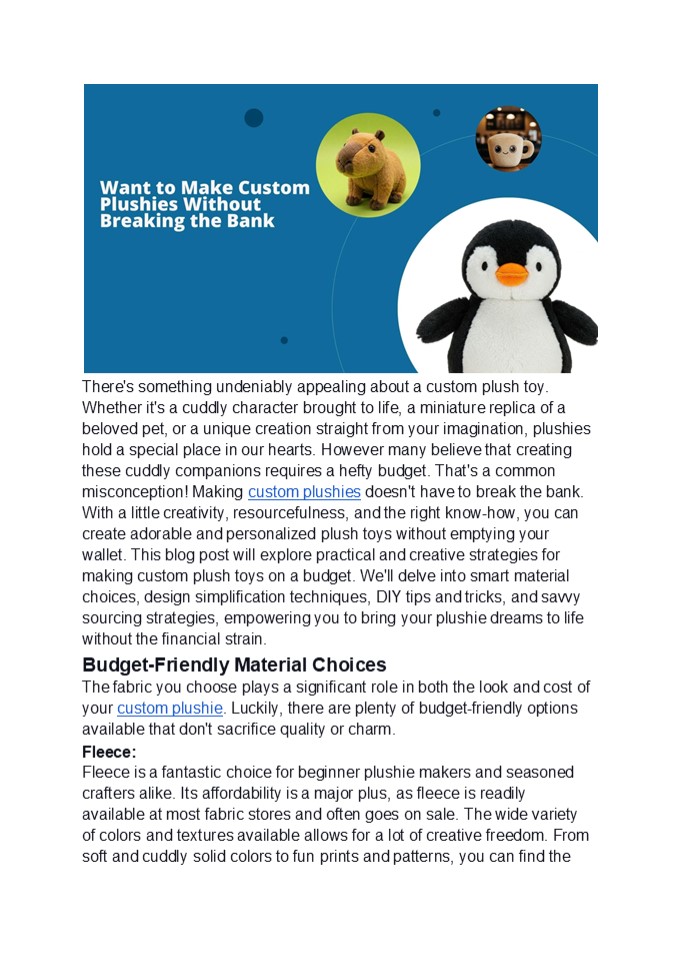
Title: Want to Make Custom Plushies Without Breaking the Bank?
1
There's something undeniably appealing about a
custom plush toy. Whether it's a cuddly character
brought to life, a miniature replica of a beloved
pet, or a unique creation straight from your
imagination, plushies hold a special place in our
hearts. However many believe that creating these
cuddly companions requires a hefty budget. That's
a common misconception! Making custom plushies
doesn't have to break the bank. With a little
creativity, resourcefulness, and the right
know-how, you can create adorable and
personalized plush toys without emptying your
wallet. This blog post will explore practical and
creative strategies for making custom plush toys
on a budget. We'll delve into smart material
choices, design simplification techniques, DIY
tips and tricks, and savvy sourcing strategies,
empowering you to bring your plushie dreams to
life without the financial strain. Budget-Friendly
Material Choices The fabric you choose plays a
significant role in both the look and cost of
your custom plushie. Luckily, there are plenty of
budget-friendly options available that don't
sacrifice quality or charm. Fleece Fleece is a
fantastic choice for beginner plushie makers and
seasoned crafters alike. Its affordability is a
major plus, as fleece is readily available at
most fabric stores and often goes on sale. The
wide variety of colors and textures available
allows for a lot of creative freedom. From soft
and cuddly solid colors to fun prints and
patterns, you can find the
2
perfect fleece to bring your plushie design to
life. Fleece is also relatively easy to work
with, making it a great option for simple plushie
designs. Its slightly stretchy nature makes it
forgiving for beginners, and it doesn't fray
easily, which simplifies sewing and finishing.
Imagine a bright yellow fleece chick plushie or a
cozy blue fleece bear the possibilities are
endless! Felt Felt is another incredibly
cost-effective material, especially for smaller
plushies. Like fleece, felt comes in a rainbow of
colors, allowing you to create vibrant and
eye-catching designs. Felt is also very easy to
use, as it doesn't fray and can be easily cut and
glued (or sewn). This makes it a popular choice
for smaller plushies, applique details, and
adding embellishments to your creations. Think of
a cute felt flower added to a plushie's ear or a
set of felt alphabet letters to personalize a
plushie for a child. Felt is also great for
creating flat plushies, like banners or
ornaments. Upcycled Materials For the truly
budget-conscious and eco-minded crafter, upcycled
materials are a goldmine. Transforming old
clothes, blankets, towels, or other fabric scraps
into custom plushies is not only incredibly
affordable but also a sustainable way to create
unique and one-of-a-kind toys. Imagine a
patchwork plushie made from old t-shirts or a
cozy stuffed animal crafted from a worn-out
flannel shirt. The possibilities are endless!
Sourcing upcycled materials is as easy as raiding
your own closets or visiting thrift stores.
Before you start sewing, make sure to wash and
prepare your upcycled fabrics. Cut out any worn
or damaged areas and iron the fabric to remove
wrinkles. Upcycling adds a special touch to your
custom plushies, giving them a story and a unique
character. Fabric Sales Coupons No matter what
fabric you choose, maximizing your budget means
being a savvy shopper. Keep an eye out for fabric
sales at local craft stores or online retailers.
Many stores offer regular discounts, especially
around holidays. Don't forget to use coupons!
Many fabric stores and online retailers offer
coupons to email subscribers or through coupon
websites. Buying fabric in bulk can also save you
money in the long run, especially if you plan on
making multiple plushies. Consider pooling
resources with
3
friends or other crafters to buy fabric together
and split the cost. A little planning and smart
shopping can go a long way in making your custom
plushie projects more affordable. Simplifying
Plush Toy Designs Creating custom plush toys on a
budget often means simplifying the design
process. Intricate patterns and elaborate details
can quickly drive up costs and require more
advanced sewing skills. By focusing on
simplicity, you can create adorable and
personalized plushies without the added expense
or complexity. Basic Shapes Sticking to basic
shapes like circles, squares, and triangles is a
game-changer when it comes to cost-effectiveness
and ease of construction. These shapes are easy
to draw, cut, and sew, making pattern making a
breeze, even for beginners. Don't underestimate
the power of simplicity! You can create
surprisingly charming plushies using just a few
basic shapes. For example, a circle can become a
cute little chick, a square can be transformed
into a blocky robot, and a combination of
triangles can create a whimsical mountain range
plushie. Think about how you can combine these
basic shapes to create different animals or
objects. A circle and two triangles can become a
cat's face, or a square and a circle can become a
simple car plushie. By focusing on basic shapes,
you can create a whole menagerie of adorable and
affordable custom plush toys. Limited
Details While intricate details like embroidery,
applique, and accessories can add a lot of
personality to a plush toy, they also add to the
time and cost of the project. Reducing the number
of these details can significantly save you both
time and money. However, simplifying doesn't mean
sacrificing style! There are plenty of creative
ways to imply details with simpler techniques.
Instead of intricate embroidery, consider using
fabric markers to draw simple facial features or
patterns. Felt applique can be replaced with
fabric scraps glued or sewn onto the plushie.
Instead of adding separate accessories, like
scarves or hats, consider incorporating these
elements into the plushie's design itself. For
example, you could use different colored fabrics
to create the impression of a scarf or sew on
buttons to represent eyes instead of using more
expensive plastic eyes.
4
- Think creatively about how you can achieve the
desired look with simpler and more affordable
methods. - Free Patterns
- The internet is a treasure trove of free plush
toy patterns, making it easier than ever to find
inspiration and start creating without spending
money on pattern books or downloads. Many
reputable websites and blogs offer a wide variety
of free patterns, from simple shapes to more
complex designs. Look for patterns specifically
labeled as - beginner-friendly if you are just starting out.
Some great places to find free patterns include
dedicated crafting websites, blogs of sewing
enthusiasts, and even social media platforms like
Pinterest. When choosing a free pattern, pay
attention to the instructions and make sure they
are clear and easy to follow. Consider the skill
level required for the pattern and choose one
that matches your abilities. Starting with a
simple and well-written pattern is key to a
successful and enjoyable plushie-making
experience. Don't be afraid to adapt or modify
free patterns to add your own personal touch and
create truly unique custom plush toys. - DIY Techniques Tips
- Making custom plushies on a budget often involves
embracing DIY techniques and getting creative
with your resources. From choosing the right
sewing method to finding affordable stuffing
options, there are many ways to save money and
personalize your plush creations. - Hand Sewing vs. Machine Sewing
- When it comes to sewing your custom plushies, you
have two main options hand sewing and machine
sewing. For small projects and those on a tight
budget, hand sewing is an excellent choice. It
requires no expensive equipment just a needle,
thread, and scissors. Hand sewing allows for
greater control and precision, especially when
working with small details or curved shapes. It's
also a portable option, allowing you to sew your
plushies anywhere, anytime. However, hand sewing
can be more time-consuming than machine sewing,
especially for larger projects. If you're making
a large number of plushies or working on a tight
deadline, machine sewing might be a better
option, even if it requires an initial investment
in a sewing machine. - Basic Hand Sewing Tips for Beginners
5
- Choose the right needle A sharp needle will make
sewing easier and prevent fabric damage. - Use quality thread Strong thread will prevent
seams from breaking. - Practice basic stitches Learn the running
stitch, back stitch, and whip stitch. These are
essential for plushie making. - Keep your stitches even Even stitches create a
neater and more professional finish. - Don't be afraid to practice The more you
practice, the better you'll become at hand
sewing. - Stuffing Options
- The stuffing you choose will determine the
softness, shape, and overall feel of your custom
plushie. Affordable stuffing options are readily
available, allowing you to create cuddly
companions without breaking the bank. - Recycled Fabric Scraps A truly budget-friendly
and - eco-conscious option is to use recycled fabric
scraps as stuffing. Cut old clothes, towels, or
blankets into small pieces and use them to fill
your plushies. This is a great way to repurpose
old materials and reduce waste. - Cotton Balls Cotton balls are another affordable
and readily available stuffing option. They're
soft and fluffy, making them ideal for smaller
plushies. However, they might not be as durable
as other stuffing options and can clump together
over time. - Old Pillows If you have old pillows that are no
longer in use, you can repurpose their stuffing
for your plushies. Simply open the pillow and
remove the stuffing. This is a great way to
recycle old bedding and save money on stuffing. - Other Affordable Options Other affordable
stuffing options include fiberfill from craft
stores (often sold in bulk), or even dried beans
or rice for a heavier, textured feel (use with
caution, and ensure seams are very strong). - Glue vs. Sewing
- Fabric glue can be a helpful tool for simplifying
plushie construction and saving time, especially
for certain details. For example, you can use
fabric glue to attach small embellishments, like
felt eyes or buttons,
6
instead of sewing them on. Glue can also be used
to hold fabric pieces in place before sewing,
making it easier to sew straight lines. However,
it's important to note that glue has limitations.
It's not suitable for all types of fabrics or for
areas that will experience a lot of stress.
Sewing is generally more durable and recommended
for the main seams of your plushie. Using glue
strategically for small details can be a great
way to save time and effort, but it's important
to rely on sewing for the structural integrity of
your plush toy. Think of glue as a helpful
assistant, not a replacement for sewing. Smart
Sourcing Production Creating custom plush toys
on a budget often requires getting creative with
sourcing and production. Smart strategies can
significantly reduce costs without compromising
the quality or charm of your plush creations.
Buying in Bulk If you plan on making multiple
plushies, buying supplies in bulk is a fantastic
way to save money. Fabric, stuffing, thread, and
other materials are often cheaper when purchased
in larger quantities. Consider pooling resources
with friends or other crafters to take advantage
of bulk discounts. Think about the long term if
you know you'll be making plushies regularly,
stocking up on essential supplies will save you
money in the long run. For example, buying a
large roll of fabric instead of several smaller
pieces can significantly reduce the per-yard
cost. Similarly, purchasing a large bag of
stuffing instead of several smaller bags will
save you money and ensure you have enough
stuffing for all your plushie projects. Local
Craft Stores Thrift Shops Don't underestimate
the value of local craft stores and thrift shops
when searching for budget-friendly materials.
Local craft stores often have sales and offer
coupons, allowing you to save money on fabric,
stuffing, and other supplies. Thrift shops are a
treasure trove of unique finds and discounted
materials. You can often find old clothes,
blankets, or towels that can be repurposed into
plush toys. Thrift shops are also a great place
to find unique embellishments, like buttons,
ribbons, or lace, to add personality to your
custom plushies. Exploring these local resources
can lead to unexpected discoveries and help you
create truly one-of-a-kind plush toys without
breaking the bank. Collaborating with Others
7
- Collaborating with friends or other crafters is a
smart way to share costs and resources. Consider
joining a local crafting group or connecting with
other plushie makers online. You can pool your
money to buy supplies in bulk and split the cost.
You can also share patterns, tips, and ideas with
each other. Collaborating with others not only
saves you money but also provides a supportive
community of fellow crafters. Sharing your
plushie projects and getting feedback from others
can be a great way to improve your skills and
find inspiration for new designs. Plus, crafting
with friends is always more fun! - Affordable Plushies Are Within Reach
- Creating custom plush toys doesn't have to be an
expensive endeavor. By utilizing smart sourcing
strategies and embracing DIY techniques, you can
create adorable and personalized plushies without
breaking the bank. From choosing budget-friendly
materials to collaborating with other crafters,
there are many ways to make your plushie dreams a
reality without the financial strain. - Ready to start creating your own budget-friendly
plushies? Connect with EverLighten today! We
offer - 100 Customization Design every detail of your
plush toy, from the character and colors to the
size, materials, and embellishments. - 100 Quality Check We guarantee top-notch
quality with rigorous checks at every stage of
production. - Free Design Help Our expert design team is here
to guide you through the process, offering
creative input and technical expertise. - Worldwide Delivery We ship your custom creations
globally, making it easy to share your unique
brand with the world. - 24/7 Support Our dedicated customer support team
is available around the clock to answer your
questions and assist with any needs. - Unlimited Revisions We're committed to your
satisfaction. We'll work with you through
unlimited revisions until your design is
absolutely perfect. - Low MOQ (Minimum Order Quantity) Whether you
need a small batch or a large run, we can
accommodate your needs with flexible minimum
order quantities.
8
- Contact EverLighten today for a free
consultation, and let's create custom plush toys
that make a statement! - FAQs
- Where can I find free plush toy patterns?
- Many websites and blogs offer free plush toy
patterns. Some good places to start include
dedicated crafting websites, blogs of sewing
enthusiasts, and social media platforms like
Pinterest. - What are the best materials for beginner plushie
makers? Fleece and felt are both excellent
choices for beginners. They are affordable,
readily available, and easy to work with. - How much does it cost to make a custom plush toy?
- The cost varies depending on the materials you
choose, the size and complexity of your design,
and whether you are making a single plushie or
multiple plushies. Buying materials in bulk and
using upcycled fabrics can help reduce costs. - What are some tips for making plush toys on a
budget? - Some tips include using affordable materials like
fleece and felt, simplifying your designs,
utilizing free patterns, buying supplies in bulk,
and exploring thrift stores for discounted
materials. - Can I use fabric glue instead of sewing?
- Fabric glue can be helpful for attaching small
details or holding pieces in place before sewing,
but sewing is generally more durable and
recommended for the main seams of your plush toy.
Recommended

