

The Future of FinTech: How Technology is Changing Finance PowerPoint PPT Presentation
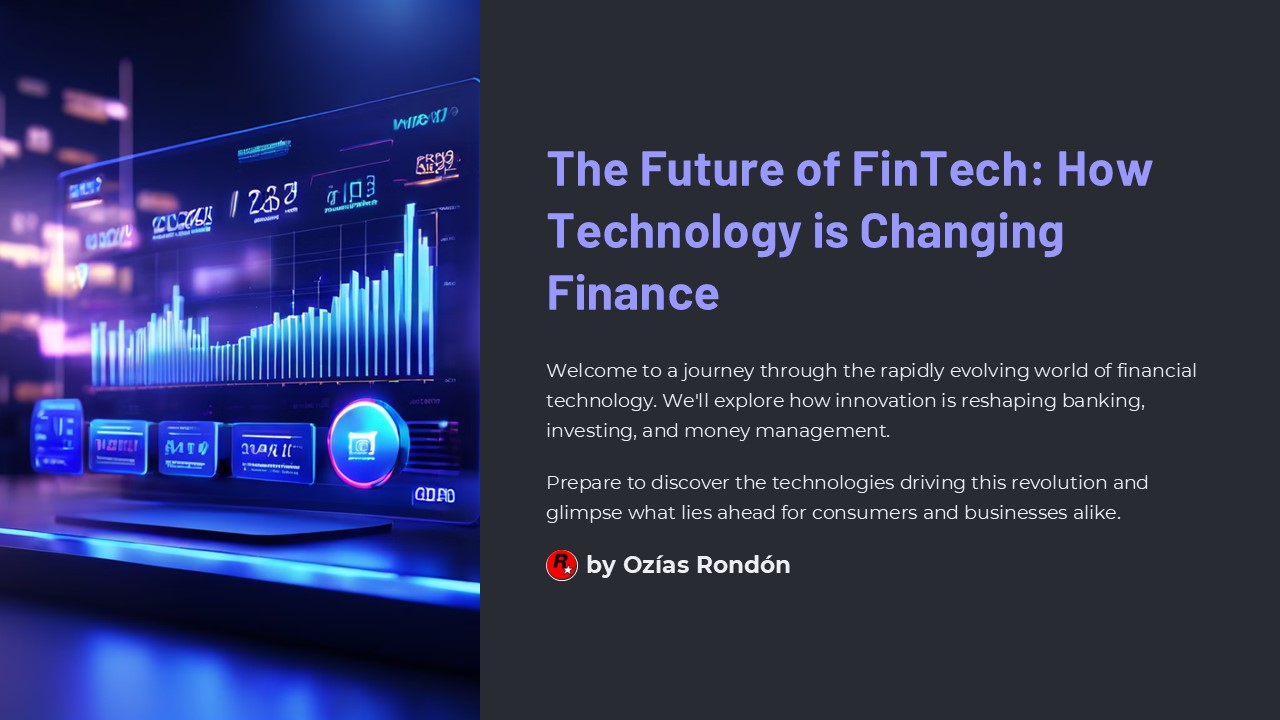
Title: The Future of FinTech: How Technology is Changing Finance
1
The Future of FinTech How Technology is Changing
Finance
Welcome to a journey through the rapidly evolving
world of financial technology. We'll explore how
innovation is reshaping banking, investing, and
money management.
Prepare to discover the technologies driving this
revolution and glimpse what lies ahead for
consumers and businesses alike.
by Ozías Rondón
2
What is FinTech?
Definition
Scope
Financial technology leverages software and
digital platforms to deliver financial services
more efficiently.
FinTech spans payments, lending, wealth
management, insurance, and regulatory compliance.
It encompasses everything from mobile banking to
cryptocurrency exchanges and AI-driven
investments.
The market continues expanding as startups
disrupt traditional financial institutions.
3
The FinTech Revolution
2016-2020
Early 2000s
Blockchain, AI and robo-advisors reshape
financial services. Traditional banks begin
digital transformation.
Online payment solutions emerge. PayPal disrupts
traditional banking transfers.
1
2
3
4
2008-2015
2021-Present
Post-financial crisis sees explosion of FinTech
startups. Mobile banking adoption grows rapidly.
Embedded finance and decentralized solutions
accelerate. Market projected to reach 324
billion by 2026.
4
Key Technologies Driving FinTech
AI and Machine Learning
Powers fraud detection, credit scoring, and
personalized financial advice. Enables processing
of vast data for actionable insights.
Blockchain
Provides secure, transparent record-keeping for
transactions. Enables cryptocurrencies and smart
contracts for automated execution.
Cloud Computing
Offers scalable infrastructure for FinTech
applications. Reduces costs while improving
accessibility across devices.
Internet of Things
Enables real-time data collection for usage-based
insurance. Facilitates contactless payments
through connected devices.
5
Artificial Intelligence in Finance
Automated Decision-Making
Predictive Analytics
Personalized Financial Advice
Machine learning models identify market trends
and investment opportunities. They detect unusual
transactions to prevent fraud.
AI algorithms approve loans in minutes instead of
days. They analyze thousands of data points for
better decisions.
AI assistants recommend tailored savings
strategies. They help users optimize spending
based on personal goals.
6
Blockchain and Cryptocurrencies
Digital Assets NFTs
1
New asset classes and ownership models
Smart Contracts
2
Self-executing agreements with code
Decentralized Finance (DeFi)
3
Financial services without intermediaries
Blockchain Foundation
4
Secure, transparent distributed ledger
7
Mobile Banking and Digital Wallets
76
Mobile Users
Percentage of Americans using mobile banking apps
in 2023
9.5T
Transaction Value
Global digital payments market size projection by
2026
1.7B
Unbanked Reached
People gaining financial access through mobile
solutions
85
Contactless Growth
Increase in contactless payments since 2020
8
Open Banking and APIs
Data Access
API Integration
Customers authorize access to their financial data
Secure connections between financial institutions
Service Innovation
Enhanced Experience
Third parties create new financial products
Customers enjoy personalized financial services
9
Robo-Advisors and Wealth Management
Initial Assessment
Portfolio Creation
Automatic Rebalancing
Performance Tracking
User completes financial profile and risk
tolerance questionnaire
Algorithm builds diversified investment mix based
on goals
User monitors progress through dashboard with
minimal fees
System maintains optimal asset allocation over
time
10
Insurtech Revolutionizing Insurance
Data-Driven Underwriting
AI evaluates risk using thousands of data points.
Premiums reflect actual behavior rather than
demographics alone.
Usage-Based Models
Telematics devices monitor driving habits for
auto insurance. Wearables track health metrics
for life insurance discounts.
Automated Claims Processing
Computer vision assesses property damage
instantly. Smart contracts trigger immediate
payouts for flight delays.
11
Regulatory Technology (RegTech)
Compliance Automation
AI monitors transactions for regulatory
violations. Systems automatically generate
required reports and documentation.
Fraud Detection
Machine learning identifies suspicious patterns.
Advanced analytics spot anomalies in real-time
transactions.
Risk Management
Predictive models assess market and credit risk.
Stress testing simulates financial crisis
scenarios.
12
Cybersecurity in FinTech
Phishing
Malware
API Vulnerabilities
Employee Error
Physical Theft
Other
13
The Future of Banking
Traditional banks are evolving rapidly. Neobanks
operate without physical branches. Every service
becomes personalized through data intelligence.
Voice assistants and AR interfaces will replace
screens. Banking becomes invisible, embedded in
our daily activities.
14
FinTech and Financial Inclusion
Mobile Access
Basic financial services through feature phones
Digital Identity
Biometric verification for the undocumented
Alternative Credit
Non-traditional data for lending decisions
Financial Empowerment
Full economic participation and opportunity
15
Embedded Finance and Banking-as-a-Service
Seamless Payments
Instant Credit
Business Banking
Financial transactions blend invisibly into
everyday apps and services. Users pay without
leaving their favorite platforms.
Point-of-sale financing appears exactly when
needed. Approval happens in seconds with minimal
friction.
Financial tools embed directly in business
software. Companies manage everything from one
dashboard.
16
The Impact of FinTech on Traditional Finance
Partnerships
Branch Evolution
Banks collaborate with FinTech startups. They
gain innovation while startups access customer
base.
Physical locations become advisory centers.
Digital transactions replace routine banking
activities.
Technology Adoption
Talent Acquisition
Legacy institutions invest heavily in digital
transformation. Cloud migration and API
development accelerate.
Banks compete for software engineers and data
scientists. New roles emerge as automation
reshapes workforce.
17
Challenges and Risks in FinTech
Challenge
Impact
Mitigation
Data Privacy
Consumer trust erosion
Privacy-by-design, transparent data policies
Regulatory Complexity
Innovation barriers
Regulatory sandboxes, compliance automation
Cybersecurity Threats
Financial and reputational damage
Advanced encryption, zero-trust architecture
Digital Divide
Exclusion of vulnerable populations
Inclusive design, alternative access channels
18
The Future of FinTech Trends to Watch
Quantum Computing
Will revolutionize cryptography and risk
modeling. Financial algorithms will process
complex scenarios instantaneously.
Voice-Activated Banking
Conversational AI will handle complex financial
tasks. Users will manage money through natural
dialogue.
Extended Reality Interfaces
AR/VR will create immersive financial
experiences. Advisors will meet clients in
virtual spaces.
Biometric Everything
Physiological markers will replace passwords and
cards. Authentication will become invisible yet
highly secure.
19
Conclusion Embracing the FinTech Revolution
Acceleration of Change
Technology adoption continues to speed up.
Customer expectations evolve rapidly across
demographics.
Blurring Boundaries
Lines between finance and other industries fade.
Banking becomes embedded in our digital
experiences.
Human Machine
Optimal solutions combine AI efficiency with
human judgment. Technology enhances rather than
replaces human expertise.
Democratized Finance
Financial tools become accessible to everyone.
Complex services simplify through intuitive
interfaces.
20
AI Content Generation Powering FinTech Innovation
Enhance Your FinTech Content Strategy
Our AI Content Generation System creates
compelling financial education materials
instantly. It helps FinTech companies explain
complex concepts clearly.
Generate regulatory-compliant marketing content
at scale. Personalize communications for
different customer segments automatically.
Download now https//www.checkout-ds24.com/redir/
599231/oziasrondon2/
Recommended

