

Atomic Structure and Function 25 September 2003 Professor Taylor PowerPoint PPT Presentation
Title: Atomic Structure and Function 25 September 2003 Professor Taylor
1
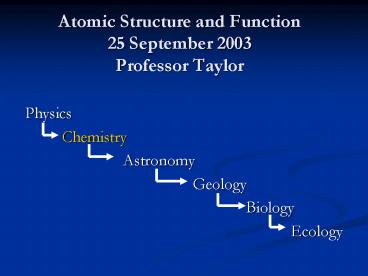
Atomic Structure and Function25 September
2003Professor Taylor
- Physics
- Chemistry
- Astronomy
- Geology
- Biology
- Ecology
2
Atomic Structure and FunctionOutline
- Early history in 18th and 19th centuries
- Discovery of the electron (1897)
- Discovery of the nucleus (1911)
- Atomic structure consternation
- Atomic structure the Bohr atom (1913)
- Atomic Structure Theory of Quantum Mechanics
(1930s) - Applications of our understanding
- Discovery of the elements
3
Atomic Structure and FunctionTake Home Message
- Science as a evolutionary, incremental process
over decades (e.g., exploring the structure of
atom) - Role of hypothesis development and testing in the
sciences scientific method - Demystification of physics and chemistry
structure of the atom is a simple concept - Understanding of atomic structure underpins
future course topics (e.g., chemical reactions,
geology, biochemistry, ecology, environmental
sciences) - Applications some examples
4
Early History in 18th and 19th Century
- Atomic Theory of Dalton
- Atoms as indivisible marbles
- Element (shape and size the same for a given
element) - Molecules/compounds (e.g., water or H2O) combine
in predictable ways and ratios - Atoms as basis for understanding chemistry but
without electrons, protons and neutrons (analogy
to a marble) - Elements 60 known (e.g., hydrogen, gold, sodium)
5
Atomic Structure and FunctionOutline
- Early history in 18th and 19th centuries
- Discovery of the electron (1897)
- Discovery of the nucleus (1911)
- Atomic structure with consternation
- Atomic structure the Bohr atom (1913)
- Atomic Structure Theory of Quantum Mechanics
(1930s) - Applications of our understanding
6
Thompsons Discovery of the Electron
- Idea that there may be some smaller components
that comprise atoms - Hypothesis Atoms consist of subcomponents, one
of which is negatively charged and very small in
mass - Experiment to test hypothesis
7
Thompsons Experiment
8
Thompsons Experiment
9
Thompsons Discovery of the Electron
- Idea that there may be some smaller components
that comprise atoms - Hypothesis Atoms consist of some subcomponents,
one of which is negatively charged and very small
in mass - Hypothesis accept the hypothesis
10
Atomic Structure and FunctionOutline
- Early history in 18th and 19th centuries
- Discovery of the electron (1897)
- Discovery of the nucleus (1911)
- Atomic structure with consternation
- Atomic structure the Bohr atom (1913)
- Atomic Structure Theory of Quantum Mechanics
(1930s) - Applications of our understanding
11
Rutherfords Discovery of a Nucleus
- Idea that there may be some smaller components
that comprise atoms, including negatively and
positively charges components - Hypothesis Atoms consist of multiple
subcomponents, some negative and some positive - Experiment to test hypothesis
- Alpha particles (), gold foil, bullets, and
tracks
12
Rutherfords Experiment
13
Explanation
14
Observations, Hypothesis and Conclusion
- Observations
- Almost all alphas passed through foil unaffected
- Very small number of alphas deflected _at_ small
angle - 1/1000 deflected at large angle (struck head
on) - Hypothesis Atoms consist of some positive
subcomponents - Accept the hypothesis
15
New Model of Atom
- Small, dense center, positively charged called
the nucleus (later to be called the proton) - Small, light (w/o mass), negative charged
subcomponent circles the nucleus (electron) - Later additions (1932)
- Neutrons
- Protons
- Charge (neutrality calls for and charges)
16
Atomic Structure and FunctionOutline
- Early history in 18th and 19th centuries
- Discovery of the electron (1897)
- Discovery of the nucleus (1911)
- Atomic structure with consternation
- Atomic structure the Bohr atom (1913)
- Atomic Structure Theory of Quantum Mechanics
(1930s) - Applications of our understanding
17
Atomic Structure with Consternation
- Consternation with Rutherford Model
- Electrons moving, so must give off energy
- 2nd Law of Thermodynamics
- Electrons should collapse
- Yet atoms are billions of years old
- Conclusions model violated fundamental laws of
physics
18
Atomic Structure and FunctionOutline
- Early history in 18th and 19th centuries
- Discovery of the electron (1897)
- Discovery of the nucleus (1911)
- Atomic structure with consternation
- Atomic structure the Bohr atom (1913)
- Atomic Structure Theory of Quantum Mechanics
(1930s) - Applications of our understanding
19
Atomic Structure Bohr Atom
- Observations (1913)
- Heat hydrogen gas and light is emitted as a
discrete wavelength (not continuous spectrum) - Other gases behave the same in producing discrete
wavelength, but each gas unique in wavelengths
produced
20
Atomic Structure Bohr Atom
- Hypothesis
- Electrons circle the nucleus at specific
distances from the nucleus in defined orbits - Diagram
21
Atomic Structure Bohr Atom
- Explanation of light in discrete wavelengths
- As excited/heated electrons drop back from
orbit, a packet of energy is lost as a function
of distance from the nucleus - Packet of energy is called photon (light)
22
Atomic Structure Bohr Atom
- Key aspects of the Bohr atom
- No space between the orbits for electrons to be
so jump has to be all or none quantum
levels of electrons - Excited electrons in outer orbit has 2 options
- Drop down to next lower orbit and emit a packet
of energy (light) unique for that distance - Drop back to even lower level (ground state) and
emit packet of energy (light) unique for that
that distance - Energy release is unique for each element and is
a window on atomic structure (lab exercise) - Ideas verified two decades later using quantum
mechanics
23
Bohr Atom
24
Atomic Structure and FunctionOutline
- Early history in 18th and 19th centuries
- Discovery of the electron (1897)
- Discovery of the nucleus (1911)
- Atomic structure consternation
- Atomic structure the Bohr atom (1913)
- Atomic Structure
- Consternation with the Bohr Atom (theory)
- Theory of Quantum Mechanics (1930s)
- Applications of our understanding
- Discovery of the elements
25
Theory of Quantum Mechanics
- Observations
- Behavior of electrons in heated hydrogen gas were
consistent with Bohr Model (orbits, etc.) - Behavior of other heavier gases could not be
explained by Bohr Model - Investigators (Heisenberg, Shrodinger)
wave-particle duality of light - Key Integrated mechanisms of waves and
particles, focusing on fuzzy electron
clouds/waves - Hypothesis new model of atomic structure and
function quantum mechanics theory of the atom - Incorporation of know facts
- Prediction of new properties yet to be discovered
26
Quantum Mechanics
27
Quantum Mechanics
28
Quantum Mechanics Model
- Key Principles
- Electron behaves as a wave not a particle (Bohr)
- Energy of electron behaves as a spread-out wave
in three dimensions - not discrete bundle of
energy (Bohr) - Description is based on quantum numbers
- Distance from nucleus
- Energy level and sublevel
- Orientation of electrons in space
- Direction of electron spin
29
Quantum Mechanics Model Principle Energy Levels
- Main energy level of electrons
- Distance from nucleus
- n 1 (lowest energy level)
- n 2
- n 3
- n 4 (highest energy level)
- etc.
- Higher the number, the higher the energy
30
Quantum Mechanics Model Sub-Energy Levels
- Electrons in fuzzy probability distribution
called an orbital - e.g., n 1 has 1 sub-energy level/orbital (2
electron orientations) - Heisenberg Uncertainty Principle
- Electrons in an orbital can only exist in pairs
(2) and the pair spins in opposite directions - Pauli Exclusion Principle
31
Paulis Exclusion Principle
32
Quantum Mechanics Model Electron Configuration
- Electrons always adopt most energetically stable
energy levels/orbitals consistent with Laws of
Thermodynamics and previous conditions (above) - If n 1, two electrons in 1st orbital (s
orbital) - If n 2, six electrons in 3 orbitals (p orbitals)
33
Electron Configuration in p Orbital
34
Atomic Structure and FunctionOutline
- Early history in 18th and 19th centuries
- Discovery of the electron (1897)
- Discovery of the nucleus (1911)
- Atomic structure with consternation
- Atomic structure the Bohr atom (1913)
- Atomic Structure Theory of Quantum Mechanics
(1930s) - Applications of our understanding
35
Applications of Our Understanding of Atomic
Structure
- Spectroscopy quantum differences in light
emitted or absorbed result in unique signature
for each element (fingerprint) - LASER (Light Amplification by Stimulated Emission
of Radiation) - Binding of elements to create compounds
- Neurotransmitters in the brain
- Allergy reactions
- Etc.
36
Atomic Structure and FunctionTake Home Message
- Science as a evolutionary, incremental process
over decades (e.g., exploring the structure of
atom) - Role of hypothesis development and testing in the
sciences scientific method and progress - Consternation, rejection, new models new
hypotheses - Demystification of physics and chemistry
structure of the atom is a simple concept - Understanding of atomic structure underpins
future course topics (e.g., chemical reactions,
geology, biochemistry, ecology, environmental
sciences) - Applications some examples
37
Atomic Structure
38
Atomic Structure and FunctionOutline
- Early history in 18th and 19th centuries
- Discovery of the electron (1897)
- Discovery of the nucleus (1911)
- Atomic structure consternation
- Atomic structure the Bohr atom (1913)
- Atomic Structure Theory of Quantum Mechanics
(1930s) - Applications of our understanding
- Discovery of the elements
Recommended

