

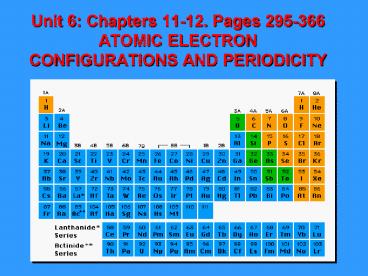
Unit 6: Chapters 1112. Pages 295366 ATOMIC ELECTRON CONFIGURATIONS AND PERIODICITY PowerPoint PPT Presentation
1 / 62
Title: Unit 6: Chapters 1112. Pages 295366 ATOMIC ELECTRON CONFIGURATIONS AND PERIODICITY
1
Unit 6 Chapters 11-12. Pages 295-366 ATOMIC
ELECTRON CONFIGURATIONS AND PERIODICITY
2
Characteristics of Electrons
- Extremely small mass
- Located outside the nucleus
- Moving at extremely high speeds in a sphere
- Have specific energy levels
3
Energy of Electrons
- When atoms are heated, bright lines appear called
line spectra - Electrons in atoms arranged in discrete levels.
- An electron absorbs energy to jump to a higher
energy level. - When an electron falls to a lower energy level,
energy is emitted.
4
Bohr Model
- First model of the electron structure
- Gives levels where an electron is most likely to
be found - Incorrect today, but a key in understanding the
atom
5
Bohr Model
6
Bohr Model Vs Wave Mechanical Model
- The Bohr model assumes that the electron is a
particle. Bohrs mathematics failed to explain
atoms with more than one electron. - If the electron is a particle, scientist should
have been able to predict both the position of
the electrons and their intended path (like
orbiting planets). - Scientists during the mid 1920s started to
consider if the electrons in an atom are like
light? both wave and particle properties.
7
The Electron and a Baseball Analogy
Because it behaves as a particle, a baseball
follows a well-defined path as it travels from
the pitcher to the catcher. Because of their wave
nature, an electron's path cannot be precisely
known. The best we can do is to calculate the
probability of the electron following a specific
path.
8
The Electron and a Baseball Analogy
If the baseball displayed wave-particle duality,
the path of the baseball could not be precisely
determined. The best we could do would be to make
a probability map of where a "pitched" electron
will cross home plate.
9
Quantum Mechanics- Describes the arrangement and
space occupied by electrons in atoms
Like the Bohr model, the quantum-mechanical model
allows only specific energies for the electron.
The difference is in the way the electron exists
around the nucleus Instead of being a little
"planet" orbiting the nucleus, as Bohr
envisioned, the quantum-mechanical electron's
location is known only through a probability map
10
Quantum Mechanical Model
In the quantum-mechanical model, specific
electron orbits are not appropriate the
electron's movement cannot be known that
precisely. Instead, we map the probability of
finding the electron at various locations outside
the nucleus. The probability map is called an
orbital.
11
Arrangement of Electrons in Atoms
- Electrons in atoms are arranged as
- SHELLS (n)
- SUBSHELLS (l)
- ORBITALS (ml)
12
Arrangement of Electrons in Atoms Shells are
organized into subshells
- The number of subshells in a given principal
shell is equal to the value of n. - There is a relationship between the quantum
number (n) and the number of subshells that a
shell possesses.
13
Comparison of 1s and 2s orbitals
The 2s orbital is similar to the 1s orbital, but
larger in size. The phrase "larger in size"
really means that the maximum probability for
finding the electron lies farther out from the
nucleus.
14
Probability maps of the three 2p orbitals
The three 2p orbitals are the same size and
shape, but are oriented in different directions.
A careful look at the orientations reveals that
they are all at right angles to one another. The
three orbitals, taken together, make up the p
subshell of the n 2 shell. Each orbital can
hold a maximum of two electrons.
15
Probability maps of the five 3d orbitals
The five 3d orbitals are generally oriented in
different directions. If we were to add all five
orbitals, we would get a sphere. The five
orbitals, taken together, make up the d subshell
of the n 3 shell. Each orbital can hold a
maximum of two electrons
16
Arrangement of Electrons in AtomsElectron Spin
Quantum Number- ms
17
Electron Spin Quantum Number
Diamagnetic Paramagnetic
18
Summary
4 QUANTUM NUMBERS
- n ---gt
- l ---gt
- ml ---gt
- ms ---gt electron spin 1/2 and -1/2
19
Pauli Exclusion Principle- No two electrons in
the same atom can have the same set of 4 quantum
numbers.
- Determine the quantum numbers for the outer two
valence electrons in the lithium atom.
20
Aufbau Principle-
21
Writing Electron Configurations
- Two ways of writing configs. One is called the
spdf notation.
22
Broad Periodic Table Classifications
- Representative Elements (main group) filling s
and p orbitals (Na, Al, Ne, O) - Transition Elements filling d orbitals (Fe, Co,
Ni) - Lanthanide and Actinide Series (inner transition
elements) filling 4f and 5f orbitals (Eu, Am,
Es)
23
Writing Orbital Notations
- Two ways of writing configs. Other is called the
orbital box notation.
One electron has n 1, l 0, ml 0, ms
1/2 Other electron has n 1, l 0, ml 0, ms
- 1/2
24
Energy ordering of orbitals for multi-electron
atoms
Different subshells within the same principal
shell have different energies. The more complex
the subshell, the higher its energy. This
explains why the 3d subshell is higher in energy
than the 4s subshell.
25
Orbital diagram and electron configuration for a
ground state lithium atom
26
Orbital diagram and electron configuration for a
ground state carbon atom
Hunds Rule-
27
Silicon's valence electrons
28
Selenium's valence electrons
29
Core electrons and valence electrons in germanium
30
Outer electron configuration for the elements
31
The periodic table gives the electron
configuration for As
32
Valence Electrons by Group
33
Ion charges by group
34
Periodic Law
- All the elements in a group have the same
electron configuration in their outermost shells - Example Group 2
- Be 2, 2
- Mg 2, 8, 2
- Ca 2, 2, 8, 2
35
Question
- Specify if each pair has chemical properties
that are similar (1) or not similar (2) - A. Cl and Br
- B. P and S
- C. O and S
36
General Periodic Trends
- 1. Atomic and ionic size 2. Electron affinity
- 3. Ionization energy 4. Metallic Character
37
Effective Nuclear Charge, Z
- Z is the nuclear charge experienced by the
outermost electrons. Screen 8.6. - Explains why E(2s) lt E(2p)
- Z increases across a period owing to incomplete
shielding by inner electrons. - Estimate Z by --gt Z - (no. inner electrons)
- Z number of electrons
- Charge felt by 2s e- in Li Z 3 - 2 1
- Be Z 4 - 2 2
- B Z 5 - 2 3 and so on!
38
Effective Nuclear Charge
Figure 8.6
Electron cloud for 1s electrons
39
Effective Nuclear Charge, Z
- Atom Z Experienced by Electrons in Valence
Orbitals - Li 1.28
- Be -------
- B 2.58
- C 3.22
- N 3.85
- O 4.49
- F 5.13
Increase in Z across a period
40
Beryllium
Lithium
Sodium
41
Atomic Size
- Size __________ on going down a group. See Figure
8.9. - Because electrons are added further from the
nucleus, there is less attraction. - Size ________ on going across a period.
42
Atomic Radii
Figure 8.9
43
Trends in Atomic SizeSee Figures 8.9 8.10
44
Ion Sizes
Does the size go up or down when losing an
electron to form a cation?
45
Ion Sizes
Forming a cation.
Li,152 pm
3e and 3p
- CATIONS are _________ than the atoms from which
they come.
46
Ion Sizes
- Does the size go up or down when gaining an
electron to form an anion?
47
Ion Sizes
Forming an anion.
- ANIONS are _________ than the atoms from which
they come.
48
Trends in Ion Sizes
Figure 8.13
49
Ionization EnergySee Screen 8.12
- IE
Mg (g) 738 kJ ---gt Mg (g) e-
50
Ionization EnergySee Screen 8.12
- Mg (g) 735 kJ ---gt Mg (g) e-
- Mg (g) 1451 kJ ---gt Mg2 (g) e-
Mg2 (g) 7733 kJ ---gt Mg3 (g) e-
Energy cost is very high to dip into a shell of
lower n. This is why ox. no. Group no.
51
Trends in Ionization Energy
52
Trends in Ionization Energy
- IE increases across a period because Z
increases. - Metals lose electrons more easily than nonmetals.
- Metals are good reducing agents.
- Nonmetals lose electrons with difficulty.
53
Trends in Ionization Energy
- IE decreases down a group
- Because size increases.
- Reducing ability generally increases down the
periodic table. - See reactions of Li, Na, K
54
Electron Affinity
- A few elements GAIN electrons to form anions.
- Electron affinity is
- A(g) e- ---gt A-(g)
- E.A. ?E
55
Electron Affinity of Oxygen
- ?E is EXOthermic because O has an affinity for an
e-.
EA - 141 kJ
56
Trends in Electron Affinity
- See Figure 8.12 and Appendix F
- Affinity for electron increases across a period
(EA becomes more negative). - Affinity decreases down a group (EA becomes less
negative).
Atom EA F -328 kJ Cl -349 kJ Br -325 kJ I -295
kJ
57
Trends in Electron Affinity
58
Metallic character trends in the periodic table
59
Metallic Character
The text links metallic character to the tendency
to lose electrons in chemical reactions, and
nonmetallic character to the tendency to gain
electrons in chemical reactions. The metallic
character trends therefore follow the ionization
energy trends
60
The metallic character trends explain the
location of metals, metalloids, and nonmetals
61
Which is the more metallic element, Sn or Te?
62
Which is the more metallic element, Si or Sn?
Recommended

