

Simulating Self Gravitating Planetesimal Disks on the Graphics Processing Unit GPU PowerPoint PPT Presentation
Title: Simulating Self Gravitating Planetesimal Disks on the Graphics Processing Unit GPU
1
Simulating Self Gravitating Planetesimal Disks on
the Graphics Processing Unit (GPU)
- Alice C. Quillen
- Alex Moore
- University of Rochester
- Poster
- DPS 2008
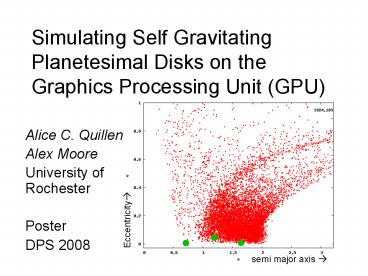
Eccentricity?
semi major axis ?
2
Abstract
- Planetesimal and dust dynamical simulations
require computations of many gravitational force
pairs as well as collision and nearest neighbor
detection. These are order N2 or O(N2)
computations for N the number of particles. I
describe an efficient parallel implementation of
an N-body integrator capable of integrating a
self-gravitating planetesimal disk in single
floating point precision. The software runs on a
GPU (graphics processing unit) and is written in
CUDA, NVIDIAs programming language for video
cards. The integrator is a parallel 2nd order
symplectic that works in heliocentric
coordinates and barycentric momenta. - A brute force implementation for sorting
interparticle distances requires O(N2)
computations, limiting the numbers of particles
that have been simulated. Algorithms recently
developed for the GPU, such as the radix sort,
can run as fast as O(N) and sort distances
between a million particles in a few hundred
milliseconds. We explore improvements in
collision and nearest neighbor detection
algorithms and how we can in future incorporate
them into our integrator.
3
Parallel computations on the GPU
- Graphics cards are a cheap and new parallel
computing platform - On a single chip large number of arithmetic
computation units (ALUs) and large on-board
memory. The fraction of the chip devoted to
arithmetic computation units exceeds that on
CPUs. - Optimization of code maximizing the numbers of
computations while minimizing slow memory
transfers. Having a large on-board memory is
extremely efficient as it bypasses many of the
man hours involved in writing code that shares
information across processors ---a problem of MPI
(message passing interface) approaches to
parallel computing.
4
N-body planetesimal systems in single precision
floating point
- Most video applications do not require double
precision floating point calculations - Current GPUs either are not capable of doing
double precision calculations or have a reduced
number of units devoted to this and so are not as
fast. - Precision limit for single precision is 10-7.
Compare this to the ratio of the mass of Earth to
the Sun 10-6. The force from the Sun swamps
that from the Earth if single precision is used
and the terms added. - To carry out N-body calculations in a
circumstellar disk in single precision the
central force term must be removed from the force
computation sum. - We work in a coordinate system that allows
interaction terms to be separated from Keplerian
evolution.
5
- The Hamiltonian for the N-body system in
heliocentric coordinates and associated
barycentric canonical momentum separates into 3
terms (Duncan et al. 1998). - HInt The interaction term contains
- the interparticle force pairs but lacks
- the force from central mass!
- O(N2) computations.
- HSun is a correction caused
- by working in a heliocentric frame
- rather than an inertial frame.
- O(N) computations.
- HKep Keplerian evolution for
- each particle separately
- O(N) computations.
6
Second order Symplectic Integrator
- To advance a timestep we use a series of
evolution operators each based on a term in the
Hamiltonian. - The interaction evolution kernel is called once
per timestep because this is the most
computationally intensive step. - The drift and Keplerian evolution kernels are
called twice per timestep but they require only
O(N) computations.
7
Memory layout and Kernels
- All particle coordinates reside in GPU global
memory. Heliocentric/barycentric coordinates
used on GPU. - Particle coordinates only transferred onoff the
GPU for initial setup and outputs. - Separate Kernels written for each term in
Hamiltonian. A kernel is code that runs on the
GPU but called from the CPU. - Shared memory on GPU used for computational
intense force pair calculation
8
Interaction Kernel on the GPU
All force pairs calculated as efficiently as on a
GRAPE board but using 20 processors on board a
video card Faster code when shared memory used. p
coordinates transferred to shared memory for each
computation tile. Same tiling and almost
identical code can be used for calculating total
energy as for calculating forces
Nyland et al. 2008 GPU Gems3
9
Kepstep Kernel
- f and g functions used to advance particle
positions. - These functions are computed with an iterative
solution of the universal differential Keplers
equation (e.g.,see Prussing Conway 1993
chapter 2). A Universal form is used so that
hyperbolic, parabolic and eccentric orbits can be
computed with the same equation. Its important
that the algorithm be robust --- never give NANs.
No case statements are required for different
classes of orbits facilitating parallel
implementation.
10
7 Iteration solution of the Universal Keplers
equation on the GPU
- Keplers equation must be solved iteratively.
- Usually the iteration is done until the equation
is solved within a desired precision level. - compute_first_iteration()
- while(computed_difference() lt
desired_precision) - compute_next_iteration()
- However this makes little sense on a GPU where
all particles are integrated simultaneously. If
one particles pops out of the while statement
early it does not speed up the code because this
particle has to wait for the other particles to
exit the loop. - Fortunately we can chose an iteration method that
rapidly converges. Using the Laguerre cubic
convergence method, I find that 7 iterations is
enough for all possible initial conditions to
achieve double precision accuracy. On the GPU we
just iterate 7 times no matter what. We trade
computations for complexity which could have
slowed the code. - compute_first_iteration()
- compute_next_iteration() compute_next_iterati
on() - compute_next_iteration() compute_next_iterati
on() compute_next_iteration()
11
Angular momentum conservation enforcement in the
Kepstep kernel
- In our first implementation we noted a steady
loss in angular momentum for particles after 106
timesteps were taken. We pinpointed the problem
finding that it was due to errors in single
precision computation in the Kepstep that dont
average to zero. - We got rid of the problem by insisting that
angular momentum is conserved during the step.
Angular momentum conservation implies that
We solve for one of these 4 functions, after
using the universal Keplers equation to
iteratively find the other 3. This ensures that
errors in angular momentum average to zero rather
than accumulating.
12
Drift Kernel
- Requires a sum of all momenta. This is done with
a parallel reduction sum (Harris et al. 2008) on
the GPU.
- References
- Duncan, M. J., Levison, H. F., Lee, M. H.
1998, A multiple timestep symplectic algorithm
for integrating close encounters, AJ, 116, 2067 - Nyland, L., Harris, M., and Prins, J. 2008,
Chap 31, Fast N-body simulation with CUDA, in
GPUGems3, edited by Hubert Nguyen, 2008,
Addison-Wesley, Upper Saddle River, NJ, page 677 - Prussing, J. E. Conway, B. A. 1993, Orbital
Mechanics, Oxford University Press, Inc., New
York, New York - Harris, M., Sengupta, S, Owens, J. D. 2008,
Chap 39, Parallel Prefix Sum (scan) with CUDA, in
GPUGems3,
13
Going beyond N-bodyIdentifying Collisions and
close approaches
- Regime of sparse collisions Collision timescale
is longer than an orbital timescale. - For Gravitating bodies
- N-body uses a smoothing length to prevent
spurious large velocity kicks caused by close
approaches. Smoothing length is chosen based on
typical mean particle spacing or Hill sphere
radii. - We would rather not use smoothing length but
instead identify which particles are likely to
approach within a Hill sphere. The 2 body problem
can be solved exactly, including collisions
leading to planetary growth or planetesimal
destruction. - For dust particles
- We can integrate particles that only feel gravity
of massive bodies (and not each others) but can
be sufficiently numerous to collide.
14
Algorithms for close approach and collision
detection
- For gravitating bodies
- Typical travel distance in each timestep can be
chosen to be small compared to Hill sphere. - For planetesimals Hill sphere is large enough
that a grid with each cell this size can be made. - Procedure for rapidly identifying nearest
neighbors create a hash table for each particle
on grid, followed by parallel sort. Can be done
faster than the interaction step. - For dust
- So numerous and small that we could never
simulate them all. - Possible approaches
- sample density distribution with a grid so
collisions probabilities can be computed from the
density field. Drawback is that this is
sensitive to the grid size and the number of
particles and time used to construct the density
distribution. - Inflate dust particle size and use approach above
for gravitating bodies. - Create an SPH type kernel and use this to compute
collision probabilities. Creating an SPH kernel
can also be done rapidly in parallel on the GPU
as sorting by distance can be done rapidly.
15
More information
- Alex Moores talk on Tuesday at the DPS 2008
meeting - http//arxiv.org/abs/0809.2855, Planet Migration
through a Self-Gravitating Planetesimal Disk - http//astro.pas.rochester.edu/aquillen/research1
.html , for code examples
Recommended

