

Chapter 5 Light and Matter: Reading Messages from the Cosmos PowerPoint PPT Presentation
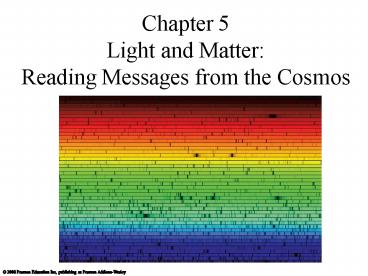
1 / 112
Title: Chapter 5 Light and Matter: Reading Messages from the Cosmos
1
Chapter 5Light and Matter Reading Messages
from the Cosmos
2
Chapter 5 Light
- Learning goals
- Properties of light
- Light as waves and particles -
- Energy, Frequency, Wavelength, speed
- The electromagnetic spectrum
- Interactions with matter - energy levels
- Doppler effect
3
How do we experience light?
- Light is a form of energy
- Flux of energy watts (m.k.s. unit)
- 1 watt 1 joule/sec
- In c.g.s. 1 joule 107 erg
- Thus, 1 Watt 107 erg/sec
4
Colors of Light
- Colors of white light
5
How do light and matter interact?
- Emission
- Absorption
- Transmission
- Transparent objects transmit light
- Opaque objects block (absorb) light
- Reflection or Scattering
6
Reflection and Scattering
Mirror reflects light in a particular direction
Movie screen scatters light in all directions
7
Thought QuestionWhy is a rose red?
- The rose absorbs red light.
- The rose transmits red light.
- The rose emits red light.
- The rose reflects red light.
8
Thought QuestionWhy is a rose red?
- The rose absorbs red light.
- The rose transmits red light.
- The rose emits red light.
- The rose reflects red light.
9
Properties of Waves
- Wavelength is the distance between two wave peaks
- Frequency is the number of times per second that
a wave vibrates up and down - wave speed wavelength x frequency
10
Light Electromagnetic Waves
- A light wave is a vibration of electric and
magnetic fields - Light interacts with charged particles
(electrons) - Electromagnetic wave wave causes charges to
- oscillate.
11
Wavelength and Frequency
- wavelength x frequency speed of light c
- c is an absolute constant, independent of motion!
12
Particles of Light
- Particles of light are called photons
- Each photon has a wavelength and a frequency
- The energy of a photon depends on its frequency
13
Wavelength, Frequency, and Energy
- l x f c
- l wavelength , f frequency
- c 3.0 x 10⁸ m/s 3.0 x 1010 cm/sec
- speed of light
- E h x f photon energy
- h 6.626 x 10⁻³⁴ joule x s photon energy
- In c.g.s. h 6.626 x 10⁻²⁷
14
The electromagnetic spectrum
15
The Electromagnetic Spectrum
16
Thought QuestionThe higher the photon energy
- the longer its wavelength.
- the shorter its wavelength.
- energy is independent of wavelength.
17
Thought QuestionThe higher the photon energy
- the longer its wavelength.
- the shorter its wavelength.
- energy is independent of wavelength.
18
5.3 Properties of Matter
- Learning goals
- What is the structure of matter?
- What are the phases of matter
- How is energy stored in atoms?
- How does light interact with matter?
19
Structure of matter
Electron Cloud
Nucleus
Atom
10-8 cm 10-13 cm Size of
atoms Size of protons
neutrons
20
Atomic Terminology
- Atomic Number of protons in nucleus
- Atomic Mass Number of protons neutrons
- Molecules consist of two or more atoms (H2O,
CO2)
21
Atomic Terminology
- Isotope same of protons but different of
neutrons. (4He, 3He)
22
Phases of matter
- Familiar phases
- Solid (ice)
- Liquid (water)
- Gas (water vapor)
- Plasma (ionized gas)
23
Phases of Water
24
Phase Changes
- Ionization Stripping of electrons, changing
atoms into plasma - Dissociation Breaking of molecules into atoms
- Evaporation Breaking of flexible chemical bonds,
changing liquid into solid - Melting Breaking of rigid chemical bonds,
changing solid into liquid
25
How is energy stored in atoms?
1 electron Volt (1 eV) 1.6 x10⁻¹³ erg
Hydrogen (H)
Excited States
Ground State
- Electrons in atoms are restricted to particular
energy levels
26
Energy Level Transitions
- The only allowed changes in energy are those
corresponding to a transition between energy
levels
Allowed
Not Allowed
27
What have we learned?
- Electrons in atoms can only have descrete energy
levels. - Atoms gain and lose energy only in amounts
corresponding to changes in energy levels. - Atoms (and molecules and ions)
- gain or lose energy by absorbing or emitting
- photons with specific energies, frequencies,
- and wavelengths.
- E h x f where E is the energy
difference - between energy
levels - E hc / ? because ? f
c -
f c/ ?
28
5.4 Learning from Light
- 3 types of spectra
- Light tells us what things are made of
- Light traces temperatures
- Interpretation of spectra
29
What are the three basic types of spectra?
Continuous Spectrum
Emission Line Spectrum
Absorption Line Spectrum
Spectra of astrophysical objects are usually
combinations of these three basic types
30
Three Types of Spectra
31
Continuous Spectrum
- The spectrum of a common (incandescent) light
bulb spans all visible wavelengths, without
interruption
32
Emission Line Spectrum
- A thin or low-density cloud of gas emits light
only at specific wavelengths that depend on its
composition and temperature, producing a spectrum
with bright emission lines
33
Absorption Line Spectrum
- A cloud of gas between us and a light bulb can
absorb light of specific wavelengths, leaving
dark absorption lines in the spectrum
34
How does light tell us what things are made of?
Spectrum of the Sun
35
Chemical Fingerprints
- Each type of atom has a unique set of energy
levels - Each transition corresponds to a unique photon
energy, frequency, and wavelength
Energy levels of Hydrogen
36
Chemical Fingerprints
- Downward transitions produce a unique pattern of
emission lines
37
Chemical Fingerprints
- Because those atoms can absorb photons with those
same energies, upward transitions produce a
pattern of absorption lines at the same
wavelengths
38
Chemical Fingerprints
- Each type of atom has a unique spectral
fingerprint
39
Chemical Fingerprints
- Observing the fingerprints in a spectrum tells us
which kinds of atoms are present
40
Example Solar Spectrum
41
Energy Levels of Molecules
- Molecules have additional energy levels because
they can vibrate and rotate
42
Energy Levels of Molecules
- The large numbers of vibrational and rotational
energy levels can make the spectra of molecules
very complicated - Many of these molecular transitions are in the
infrared part of the spectrum
43
Thermal Radiation
- All large objects emit thermal radiation,
including stars, planets, you - An objects thermal radiation spectrum depends on
only one property its temperature
44
Properties of Thermal Radiation
- Hotter objects emit more light at all frequencies
per unit area. - Hotter objects emit photons with a higher average
energy.
45
Thought QuestionWhich is hotter?
- A blue star.
- A red star.
- A planet that emits only infrared light.
46
Thought QuestionWhich is hotter?
- A blue star.
- A red star.
- A planet that emits only infrared light.
47
Thought QuestionWhy dont we glow in the dark?
- People do not emit any kind of light.
- People only emit infrared light that is invisible
to our eyes. - People only emit radio waves.
- People do not contain enough radioactive material.
48
Thought QuestionWhy dont we glow in the dark?
- People do not emit any kind of light.
- People only emit infrared light that is invisible
to our eyes. - People only emit radio waves.
- People do not contain enough radioactive material.
49
What is this object?
Carbon Dioxide Absorption lines are the
fingerprint of CO2 in the atmosphere. Strongest
absorption is at ? 14 to 15 ?m This
absorption prevents the escape of some thermal
infrared radiation emitted by the ground to
space More CO2 gt warmer Earth!
50
(No Transcript)
51
How does light tell us the speed of a distant
object?
The Doppler Effect
Change in f / f Change in ? /?? V / c
52
Measuring the Shift
Stationary
Moving Away
Away Faster
Moving Toward
Toward Faster
- We generally measure the Doppler Effect from
shifts in the wavelengths of spectral lines
53
Doppler shift tells us ONLY about the part of an
objects motion toward or away from us
54
Thought QuestionI measure a line in the lab at
500.7 nm.The same line in a star has wavelength
502.8 nm. What can I say about this star?
- It is moving away from me.
- It is moving toward me.
- It has unusually long spectral lines.
55
Thought QuestionI measure a line in the lab at
500.7 nm.The same line in a star has wavelength
502.8 nm. What can I say about this star?
- It is moving away from me.
- It is moving toward me.
- It has unusually long spectral lines.
56
How does light tell us the rotation rate of an
object?
- Different Doppler shifts from different sides of
a rotating object spread out its spectral lines
57
Spectrum of a Rotating Object
- Spectral lines are wider when an object rotates
faster
58
What have we learned?
- How does light tell us the speed of a distant
object? - The Doppler effect tells us how fast an object is
moving toward or away from us. - Blueshiftobjects moving toward us
- Redshift objects moving away from us
- How does light tell us the rotation rate of an
object? - The width of an objects spectral lines can tell
us how fast it is rotating
59
Chapter 6Telescopes Portals of Discovery
60
6.1 Eyes and Cameras Everyday Light Sensors
- Our goals for learning
- How does your eye form an image?
- How do we record images?
61
How does your eye form an image?
62
Refraction
- Refraction is the bending of light when it passes
from one substance into another - Your eye uses refraction to focus light
63
Example Refraction at Sunset
- Sun appears distorted at sunset because of how
light bends in Earths atmosphere
64
Focusing Light
- Refraction can cause parallel light rays to
converge to a focus
65
Image Formation
- The focal plane is where light from different
directions comes into focus - The image behind a single (convex) lens is
actually upside-down!
66
How do we record images?
67
Focusing Light
Digital cameras detect light with charge-coupled
devices (CCDs)
- A camera focuses light like an eye and captures
the image with a detector - The CCD detectors in digital cameras are similar
to those used in modern telescopes
68
6.2 Telescopes Giant Eyes
- Collect as much light as possible
- Diameter of primary mirror or lens D
- Area of collecting mirror or lens ? (D /
2)2 - Resolve small details in images
- ?????? / D (in radians)
- There are 206,265 2 x 10⁵ arc-seconds in
a radian - Obtain spectra
- Telescopes can work at all wavelengths
69
What are the two most important properties of a
telescope?
- Light-collecting area Telescopes with a larger
collecting area can gather a greater amount of
light in a shorter time. - Angular resolution Telescopes that are larger
are capable of taking images with greater detail.
70
Light Collecting Area
- A telescopes diameter tells us its
light-collecting area Area p(diameter/2)2 - The largest telescopes currently in use have a
diameter of about 10 meters
71
Bigger is better
72
Thought QuestionHow does the collecting area of
a 10-meter telescope compare with that of a
2-meter telescope?
- Its 5 times greater.
- Its 10 times greater.
- Its 25 times greater.
73
Thought QuestionHow does the collecting area of
a 10-meter telescope compare with that of a
2-meter telescope?
- Its 5 times greater.
- Its 10 times greater.
- Its 25 times greater.
74
Angular Resolution
- The minimum angular separation that the telescope
can distinguish.
75
Angular Resolution
- Ultimate limit to resolution comes from
interference of light waves within a telescope. - Larger telescopes are capable of greater
resolution because theres less interference
76
Angular Resolution
- Ultimate limit to resolution comes from
interference of light waves within a telescope. - Larger telescopes are capable of greater
resolution because theres less interference
77
Angular Resolution
- The rings in this image of a star come from
interference of light wave. - This limit on angular resolution is known as the
diffraction limit
Close-up of a star from the Hubble Space Telescope
78
What are the two basic designs of telescopes?
- Refracting telescope Focuses light with lenses
- Reflecting telescope Focuses light with mirrors
79
Refracting Telescope
- Refracting telescopes need to be very long, with
large, heavy lenses
80
Reflecting Telescope
- Reflecting telescopes can have much greater
diameters - Most modern telescopes are reflectors
81
Designs for Reflecting Telescopes
82
Mirrors in Reflecting Telescopes
Twin Keck telescopes on Mauna Kea in Hawaii
Segmented 10-meter mirror of a Keck telescope
83
What do astronomers do with telescopes?
- Imaging Taking pictures of the sky
- Spectroscopy Breaking light into spectra
- Timing Measuring how light output varies with
time
84
Imaging
- Astronomical detectors generally record only one
color of light at a time - Several images must be combined to make
full-color pictures
85
Imaging
- Astronomical detectors can record formsof light
oureyes cant see - Color is sometimes used to represent different
energies of nonvisible light
86
Spectroscopy
- A spectrograph separates the different
wavelengths of light before they hit the detector
Diffraction grating breaks light into spectrum
Light from only one star enters
Detector records spectrum
87
Spectroscopy
- Graphing relative brightness of light at each
wavelength shows the details in a spectrum
88
Timing
- A light curve represents a series of brightness
measurements made over a period of time
89
Want to buy your own telescope?
- Buy binoculars first (e.g. 7x35) - you get much
more for the same money. - Ignore magnification (sales pitch!)
- Notice aperture size, optical quality,
portability. - Consumer research Astronomy, Sky Tel, Mercury.
Astronomy clubs.
90
What have we learned?
- What are the two most important properties of a
telescope? - Collecting area determines how much light a
telescope can gather - Angular resolution is the minimum angular
separation a telescope can distinguish - What are the two basic designs of telescopes?
- Refracting telescopes focus light with lenses
- Reflecting telescopes focus light with mirrors
- The vast majority of professional telescopes are
reflectors
91
What have we learned?
- What do astronomers do with telescopes?
- Imaging
- Spectroscopy
- Timing
92
6.3 Telescopes and the Atmosphere
- Our goals for learning
- How does Earths atmosphere affect ground-based
observations? - Why do we put telescopes into space?
93
How does Earths atmosphere affect ground-based
observations?
- The best ground-based sites for astronomical
observing are - Calm (not too windy)
- High (less atmosphere to see through)
- Dark (far from city lights)
- Dry (few cloudy nights)
94
Light Pollution
- Scattering of human-made light in the atmosphere
is a growing problem for astronomy
95
Twinkling and Turbulence
Star viewed with ground-based telescope
Same star viewed with Hubble Space Telescope
- Turbulent air flow in Earths atmosphere
distorts our view, causing stars to appear to
twinkle
96
Adaptive Optics
Without adaptive optics
With adaptive optics
- Rapidly changing the shape of a telescopes
mirror compensates for some of the effects of
turbulence
97
(No Transcript)
98
Calm, High, Dark, Dry
- The best observing sites are atop remote mountains
Summit of Mauna Kea, Hawaii
99
Why do we put telescopes into space?
100
Transmission in Atmosphere
- Only radio and visible light pass easily through
Earths atmosphere - We need telescopes in space to observe other forms
101
What have learned?
- How does Earths atmosphere affect ground-based
observations? - Telescope sites are chosen to minimize the
problems of light pollution, atmospheric
turbulence, and bad weather. - Why do we put telescopes into space?
- Forms of light other than radio and visible do
not pass through Earths atmosphere. - Also, much sharper images are possible because
there is no turbulence.
102
6.4 Eyes and Cameras Everyday Light Sensors
- Our goals for learning
- How can we observe nonvisible light?
- How can multiple telescopes work together?
103
How can we observe nonvisible light?
- A standard satellite dish is essentially a
telescope for observing radio waves
104
Radio Telescopes
- A radio telescope is like a giant mirror that
reflects radio waves to a focus
105
IR UV Telescopes
SOFIA
Spitzer
- Infrared and ultraviolet-light telescopes operate
like visible-light telescopes but need to be
above atmosphere to see all IR and UV wavelengths
106
X-Ray Telescopes
- X-ray telescopes also need to be above the
atmosphere
Chandra
107
X-Ray Telescopes
- Focusing of X-rays requires special mirrors
- Mirrors are arranged to focus X-ray photons
through grazing bounces off the surface
108
Gamma Ray Telescopes
- Gamma ray telescopes also need to be in space
- Focusing gamma rays is extremely difficult
Compton Observatory
109
How can multiple telescopes work together?
110
Interferometry
- Interferometery is a technique for linking two or
more telescopes so that they have the angular
resolution of a single large one
111
Interferometry
- Easiest to do with radio telescopes
- Now becoming possible with infrared and
visible-light telescopes
Very Large Array (VLA)
112
Future of Astronomy in Space?
- The Moon would be a good observing site
- - no atmosphere!
- Deep space is even better
- - no gravity
- - can see most of
- the sky at once!
- James Web Space
- Telescope JWST
- D 6.5 meter
- infrared telescope
- launch in 2013 .
Recommended

