

Opportunities to Make Science Museum Visits More Meaningful: PowerPoint PPT Presentation
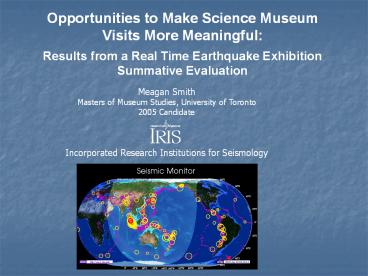
Title: Opportunities to Make Science Museum Visits More Meaningful:
1
Opportunities to Make Science Museum Visits More
Meaningful Results from a Real Time Earthquake
Exhibition Summative Evaluation
Meagan Smith Masters of Museum Studies,
University of Toronto 2005 Candidate
Incorporated Research Institutions for Seismology
2
The IRIS/USGS Earthquake Display
- 51-inch plasma monitor that displays the
- locations of earthquakes
- 2) Computer monitor that lists the times,
- magnitudes, and geographic locations of the
- displayed earthquakes
- 3) Mechanical triple drum records four days of
- continuous ground motion at three remote
- locations
- 4) Associated text and visuals (varies by museum)
3
Evaluation Methodology
- Museums
- 1) Smithsonian National Museum of Natural
History (NMNH) - Plate Tectonics Gallery (PTG)
- 2) American Museum of Natural History (AMNH)
- Gottesman Hall of Planet Earth (HoPE)
- Method
- Phase 1 Gallery IRIS/USGS Display
- Tracking timing (n100)
- Sweeps (n100)
- Open-ended exit interviews (n34) (PTG only)
- Phase 2 IRIS/USGS Display
- Focused observations (n100)
- Open-ended post experience interviews (n50)
4
Gallery Space
NMNH Plate Tectonics Gallery
AMNH Gottesman Hall of Planet Earth
- 46 elements
- 32 elements
IRIS/ USGS display
5
Display Layout
NMNH Plate Tectonics Gallery
AMNH Gottesman Hall of Planet Earth
6
Quantitative Evaluation Results
- Attracting Power Tracking and Timing
- NMNH - 38 of visitors stopped (1 of 46 elements)
- AMNH - 41 of visitors stopped (1 of 32 elements)
- Holding Power Tracking and Timing
- NMNH - 046 or 0.8 minutes median stop
time/visitor (6 of 46) - AMNH - 123 or 1.4 minutes median stop
time/visitor (1 of 32) - Cumulative Stop Time Tracking and Timing
- NMNH - 30.8 minutes (1 of 46 by 5 minutes)
- AMNH - 64.2 minutes (1 of 32 by 22 minutes)
- Total Number of Stopped Visitors Sweeps
- NMNH - 210 visitors or 11 of all stops (1 of 46)
- AMNH - 283 visitors or 15 of all stops (1 of 32)
- Most Liked or Interesting Part of the PTG Exit
Interviews - NMNH - 27 of all responses (1 of 46)
7
Understanding the Displays Success Real Time
Information
Interview Results What attracted you to the
display?
Interest in earthquakes
Other
Plasma monitor (22 at both the NMNH
AMNH)
Real time information (11 at the NMNH
20 at the AMNH)
Triple drum
Location of home
8
Understanding the Displays Success Real Time
Information
Interview Results What did you like best about
this display?
Other
Make your own earthquake
6
Real time / up to date information (31 at
both the NMNH AMNH)
9
Global information
2
Easy to understand
2
31
3
Interactive
7
Triple drum
9
20
Overall presentation
10
Map of recent earthquakes/ (plasma monitor)
Small monitor with updated list
Only present in the PTG at the NMNH
9
Understanding the Displays Success Real Time
Information
Examples of Visitor Responses It was very
interesting to see what just happened only a few
minutes ago. I recognized the drum, but had
never seen one actively working. I like that
it is up to date, and I heard in the news this
morning that there was in earthquake in Illinois
this morning and there it was. The way they
were able to bring the information to you in
real time. I was surprised at the number of
earthquakes it showed, and how it was able to
show all the locations
10
Understanding the Displays Success Real Time
Information
Interview Results What information did you find
the most interesting or surprising?
Other
Real time / up to date
Frequency of earthquakes
Particular event(s)
Where earthquakes occur
That the Earth is moving even though we dont
notice it. That there are so many minor
earthquakes every day. That they had
earthquakes clear across the United States.
11
What Makes Science Interesting?
Herbal Medicines Climate Change Genetically
Modified Foods
- Practicing Scientist
- Current / Hot Topic
- Sexy / Popular Culture
- Science in action
Relevant to our lives
Cloning Stem Cell Research Euthanasia Space
Exploration
12
Relevance and Museum Displays
Most important, the link between the museum and
the visitors life needs to be made clear.
(Csikszentmihalyi and Hermanson, 1995) In
order to make meaning of our experience, we need
to be able to connect it with what we already
know. (Hein, 1999) we must find ways to
reach visitors, building bridges to their past
experiences and knowledge. (Jeffrey, 1998) Do
real time displays offer more opportunities for
connections between visitors and the display? Do
they increase relevance for visitors?
13
Didactic Earthquake Displays
Did You Know?
- Earthquakes are the geological forces of the
Earth that build mountains and - create ocean. They are natures reminder
that we are living on the thin outer - crust of a planet that is cooling.
- Each year, approximately 800,000 earthquakes are
recorded worldwide. Most - are too small to be felt, but typically at
least one is a great earthquake.
- The Earths outer crust is divided into plates.
- Earthquakes occur when plates move under
- over, or slide past each other.
- Earthquakes typically occur along plate
- boundaries
14
Interactive / Hands-On Earthquake Displays
Activities
- Shake a city in a pan of sand and water
- Watch video footage of the Great Alaskan
Earthquake, 1964 - Use a slinky to visualize how seismic waves
travel through the Earth - Use a computer to simulate an earthquake.
- Choose the magnitude and epicentre
- Record your own seismic waves by jumping in
- front of a seismograph
15
Real Time Earthquake Displays
Watch Earthquakes Occur
16
Real Time Earthquake Displays
Watch Earthquakes Occur
17
Earthquake Displays
Didactic
Interactive/Hands-On
Discovery and constructivist Visual / auditory /
tactile / social learning Museum as discovery
center / edutainment
Transmission Visual learning Museum as authority
Real Time
Discovery and constructivist Visual / social
learning Museums providing current science
information Increases relevance / connection to
the visitor
BEST RESULTS Combine all three
18
Learning Theories
Falk Dierkings Contextual Model of Learning
Csikszentmihalyis Flow Experience
- Hook
- Opportunities for involvement
- sensory, intellectual, emotional
- Conditions for flow
- clear goals
- challenges that match a wide variety of
visitor skill levels - choice
- a supportive environment
- Growth of complexity in consciousness
- sensory, intellectual emotional
- Learning as an integrated experience
- Personal, sociocultural,
- and physical contexts
- Time
Piagets Learning Theory
Accommodation and Assimilation
19
Challenges Facing Real Time Exhibits
- Technology
- Cost ( and staff resources)
- Maintenance
- Need scientific expertise
- Need dynamic subjects
Possible Topics
Weather Population clock Deforestation
clock Live video feeds
Exhibits Must
Be active / change continually Present new or
interesting ideas to visitors a-ha Allow
visitors of all skill levels to understand
content Provide on-going learning opportunities
inside and outside of the museum
20
Acknowledgements
Ellen Giusti Coordinator of Exhibit Evaluation,
American Museum of Natural History Paul
Kimberly Computer Specialist Global Volcanism
Program, NMNH Dr. James Luhr Geologist
Mineral Sciences Department Chairman,
AMNH Dr. Ed Mathez Chairman, Department of
Earth and Planetary Sciences Curator,
Department of Earth and Planetary Sciences,
AMNH Barbara Soren Graduate Coordinator,
Museum Studies, University of Toronto John
Taber Education Outreach Program Manager, IRIS
Recommended

