

Subcategorization Possibilities Trigger Syntactic Expectations: Evidence from the Processing of Heav PowerPoint PPT Presentation
1 / 1
Title: Subcategorization Possibilities Trigger Syntactic Expectations: Evidence from the Processing of Heav
1
Subcategorization Possibilities Trigger Syntactic
Expectations Evidence from the Processing of
Heavy NP Shift
Adrian Staub, Charles Clifton, Jr., and Lyn
FrazierUniversity of Massachusetts, Amherst
- Introduction
- In English, a direct object noun phrase tends to
appear immediately after the verb. An exception
is Heavy NP Shift (HNPS Ross, 1967), in which a
long (or heavy) noun phrase is moved to the end
of the sentence, over intervening material. - Wasow (1997) suggested that the difficulty of
processing HNPS may be determined, in part, by
the verbs subcategorization possibilities. - When the verb is obligatorily transitive (e.g.,
guard, include), the comprehender is able to
predict that a direct object will ultimately
arrive, even when other material intervenes. - When the verb is optionally transitive (e.g.,
cheat, lecture), the comprehender may assume an
intransitive frame, and may have difficulty
integrating a subsequent noun phrase. - Experiment 1
- Purpose To test Wasows suggestion that the
difficulty of processing HNPS is influenced by
the verbs subcategorization possibilities. - Stimuli 28 sentences, four versions of each
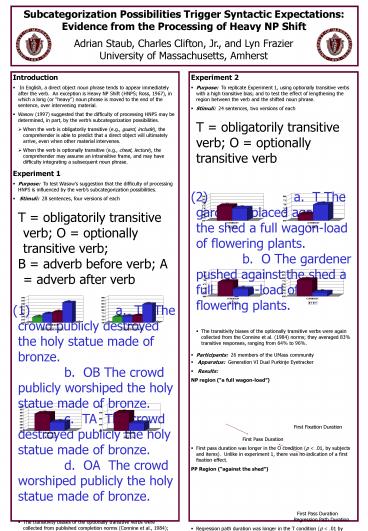
- T obligatorily transitive verb O optionally
transitive verb - B adverb before verb A adverb after verb
- (1) a. TB The crowd publicly destroyed the holy
statue made of bronze. - b. OB The crowd publicly worshiped the holy
statue made of bronze. - c. TA The crowd destroyed publicly the holy
statue made of bronze. - d. OA The crowd worshiped publicly the holy
statue made of bronze. - The transitivity biases of the optionally
transitive verbs were collected from published
completion norms (Connine et al., 1984) they
averaged 47 transitive responses, ranging from
3 to 94. - Participants 24 members of the UMass community
- Experiment 2
- Purpose To replicate Experiment 1, using
optionally transitive verbs with a high
transitive bias and to test the effect of
lengthening the region between the verb and the
shifted noun phrase. - Stimuli 24 sentences, two versions of each
- T obligatorily transitive verb O optionally
transitive verb - (2) a. T The gardener placed against the shed a
full wagon-load of flowering plants. - b. O The gardener pushed against the shed a
full wagon-load of flowering plants. - The transitivity biases of the optionally
transitive verbs were again collected from the
Connine et al. (1984) norms they averaged 83
transitive responses, ranging from 64 to 96. - Participants 26 members of the UMass community
- Apparatus Generation VI Dual Purkinje
Eyetracker - Results
- NP region (a full wagon-load)
- First Fixation Duration First Pass
Duration
Recommended

