

Presentacin de PowerPoint PowerPoint PPT Presentation
1 / 56
Title: Presentacin de PowerPoint
1
(No Transcript)
2
Restoration of the
Pont Trencat
Xavier Font ALFA POLARIS
3
LOCATION
4
HISTORY
It was believed to be a Roman structure Documentat
ion was found that suggested the structure was
built in 1453 The destruction of main arch of the
Pont Trencat was ordered by the Spanish General
Mr Josep Obispo, in order to obstruct the
movements of the invading army during the
Napoleonic War The efforts of the Sant Celoni
authorities to reconstruct that bridge finally
brought about the construction of the Queens
bridge in 1866, down the river from the old
bridge.
5
PRELIMINARY STATE
6
PRELIMINARY STATE
7
PRELIMINARY STATE
8
FIRST STUDIES
Topographic plan Geotecnical Report Historical
pictures search Document search Photogrametric
processing Archaeological excavations
9
FIRST STUDIES
Topographic plan Geotecnical Report Historical
pictures search Document search Photogrametric
processing Archaeological excavations
10
FIRST STUDIES
Topographic plan Geotecnical Report Historical
pictures search Document search Photogrametric
processing Archaeological excavations
11
FIRST STUDIES
Topographic plan Geotecnical Report Historical
pictures search Document search Photogrametric
processing Archaeological excavations
12
REFLECTION ABOUT THE SOLUTION
How should the bridge be rebuilt? There were
three main possibilities.
13
REFLECTION ABOUT THE SOLUTION
How should the bridge be rebuilt? There were
three main possibilities. The first one was just
to reinforce the remains without recovering its
function
14
REFLECTION ABOUT THE SOLUTION
How should the bridge be rebuilt? There were
three main possibilities. The second one was to
rebuilt the bridge trying to give the shape we
thing it has back
15
REFLECTION ABOUT THE SOLUTION
How should the bridge be rebuilt? There were
three main possibilities. And the third one was
to restore its function constructing the missing
part in a totally different way, making clear the
contrast between the old and the new part.
16
REFLECTION ABOUT THE SOLUTION
But... We didn't know what the bridge looked
like before it collapsed, and the only image
known was of its broken shape The present project
is part of the history of the bridge. It's an
intervention that takes place in a certain age,
with its own characteristic materials and
construction techniques, quite different than the
ones from other times. Trying to use the stone
and its proper techniques would give future
generations false information. Several people
asked us if, after its reconstruction, it would
stop being the Pont Trencat. This latest aspect
may not seem so important, but we strongly think
it must be taken into account. The bridge
remained broken for almost one hundred and ninety
years, and this is a period of time long enough
to be taken into consideration.
17
REFLECTION ABOUT THE SOLUTION
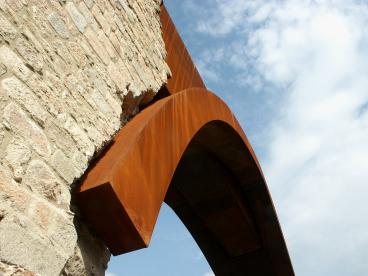
We looked for a structure that emphasized the
difference between the old and the new volume,
throwing into relief the silhouette of the
ancient part, that is the one which better
symbolizes the image of the bridge. We wanted the
top line of the new deck and the intrados of the
steel arch to follow the shape we think the old
bridge had in order that the new structure tried
to evoke the missing silhouette of the original
bridge.
18
DESIGN PROCESS
Study of alternatives
19
DESIGN PROCESS
Study of alternatives
20
DESIGN PROCESS
Study of alternatives
21
THE SOLUTION
Two span box girder deck, 3.00 meters in depth,
varying in width from 2.08 meters at the bottom
to 3.36 meters at the top. This is supported by
three pairs of bearings, two at both ends and the
intermediate one placed over the crown of a
hollow box ogive arch The arch spans 24 meters
and its width varies from 3.40 meters over the
foundations to 5.12 meters at the crown.
22
THE SOLUTION
Two span box girder deck, 3.00 meters in depth,
varying in width from 2.08 meters at the bottom
to 3.36 meters at the top. This is supported by
three pairs of bearings, two at both ends and the
intermediate one placed over the crown of a
hollow box ogive arch The arch spans 24 meters
and its width varies from 3.40 meters over the
foundations to 5.12 meters at the crown.
23
THE CONSTRUCTION PROCESS
24
THE CONSTRUCTION PROCESS
25
THE CONSTRUCTION PROCESS
26
THE CONSTRUCTION PROCESS
27
THE CONSTRUCTION PROCESS
28
THE CONSTRUCTION PROCESS
29
THE CONSTRUCTION PROCESS
30
THE CONSTRUCTION PROCESS
31
THE CONSTRUCTION PROCESS
32
THE CONSTRUCTION PROCESS
33
THE CONSTRUCTION PROCESS
34
THE CONSTRUCTION PROCESS
35
THE CONSTRUCTION PROCESS
36
THE CONSTRUCTION PROCESS
37
THE CONSTRUCTION PROCESS
38
THE CONSTRUCTION PROCESS
39
FINISHED WORK
40
FINISHED WORK
41
FINISHED WORK
42
FINISHED WORK
43
CONCLUSION
- We think this is an original use of steel,
which was chosen, not for economical or
structural reasons, but for its aesthetic
purposes in combining the old use of granite
stone with the modern use of steel. - The restoration of the bridge has induced
improvements of the surroundings - We recovered the bridge's use, but, in some
way, the bridge keeps on being broken. - In the last fifteen years society has increased
its sensitivity toward aesthetical issues and the
recovery of the historical heritage, so we should
think of adapting the curricula of the
engineering studies to the new needs.
44
(No Transcript)
45
(No Transcript)
46
(No Transcript)
47
(No Transcript)
48
(No Transcript)
49
(No Transcript)
50
(No Transcript)
51
(No Transcript)
52
(No Transcript)
53
(No Transcript)
54
(No Transcript)
55
(No Transcript)
56
(No Transcript)
Recommended

