

CSC 8420 Advanced Operating Systems Georgia State University Yi Pan PowerPoint PPT Presentation
1 / 26
Title: CSC 8420 Advanced Operating Systems Georgia State University Yi Pan
1
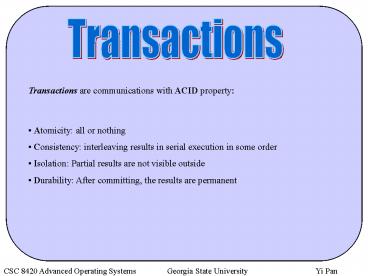
Transactions
Transactions are communications with ACID
property
- Atomicity all or nothing
- Consistency interleaving results in serial
execution in some order - Isolation Partial results are not visible
outside - Durability After committing, the results are
permanent
CSC 8420 Advanced Operating Systems
Georgia State University
Yi Pan
2
Two-phase Commit Protocol
Participant
- Prepare to commit the transaction by writing
every update in activity log. - Write a precommit message in the activity log.
Wait for request to vote from coordinator. - Wait for commit message from the coordinator. If
received, commit the transaction. If abort
message is received, abort the transaction.
CSC 8420 Advanced Operating Systems
Georgia State University
Yi Pan
3
Two-phase Commit Protocol (Recovery)
Coordinator
- If the processor crashes, it will check the
activity log for the transaction. - If the precommit message is not in the log, abort
the transaction. - If the commit message is not in the log, retake
the vote. - If the commit message is there in the log, finish
the transaction.
CSC 8420 Advanced Operating Systems
Georgia State University
Yi Pan
4
Distributed Mutual Exclusion
- Contention based Lamports algorithm,
Ricart Agrawalas algorithm, Voting algorithm - Token based Ring structure, tree
structure, broadcast structure
CSC 8420 Advanced Operating Systems
Georgia State University
Yi Pan
5
Lamport's Algorithm
Every process maintains a queue of pending
requests for entering critical section ordered
according to the logical time-stamp.
Requestor
- Send a request to every process.
- After all replies are collected, enter its own
request in its own queue - If own request is at the head of the queue, enter
critical section. - Upon exiting the critical section, send a release
message to every process.
CSC 8420 Advanced Operating Systems
Georgia State University
Yi Pan
6
Lamport's Algorithm
Other processes
- After receiving a request, send a reply and enter
the request in the queue - After receiving release message, remove the
corresponding request from the queue. - If own request is at the head of the queue, enter
critical section.
Problems
- 3(N-1) messages per requests
- Multiple points of failure
CSC 8420 Advanced Operating Systems
Georgia State University
Yi Pan
7
Ricart Agrawal's Algorithm
Requestor
- Send a request to all other process.
- Enter critical section upon receipt of reply from
all processes.
Other Processes
- Upon receipt of a request check whether it has
any older (by logical clock) pending request of
its own or whether it is executing in critical
section. - If neither of the above conditions hold, send
reply. Otherwise delay the reply message till
both the conditions are false.
Problems
- 2(N-1) message exchange per request.
- Multiple points of failure.
CSC 8420 Advanced Operating Systems
Georgia State University
Yi Pan
8
Voting Scheme
Requestor
- Send a request to all other process.
- Enter critical section once REPLY from a majority
is received - Broadcast RELEASE upon exit from the critical
section.
Other processes
- REPLY to a request if no REPLY has been sent.
Otherwise, hold the request in a queue. - If a REPLY has been sent, do not send another
REPLY till the RELEASE is received.
Observations
- No single point of failure, but possibility of
deadlock. - O(N) messages per request.
CSC 8420 Advanced Operating Systems
Georgia State University
Yi Pan
9
Voting Scheme (Improved-1)
Deadlock prevention method is used by ensuring no
hold-and-wait
Requestor
- Send a request with time stamp to all other
process. - Enter critical section once REPLY from a majority
is received - Return the REPLY message upon receipt of an
INQUIRY if not currently executing in the
critical section. - Broadcast RELEASE upon exit from the critical
section.
CSC 8420 Advanced Operating Systems
Georgia State University
Yi Pan
10
Voting Scheme (Improved-1)
Other processes
- If no REPLY has been sent, REPLY to any REQUEST.
- If a REPLY has been sent but the RELEASE has not
been received, compare the time stamp of the new
REQUEST with the time stamp of the replied
REQUEST. If the new REQUEST has an earlier time
stamp, try to retract the old REPLY sending
INQUIRY message. If the older REPLY is returned,
send REPLY to the new REQUEST. Otherwise, wait
for the RELEASE.
Observation
- High (O(N)) messages per critical section entry.
CSC 8420 Advanced Operating Systems
Georgia State University
Yi Pan
11
Voting Scheme (Improved-2)
To reduce message overhead, the set of (N)
processes is divided into N sets S1 to Sn such
that Si I Sk is non-null for all i and k. Si is
called the quorum of process i.
Requestor
- Need to secure the REPLY messages from all
members of its quorum only.
Observations
- It is possible to reduce number of messages
significantly. - Depending on the structure of the quorum and the
exact algorithm, single point of failure may
exist.
CSC 8420 Advanced Operating Systems
Georgia State University
Yi Pan
12
Token based Mutual Exclusion
Control-token circulates in the system in some
fixed order. Possession of the token grants
permission to enter critical section.
- Ring structure simple, deadlock-free, fair.
The token circulates even in the absence of any
request (unnecessary traffic). Long path (O(N))
the wait for token may be high. - Tree structure
- Broadcast structure
CSC 8420 Advanced Operating Systems
Georgia State University
Yi Pan
13
Token circulation in tree
The processes are organized in a logical tree
structure, each node pointing to its parent.
Further, each node maintains a FIFO list of token
requesting neighbors. Each node has a variable
Tokenholder initialized to false for everybody
except for the first token holder (token
generator).
Entry section
If not Tokenholder If the request queue
empty request token from parent put itself in
request queue block self until Tokenholder is
true
CSC 8420 Advanced Operating Systems
Georgia State University
Yi Pan
14
Token circulation in tree
Exit section
If the request queue is not empty parent
dequeue(request queue) send token to
parent set Tokenholder to false if the
request queue is still not empty, request token
from parent
CSC 8420 Advanced Operating Systems
Georgia State University
Yi Pan
15
Token circulation in tree
Upon receipt of a request
If Tokenholder If in critical section put
the requestor in the queue else
parent requestor Tokenholder false send
token to parent endif else
if the queue is empty send a request
to the parent
put the requestor in queue
CSC 8420 Advanced Operating Systems
Georgia State University
Yi Pan
16
Token circulation in tree
Upon receipt of a token
Parent Dequeue(request queue)
if self is the parent Tokenholder
true else send token to
the parent if the queue is not
empty request token from parent
Note that all requests/token receipts must be
processed in FIFO order and the routines must
execute atomically.
CSC 8420 Advanced Operating Systems
Georgia State University
Yi Pan
17
Token Circulation by Broadcast
Suzuki/Kasami Algorithm
Data Structure
The token contains Token vector T(.)
number of completion of the critical
section for every process. Request queue
Q(.) queue of requesting processes. Every
process (i) maintains the following seq_no
how many times i requested critical
section. Si(.) the highest sequence number
from every process i heard of.
CSC 8420 Advanced Operating Systems
Georgia State University
Yi Pan
18
Suzuki/Kasami Algorithm
Entry Section (process i)
Broadcast a REQUEST message stamped with
seq_no. Enter critical section after receiving
token.
Exit Section (process i)
Update the token vector T by setting T(i) to
Si(i). If process k is not in request queue Q and
there are pending requests from k (Si(k)gtT(k)),
append process k to Q. If Q is non-empty, remove
the first entry from Q and send the token to the
process indicated by the top entry.
CSC 8420 Advanced Operating Systems
Georgia State University
Yi Pan
19
Suzuki/Kasami Algorithm
Processing a REQUEST (process j)
Set Sj(k) to max(Sj(k), seq_no) after receiving a
REQUEST from process k. If holds an idle token,
send it to k.
Requires broadcast. Therefore message overhead is
high.
CSC 8420 Advanced Operating Systems
Georgia State University
Yi Pan
20
Election Algorithms
Used to elect a centralized controller if the
older one fails. The election of a new controller
helps to alleviate some of the problems arising
from having a single point of failure.
- Two types of election algorithm
- Extrema- finding based on global priority
- Preference-based based on local preferences.
CSC 8420 Advanced Operating Systems
Georgia State University
Yi Pan
21
Election Algorithms
Election algorithms and mutual-exclusion
algorithms are similar in the sense that they try
to find one process that will be leader or enter
the critical section. However, there are
significant differences between two.
- Leader election is one time. A process may yield
to another process. In mutual exclusion
algorithm, a process competes until it succeeds. - In leader election starvation is not an issue.
- Once the leader is elected, all other processes
must know who is the leader.
CSC 8420 Advanced Operating Systems
Georgia State University
Yi Pan
22
Election Algorithms
- Election algorithms are designed on the basis of
the logical topology of the group of the
processes. - Complete topology
- Ring
- Tree
CSC 8420 Advanced Operating Systems
Georgia State University
Yi Pan
23
Complete Topology
Assumptions
- A process may reach all other processes in one
logical hop. - Communication is reliable, only processes may
fail. - Time to handle a message is bounded.
- Process faults are benign, i.e., a faulty process
stops to generate messages. In other words, a
process never generates confusing wrong messages. - Upon recovery, a process knows that it
experienced a failure. - A failed process may rejoin the group upon
recovery.
CSC 8420 Advanced Operating Systems
Georgia State University
Yi Pan
24
Complete Topology
Our algorithm is an extrema-finding algorithm. It
is called the bully algorithm.
Upon detecting that the leader has failed, a
process sends an inquiry message to all
higher-priority processes. If no reply is
received within the time-out period, the
initiator sends an enter-election message to all
lower priority processes. After the initiator
receives a reply from all lower-priority
processes or after the time-out, it declares
itself as new leader and broadcasts that
information to all processes.
If a process receives an inquiry message from a
lower priority process, it send inquiry message
to all higher priority process and enters
election.
CSC 8420 Advanced Operating Systems
Georgia State University
Yi Pan
25
Logical Ring Topology
Our algorithm is an extrema-finding algorithm.
The processes are organized in a logical ring.
The initiator sends a message along ring with its
own id. Requesting everybody to elect it the
leader.
A process compares its own priority with that of
the id. on an incoming message. If its own
priority is higher, and it never forwarded any
other messages, replace the message with its own
id. and forward it. If its own priority is lower,
forward the message. If the message carries its
own id. then elect itself the leader and forward
the election message.
Message complexity O(N2) in the worst-case, O(N)
in the best-case.
CSC 8420 Advanced Operating Systems
Georgia State University
Yi Pan
26
Logical Tree Topology
There are two types of election algorithms those
use the logical tree topology.
- The algorithm runs after the spanning tree is
constructed. - The algorithm runs before the spanning tree is
constructed and constructs the spanning tree in
the process.
CSC 8420 Advanced Operating Systems
Georgia State University
Yi Pan
Recommended

