

Who WereAre the Terrorists and What is their Current Status PowerPoint PPT Presentation
1 / 49
Title: Who WereAre the Terrorists and What is their Current Status
1
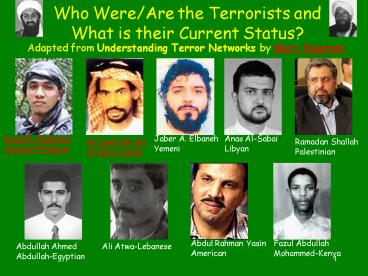
Who Were/Are the Terrorists and What is their
Current Status?
- Adapted from Understanding Terror Networks by
Marc Sageman
Khadafi Abubakar Janjala-Philippine
Anas Al-Sabai
Libyan
Jaber A. Elbaneh Yemeni
Ramadan Shallah
Palestinian
Ali Saed Bin Ali Al Houri-Saudi
Abdul Rahman Yasin American
Fazul Abdullah Mohammed-Kenya
Abdullah Ahmed Abdullah-Egyptian
Ali Atwa-Lebanese
2
(No Transcript)
3
TerrorismIntelligence Community Definition
- Premeditated Violence, or Threat of Violence
- Politically Motivated
- Against Non-Combatants
- A Criminal Act
- Symbolic In Nature
- Intended to Impact Audience Beyond the Immediate
Victims
Perpetrated by sub national groups or clandestine
state agents
The Psycho-cultural Foundations of Contemporary
Terrorism Jerrold Post, GW University
4
Targets of Terrorism
- Violence
- Terror
- Compliance
- Influence
The Media are not just Observers and Reporters,
but are participants in the terrorists drama.
They are active targets of manipulation
Psychological Warfare Waged Through the Media
The Psycho-cultural Foundations of Contemporary
Terrorism Jerrold Post, GW University
5
TerrorISMS
- Global Salafi Jihadists
- Terrorists Organizations with Broad Social
Support - Terrorism Arising from Diaspora Émigré
Populations - Anti-Regime Terrorists
Each should be understood in its unique
historical, cultural, and political context.
- The Psycho-cultural Foundations of Contemporary
Terrorism - Jerrold Post, GW University
6
Evidence Based Terrorism Research
- Application of scientific method to terrorism
research - Started with 9/11 Perpetrators as index sample
- 400 biographies of terrorists Open Source
information
- Trial transcripts
- US, France, Germany, Egypt, Indonesia, Morocco,
Canada - Press accounts English, French, German, Arabic,
Spanish, Turkish, Dutch - Academic publications
- Internet (corroborated)
7
Global Salafi Jihad
- Violent Islamist born-again social movement
- Fight for justice fairness
- Build a better world utopia modeled on the
community of the Prophet his companions (Salaf) - Four phases
- Peaceful capture of a state (Afghanistan?)
- Against the near enemy (Saudi Arabia, Egypt,
Jordan, etc.) - Global expansion of defensive jihad
- - Global offense against the far enemy (Western
Nations) - Expel the West from the Middle East
- Establish an Islamist state
8
Evolution of al Qaeda
Three processes of self-selection of the most
militants
- 1988-9 Militants come to fight the anti-Soviet
jihad could not go home stayed behind and
formed al Qaeda - 1991-2 Most militants expelled
from Pakistan went to Sudan - Switch of strategy
from near enemy to far enemy 1996 150
militants expelled from Sudan returned to
Afghanistan
1996-2001 Golden age of al Qaeda
- - Control of Golden Chain exclusive funding
for terrorism - - Control of training camps establishment of
shelter - - Staff for planning coordination
- - Afghanistan, as failed state, has little
ability to control al Qaeda
- Al Qaeda controlled social movement focused it
on far enemy
9
- GLOBAL SALAFI NETWORK
- Central Staff (38)
- Militants who formed bonds after the Soviets left
Afghanistan
Maghreb Arabs Tunisia Algeria Morroco (162)
Southeast Asians Indonesia Malaysia (55)
Core Arabs Arabian Peninsula Jordan Egypt (127)
10
Family of Origin (SES)
11
Age Distribution
12
Age
- Average 25.69 years
- Southeast Asians 29.35 years
- Central Staff 27.90 years
- Core Arabs 23.75 years
13
Type of Education
- .
14
Levels of Education
15
Devotion as Youth
16
Occupation
17
Family Status
- 73 married
- Most had children
- All of Central Staff and Southeast Asian members
were married - Most unmarried were students or too young
- Consistent with Salafi Islam
18
Criminal Background
- Vast Majority no crime
- Some major crime
- Robbery (Roubaix gang, Kelkal gang, JI)
- Petty crime Maghreb logistic cells
- Credit card fraud, false documents, insurance
fraud - Drug traffic (more common now)
- Those least likely to do harm individually are
most able to do so collectively.
19
Mental Health
- Very little evidence of mental illness
- Very little evidence of personality disorder
- No narcissism (willingness to sacrifice for the
comrade cause) - No pathological hatred
- Very little trauma in family studies usually
overprotected youths
Overall, good kids, except second generation
Maghreb Arabs, who lived life of petty crime
20
Diaspora
- Global Salafi Jihad is a Diaspora phenomenon
- 84 of Global Salafi Mujahedin have joined the
jihad, while living in a Diaspora (87 in Western
Europe)
Since the early 1960s, Muslim Brotherhood members
and sympathizers have moved to Europe and slowly
but steadily established a wide and
well-organized network of mosques, charities and
Islamic organizations. Its motto is telling
"Allah is our objective. The Prophet is our
leader. The Qur'an is our law. Jihad is our way.
Dying in the way of Allah is our highest hope."
21
Joining the Jihad
- Friendship (pre-existing) 68
- Bunch of guys collectively deciding to join
- Joining childhood friends
- Kinship 20
- Fathers, brothers, first cousins
- Importance of in-laws marriage to cement
friendship bonds
Abu Bakar Bashir an Indonesian Muslim cleric and
leader of the Indonesian Mujahedeen Council
(MMI). Intelligence agencies claim he is the
spiritual head of Jemaah Islamiyah (JI) and has
links with Al Qaeda
- Discipleship 10
- Students of Sungkar Baasyir from Jamaah
Islamiyah
22
Trajectory of Core Arabs
- Upwardly geographically
- mobile (best brightest)
- Mostly from religious, caring
- middle class families
- Global citizens, conversant
- in 3 or 4 languages, skilled in
- computer technology
- Separated from traditional bonds culture
- Homesick, lonely, marginalized excluded from
society - Seek friends
- Drifted to mosques for companionship, not
religion - Moved in together (halal food), formed cliques
HATE THE HYPOCRACY OF THE ROYAL FAMILIES
23
The Core Arabs
- The Foment of Islamic Fundamentalism
24
The family home of Sheikh Zayed bin Sultan Al
Nahyan, the former president of the United Arab
Emirates and ruler of Abu-Dhabi
25
(No Transcript)
26
(No Transcript)
27
(No Transcript)
28
(No Transcript)
29
(No Transcript)
30
(No Transcript)
31
(No Transcript)
32
(No Transcript)
33
(No Transcript)
34
Saudi Arabian Wealth
- Dozens of palaces are under construction.
- Even the average businessman is likely to have a
huge home with silk draperies, secluded fountains
and crystal chandeliers. - When ailing King Fahd vacationed in Spain last
year, he took 50 black Mercedeses, 350 attendants
and a 234-foot yacht, and had 2,000 worth of
flowers and 50 cakes delivered each day.
35
Saudi Arabian Poverty
- Since the Persian Gulf War the outskirts of Jidda
and Riyadh (The Capital) have seen the growth of
slums. - Joblessness, low wages and incomes and difficulty
in collecting enough money to marry and start
families are all issues that can evoke anger. - Officially, unemployment is about 8. Private
economists put the figure closer to 13, and some
Saudi political scientists have said it may be
about 25, if one considers the large number of
young adults still living at home with their
parents. - Few women in the work force.
Poverty and the Closed Society Breed
Fundamentalism
36
Trajectory of Maghreb Arabs
- Two main paths
- Second generation in the West
- Young economic immigrants to the West
- Upwardly mobile, completely secular background
- Excluded from society in Europe
- Dropped out of school
- Petty crime (false documents drug dealing)
- Drug addiction
Groups of friends, who grew up together
collectively drifted to religion to escape their
situation
37
Suprême NTM (French Rap Group)
We have nothing to lose for we have nothing In
your place I would not sleep well The bourgeoisie
should tremble, the gangstas are in town Not to
party, but to burn the place down. Where are our
roots? Who are our models? Youve burned the
wings of a whole generation Shattered dreams,
soiled the seed of hope. Oh! when I think about
it Its time to think its time that
France Deigns to take account of its crimes But
in any event, the cup is full History teaches
that our chances are nil So stop before it gets
out of hand Or creates even more hatred Lets
unite and incinerate the system But why, why are
we waiting to set the fire?
38
The Closed Society
- Ethnic/Race/Class Exploitation
- The aim of a closed society is to ensure the
supremacy of one class (or race or group) over
another - To bridge the gap, an elaborate set of
explanations and ideas are needed which is, by
definition, at variance with the facts
SEGREGATION, APARTHIED, ROYALTY, ETC.
39
European Social Conditions
- Alienated young Muslims, who became radicalized
in Europe - Lack of alternative expression of social protest
- Utopian vision for Justice Fairness (Communist,
Salafist) - Demise of old Left in Europe (same people
attracted to both)
- Failure of European integration policy for
Muslim populations - - Rapid immigration growth post WWII
- - Vulnerable to economic crises
- Rigid social structure in Europe
- - Lack of bottom up integration
- - Failure of top down policy (France,
Germany Britain) - Europe v. countries built on immigration
- - No European Dream but an alienation
radicalization of the younger generation
40
What Mobilizes Them?
- Spontaneously self-organized bunches of guys of
trusted friends, from the bottom up - No top down Al Qaeda recruitment program
- No campaign, or budget dedicated to recruitment
Social bonds came before ideological
commitment No evidence of brainwashing they
simply acquired the beliefs of their friends
41
Motivation
- Insidious process
- Low risk participation with an increasingly
closer set of - friends
- Importance of specific script for the global
Salafi - jihad 12 Islamist institutions generated 50
of sample
- Salafi ideology new values (Islam ummah)
- - Greater jihad born again, imitate Salaf
through - personal example
- - Faith commitment grounded in intense
small - group dynamics
- - Gradual development of a collective identity
- Complete transformation of values
- Self-sacrifice for comrades and the cause
- Dynamics of dense social networks promotes
in-group love
42
Out-group hate
- Grounded in everyday experience of discrimination
exclusion from highest levels of society - Endemic in Middle East Western Europe
- Grounded in group dynamics
- Bunch of guys escalation of mutual complaints
about the unfairness injustice in society - Endorse conspiracy theories
- Endorse takfir doctrine ? naming unbelievers and
sanctions commission of crimes against them
43
Group Dynamics
- Explanation in normal group dynamics, rather than
individual mental pathology - Once in the movement, difficult to abandon it
without betraying close friends family - This natural intense loyalty to the group,
inspired by a violent Salafi script, transforms
alienated young Muslims into fanatic terrorists - High risk terrorist operation
The Formula In-group love out-group hate (under
specific violent script, often religious) ? mass
murder suicide
44
Continued Evolution
- Success of Post 9/11 Counter-Terrorism campaign
- Elimination of sanctuary, funding, communication
key leaders - Neutralization of al Qaeda proper
- Physical break up of formal global Salafi jihad
networks - Expansion of home-grown initiative due to lack of
leadership restraints - Local autonomy, self-financing self-training
- Informal communications, difficult to monitor
- Fuzzy boundaries no formal initiation or fixed
numbers - New local, more aggressive reckless leadership
45
Present Status
- Four types of networks existing in parallel
- The old al Qaeda organization
- Effectively neutralized (sanctuary denial,
monitored) - Quickly regaining a foot hold in Afghanistan and
Pakistan - The organized affiliated groups, now more
autonomous - Iraqi organization JI/Philippines
MILF/Mindanao GSPC/Algeria - Unaffiliated informal groups
- Madrid group Salafia Jihadia (Morocco)
Hofstad group Benchellali group
(Algerian/Ricen) London groups Khan al-Khalili
and Taba resorts (Egypt) Istanbul group - Singletons
- Osman Petmezci Turk in Germany
- Kamel Bourgass London Poison Plot
46
- Effectiveness of U.S. Counterterrorism
campaign pressures Global Salafi Jihad to evolve
into the last two types of networks. - Unaffiliated informal groups
- Singletons
Forces migration of the Jihad to the Internet
Virtually connected via Internet World Wide
Web mass medium (passive, informative)
Internet interactive transformation of the jihad
47
Mass Medium for the Jihad
- WWW impacts the substance of the Salafi message
- Diffusion of Salafi message, bypassing
traditional imams - Selective sound bite version of Islam
- Rejection of traditions fosters unique
interpretation of the Quran
- No more need for preachers of hate
- Jihadi message alive on WWW
- WWW is home to war of narratives, fought on the
- battlefield of interpretations
48
Impact of WWW
- Virtual anonymous market place for providers
(ideologues) consumers (home-grown volunteers)
of ideas goals, strategy tactics - No need for leaders or training camps
- Co-existence of multiple competing websites
- Peaceful co-existence of rivals on competing
sites - decrease of internal dissent
- Consumers pick choose preferred sites
messages - (inspiration activation)
- Inversion of power pyramid followers are in
control - Natural selection of most persuasive sites
Rapid evolution toward a Leaderless Jihad
49
Toward a Global Leaderless Jihad
- Decentralized, loosely connected network
- Mobilized and motivated autonomously
- No more 9/11, but lots of 3/11 (Spain) or 7/7
(London), especially in Europe - Threat to the West from Western Europe
- Military role (no hard targets)
- Sanctuary denial in potential failed or friendly
states - Coordination of local CT activities
Virtual Invisible Hand Organizing Terrorist
Operations Vision Of Salafi Utopia Unites The
Leaderless Jihad Ideological Battleground A
War Of Ideas
Recommended

