

ObjectBased Image Editing, William A. Barrett and Alan S. Cheney, SIGGRAPH 2002 PowerPoint PPT Presentation
1 / 12
Title: ObjectBased Image Editing, William A. Barrett and Alan S. Cheney, SIGGRAPH 2002
1
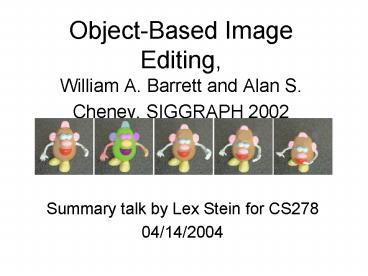
Object-Based Image Editing,William A. Barrett
and Alan S. Cheney, SIGGRAPH 2002
- Summary talk by Lex Stein for CS278
- 04/14/2004
2
Image-editing methods
- Pixel-based push pixels around.
- Region-of-interest (ROI) global manipulation of
axis-aligned bounding box. - Image-based affect the entire image like a
rubber sheet.
3
The Problem
- Image editors want something between pixel and
global manipulation that operates on the objects
within images. - Challenges operating at interactive rates,
hole-filling, preserving texture, aliasing,
non-linear transforms. - Tricks indirect editing, texture spraying.
4
Tobogganed Regions of Accumulated Plateaus (TRAPs)
- Image is automatically segmented into TRAPs using
gradient methods. - TRAPs are the primitives that provide texture for
hole-filling and texture spraying. - TRAPs are not objects. Users manually create
objects from TRAPs. - An objects TRAPs are triangulated to improve
object transform efficiency.
5
Creating triangulated objects
1. TRAP segmentation
2. Manual aggregation of TRAPS into an object
3. Triangulation
6
Object-Based Editing Operations
- Suite includes linear transforms that update at
interactive rates. - New nonlinear per-object operators stretching,
warping, and rotational bend. - Object transforms are computed in their own layer
and in a local coordinate system for speed. - Objects are antialiased with their background.
- Objects have adjustable transform pivot points.
7
Background Filling
- Two methods implemented
- Scale-down (2a-3a)
- Random-grid (2b-3b)
- Both use TRAPs for regions of texture.
- The entire space behind an object is filled in
whenever the object is modified.
8
Texture-Preserving Operations
- Instead of stretching TRAPs, keep their size
fixed and copy them to fill a warped region.
original
cutoff map
stretched
stretched more
9
Non-linear Transformations
- Ai is a general attenuation multiplier.
- stretch
- rotation
- stretches and rotations are computed in two steps
but require only a single user interaction.
10
Curve Deformers
- The user specifies the Ais (can edit the
points with automatic function interpolation).
Consider this to be a feature. Different Ais
will yield different transforms.
11
Papers Results and Conclusion
- Speed and quality
- Faster and better-looking than the competition on
the benchmarks. - Claim
- OBIE changes fundamentally the way image editing
is performed by changing the granularity of
operations. - Improvements
- more sophisticated curve deformers.
- Challenges
- when gradients disappear at object boundaries
- texture with regular structure.
12
Issues
- Specifying the attenuation multipliers (Ais).
Need different multipliers for different kinds of
objects. What about objects with complicated
internal structure and mechanics? - Manual aggregation of TRAPs into objects.
Consider Figure 2(a).
Recommended

