

Kenyas Cash Transfer Programme for Orphans and Vulnerable Children PowerPoint PPT Presentation
1 / 8
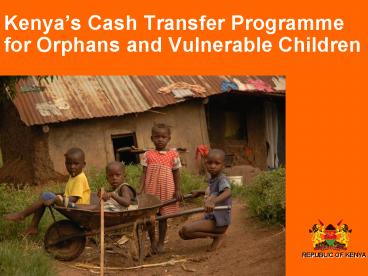
Title: Kenyas Cash Transfer Programme for Orphans and Vulnerable Children
1
- Kenyas Cash Transfer Programme for Orphans and
Vulnerable Children
REPUBLIC OF KENYA
2
Challenges
Kenya has about 2.4 million Orphans and
Vulnerable children About a half (48) of the
orphans are due to HIV and AIDS pandemic, which
has overstretched the capacity of extended
families to absorb them
- Most of these children live in poor households
- Elderly grandparents are main caregivers
- Some live in child-headed households and must
fend for themselves
3
Political Will for Social Protection
Government and civil society organizations have
been developing a common response to the
situation of OVC (OVC Policy and National Plan of
Action) since 2002 The Cash Transfer Programme
was introduced, as a pilot, in 2004 in response
to the growing crisis of OVC
In 2006 12 African countries committed to develop
social protection strategies (Livingston Call for
Action) A first draft of Kenyas Social
Protection Strategy is under revision The CT-OVC
expanded into a national scale social protection
intervention in 2007 and is the most significant
initiative of the Social Protection Strategy
4
Coordination and Commitment
- The CT-OVC is under the Department of Childrens
Services, Ministry of Gender, Children Affairs
and Social Development (MGCSD) which
coordinates the national Social Protection
Strategy (including components from health,
education, social work, civil registrar etc) to
achieve results under the social pillar of
Kenyas Vision 2030
- The CT-OVC is also part of the Child Protection
System which is oriented at reducing
vulnerability and focusing in three result areas
Protective Services, Family Based Care and
Prevention from Abuse and Exploitation
5
Increasing Funding
National Budget allocation to CT-OVC has
increased from 800,000 to more than 9 million
in four years. External funding has increased,
with commitments of more than 150 million over
the next 10 years (UNICEF, DFID, SIDA, WB) More
than 98 of the beneficiaries have successfully
collected the bi-monthly payments
SCALING UP 2004 Pilot targeting 500 households
in three districts launched by Government of
Kenya with support from UNICEF 2006 2008
systems for national scale are in place. The
programme will reach 65,000 households by the end
of 2008 2010 Target of 100,000 households
(330,000 OVC) to be attained sooner due to
adequate technical assistance and Governments
increasing capacity
6
Objectives and Processes
Regular cash transfers to families living with
OVC to encourage retention of OVC within their
families and communities After piloting, human
capital objectives introduced to increase
investment in nutrition, health, education
civil registration Parenting sessions are
conducted with caregivers to promote a protective
environment for women and children
Beneficiaries identified and enrolled through
comprehensive targeting process involving
communities Ranking criteria gives priority to
households that have children and elderly persons
as caregivers Post Office contracted for
delivering the subsidies to the beneficiaries
7
Mechanisms for National Scale
Operational Manual developed including
description of all processes, guidelines and
instruments (e.g. Targeting, registration,
payment forms) A comprehensive Management
Information System (MIS) is in place to support
all operational processes of the programme
- Impact evaluation used to adjust the programme
and to help in the future dialogue and advocacy
for national funding - The targeting system has been modified in
response to the impact evaluation and ensures
inclusion of the hardcore poor OVC households - Evaluation is testing whether conditionalities
impact results for children in OVC households
8
Preparing for the Future
A Building Capacity Strategy is being implemented
in order to support the development of the GOK
structures and the communities for a national
scale programme A special financial agreement for
the programme is being developed with the
Ministry of Finance
Community participation is necessary for the
success, ownership, transparency and
sustainability of the programme As systems for
the programme are adjusted and consolidated,
complementary social services will be provided to
the beneficiary households
Recommended

